About This Edition
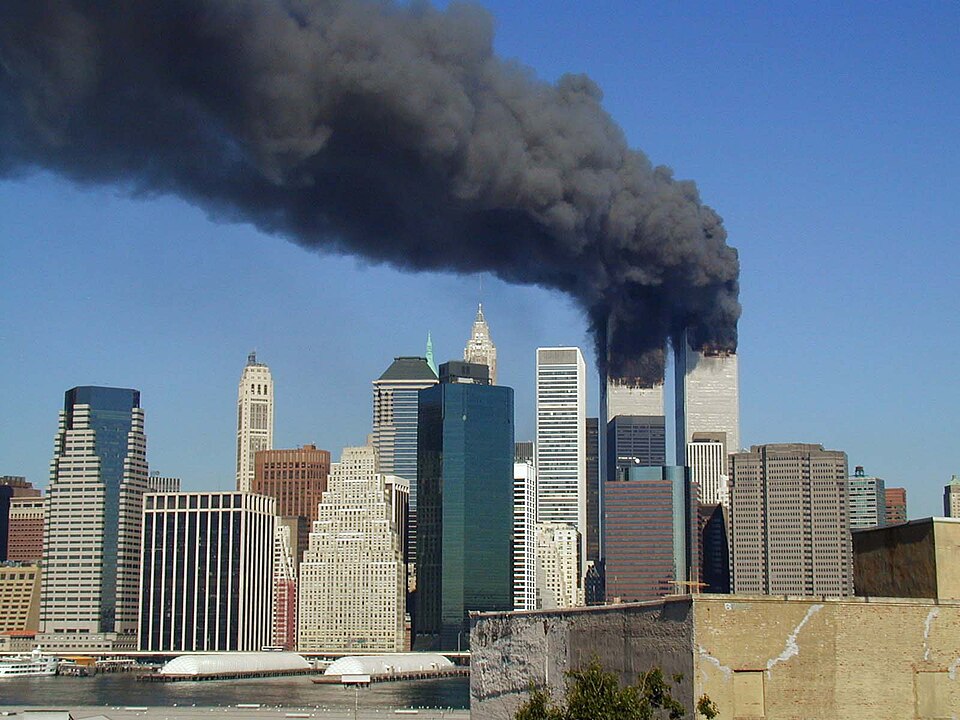
The towers on fire. Photo Credit: Michael Foran, Wikimedia.
Why are we publishing this special edition?
This special edition of Eno Transportation Weekly takes readers back to the chaotic and frightening moments surrounding the September 11 terrorist attacks. It examines how transportation agencies and their leaders responded, the lasting effects of the attacks on transportation, and the critical insights that have become clearer with time.
With this 25-year perspective, we can better understand how transportation agencies have changed their approaches to security and preparedness, the lessons that proved valuable far beyond terrorism, and the vulnerabilities that remain.
Many of the contributors to this edition made consequential decisions on September 11. This combination of historical perspective and firsthand experience is why we are devoting this special edition of Eno Transportation Weekly to the 25th anniversary of the attacks.
The contributors experienced the attacks from very different places. Yet common themes run through their accounts.
Effectively responding to a crisis requires preparation, strong relationships, clear communication, effective leadership, and capable frontline employees. Just as important, agencies must be able to adapt quickly when circumstances suddenly change.
Perhaps the most important lesson from this edition is the need to be prepared for the unexpected. The threats facing transportation agencies continue to evolve. They must confront cyberattacks, infrastructure failures, extreme weather, public health emergencies, and risks we might not fully understand. This week, we need to add rogue artificial intelligence agents to the list of threats.
That means developing trusted relationships before a crisis occurs, sharing information quickly, conducting realistic exercises, empowering frontline employees to make decisions, understanding the interdependence of transportation systems, thinking seriously about events that may appear improbable, and being willing to improvise when established plans no longer fit the circumstances.
The Articles
September 11 was, among many other things, a transportation crisis.
Terrorists turned four commercial aircraft into weapons. The nation’s airspace was shut down and airports were evacuated. Rail stations, roadways, and pedestrian bridges were destroyed. Buses, trains, ferries, roads, bridges, and tunnels became part of an enormous emergency response. Transportation officials had to make decisions for circumstances they had never encountered and, in many cases, never imagined.
The authors in this edition approach their articles from different vantage points.
Former FAA Administrator Jane Garvey describes the uncertainty of those first minutes and the unprecedented decision to bring approximately 4,500 aircraft down across the country. Former Maryland Transportation Secretary John D. Porcari and the state’s Acting Aviation Administrator Beverley Swaim-Staley describe securing airports, moving commuters out of Washington, and responding to rapidly changing circumstances.
Sam Schwartz, New York City’s former traffic commissioner, describes how transportation professionals improvised when subway and bus service was disrupted and streets around the World Trade Center were closed off. Former American Public Transportation Association President William Millar explains how transit agencies across the country evacuated people, transported airline passengers stranded far from home, supported emergency responders, and improvised new services as circumstances changed. Amtrak Interim Police Chief Jim Cook explains how 9/11 transformed Amtrak’s approach to security, intelligence, employee training, interagency coordination, and resilience.
Sam Whitehorn, who served as senior counsel to the Senate Commerce Committee’s Aviation Subcommittee, reflects on the chaos in and around Congress on September 11 and how, in the days that followed, lawmakers worked with unusual speed and bipartisanship to respond to the attacks and reshape federal aviation security. Air Line Pilots Association President Capt. Jason Ambrosi describes the security improvements made since September 11 while advocating for more measures to strengthen cockpits.
After terrorists detonated a truck bomb beneath the World Trade Center in 1993, Brian Michael Jenkins was part of a team that examined how terrorists might attack the complex again. One scenario they considered was an airplane deliberately crashing into a tower. Although they could not prevent that from happening, more than 10,000 people safely escaped from the towers on September 11, aided by improved emergency evacuation procedures implemented after 1993.
We also look back at Jeff Davis’s coverage of September 11 and its aftermath in Transportation Weekly. His network of trusted government officials allowed him to make sense of rapidly changing events at a chaotic moment.
Bob Yaro, former president of the Regional Plan Association, describes how civic leaders responded to the destruction of the World Trade Center with an ambitious vision for rebuilding Lower Manhattan.
Three of the articles offer perspectives from former officials of the Port Authority of New York and New Jersey. The Authority was at the center of both the tragedy and the rebuilding that followed. It had built and owned the World Trade Center, and its headquarters were on the 64th floor of the North Tower. The Port Authority also operated airports, bridges, tunnels, bus stations, and rail services in the metropolitan region – all of which were vulnerable terrorist targets.
Two of the contributors walked down more than 60 floors before the towers collapsed, and the third drove 120 miles per hour on the Massachusetts Turnpike to make his way back to the Authority’s emergency management center.
Mark Muriello reflects on resilience, vigilance, preparedness, and collaboration. Lou Venech draws an important distinction between projects necessary for recovery and more ambitious transportation improvements that were desired by businesses, residents, and other stakeholders. The third Port Authority contributor, Patty Clark, co-authored her article with Liliana Petrova, a former JetBlue executive. They explain how 9/11 transformed airport security and the passenger experience – and how that experience needs to be improved.
My Own World Trade Center Connection
This special edition is personal for me as well.
I’m a New Yorker with friends, colleagues, and family members who were in the towers on September 11. The hours and days that followed were terrifying. When I first saw the remnants of the World Trade Center towers after the attacks, I could not fathom how two 110-story buildings had seemingly disappeared.
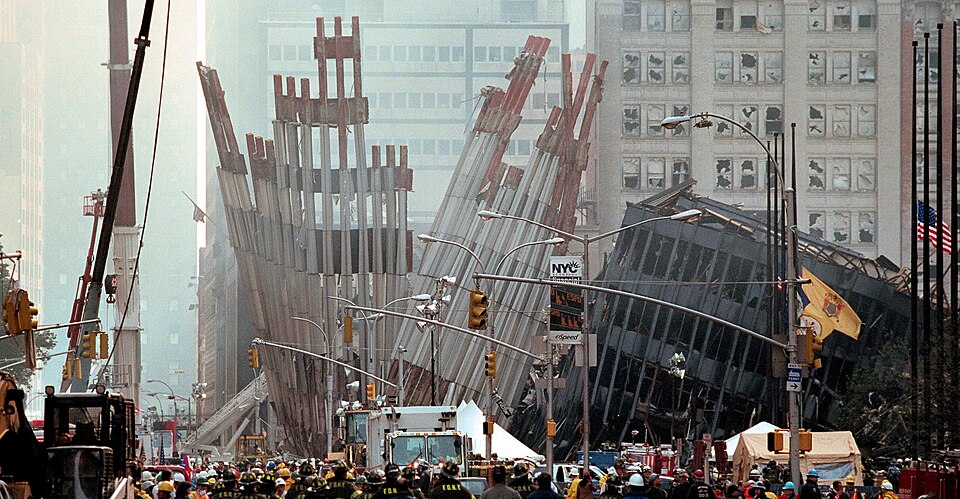
Remnants of the tower on September 14, 2001. Photo Credit: Paul Morse, courtesy of the George W. Bush Presidential Library, National Archives.
I later became the Lower Manhattan Development Corporation’s Director of World Trade Center Redevelopment and Special Projects and spent years working on the rebuilding of the area. I’m also the author of the book, Mobilizing the Metropolis: How the Port Authority Built New York (University of Michigan Press, 2023), which includes a chapter devoted to the World Trade Center.
These experiences led me to reach out to our contributors because the lessons they learned deserve to be shared and understood. We may not be able to prevent every catastrophe, but we can learn from those who have faced them and be better prepared to minimize their impacts.