On the Ground at a State DOT
The transportation system in the United States is, in many ways, federalism in America operationalized. Contrary to many people’s perception, this system of systems is built and run from the ground up, not from Washington down. Project selections and modal priorities are established by states and their local government counterparts, and built with various combinations of local, state and federal public (and sometimes private) funds.
Transit systems, ports, airports, bridges and tunnels are local choices aggregated into a national system. Even something as seemingly federal as the Interstate Highway System is built, owned and operated by the states, albeit with a torrent of federal funding.
The very large exception to this federal-state division of transportation system responsibilities is the National Airspace System (NAS), the control and operation of airspace throughout the country. The 24/7/365 safe operation of the NAS by the Federal Aviation Administration of the US Department of Transportation is one of the largest and most crucial federal civilian operational responsibilities. It’s worth noting that approximately 47,000 of USDOT’s 55,000 person head count are FAA employees. Swift, decisive leadership by Secretary Norman Mineta and FAA Administrator Jane Garvey mobilized that entire FAA workforce to secure the airspace while the attacks were still underway. The terrorist attacks rippled throughout the rest of the transportation system as well.
The Maryland Department of Transportation’s headquarters was at Baltimore-Washington International (BWI) Thurgood Marshall Airport, and John (the department’s secretary) was in his office meeting with the chairman of a state legislative transportation committee when the first plane hit the World Trade Center. Beverley (the state’s Acting Aviation Administrator) was on a Montreal-BWI airline flight, returning from an aviation conference. Her plane was directed to land in Rochester, N.Y., and she and an FAA employee were able to rent a car and quickly drove back to the DC metro area.

Less than an hour after the World Trade Center was attacked, an American Airlines flight struck the Pentagon. Photo Credit: Bob Houlihan, Wikipedia.
We activated the Statewide Operations Center, briefed the Governor and State House staff, and immediate actions included emptying the BWI terminal of passengers, securing the parking garage adjacent to the terminal, disconnecting jetways from individual aircraft, taping airside doors as a security precaution, and surging additional law enforcement agencies (and, later, the Maryland National Guard) to BWI. The FAA’s immediate grounding order applied to ALL aircraft, requiring us to also secure all 43 public use airports in the state by directing, in some cases, local law enforcement to station police vehicles on the runways to prevent any takeoffs or landings.
Washington, D.C. was already emptying in advance of a formal evacuation order. In addition to WMATA’s Metrorail and Metrobus service, MDOT operated MARC commuter rail and MTA commuter bus service into the heart of the District of Columbia. Maryland MTA commuter buses, which normally dropped off and picked up commuters in the monumental core of the District of Columbia, had to be rerouted to Metrorail terminal stations; Metrorail stations at the Pentagon and National Airport were closed. Law enforcement officers were surged to transit systems as a visible deterrent. At one point we were informed that the Secret Service was ordering the closure of the entire Metrorail system—which would have been disastrous— but cooler heads prevailed. Local media, including radio station WTOP, were invaluable resources in providing real-time transit, traffic and commuter rail updates.
All our highway emergency response crews were deployed; traffic was extremely heavy in both the DC and Baltimore metro areas. Within hours the highway systems became virtually deserted; formal road closures were put in place in the DC area on I-395, the George Washington Parkway, Route 29 and parts of the Monumental Core. Highway haul permits for oversize/overweight loads were cancelled, and abandoned vehicles on the shoulders were towed. CSX freight trains headed to Washington were stopped in Baltimore. We were requested to post the message “New York City Closed” on our variable message signs on I-95.
One early assumption on the day of the attacks was that other World Trade Centers would be targeted, so City of Baltimore and State Highway dump trucks filled with sand were dispatched to ring the MDOT-owned World Trade Center Baltimore. Barges were later moored in a semicircle on the water side. Police marine units were dispatched to the Bay Bridge, Key Bridge, and Baltimore highway tunnels. Dump trucks blocked doors to the mechanical rooms at the bases of bridges.
The USNS Comfort, one of the U.S. Navy’s two hospital ships, was berthed at the Port of Baltimore and our port team helped prepare it for activation when it sailed for New York on September 12. Cruise ships destined for New York were diverted to Baltimore; the Coast Guard implemented an ad hoc security protocol for a fully-laden LNG tanker headed up the Chesapeake Bay to the LNG terminal at Cove Point. Andrews Air Force Base and Ft. Meade requested Jersey barriers to harden vulnerable entry points; we put a statewide call out to highway contractors for Jersey barriers.
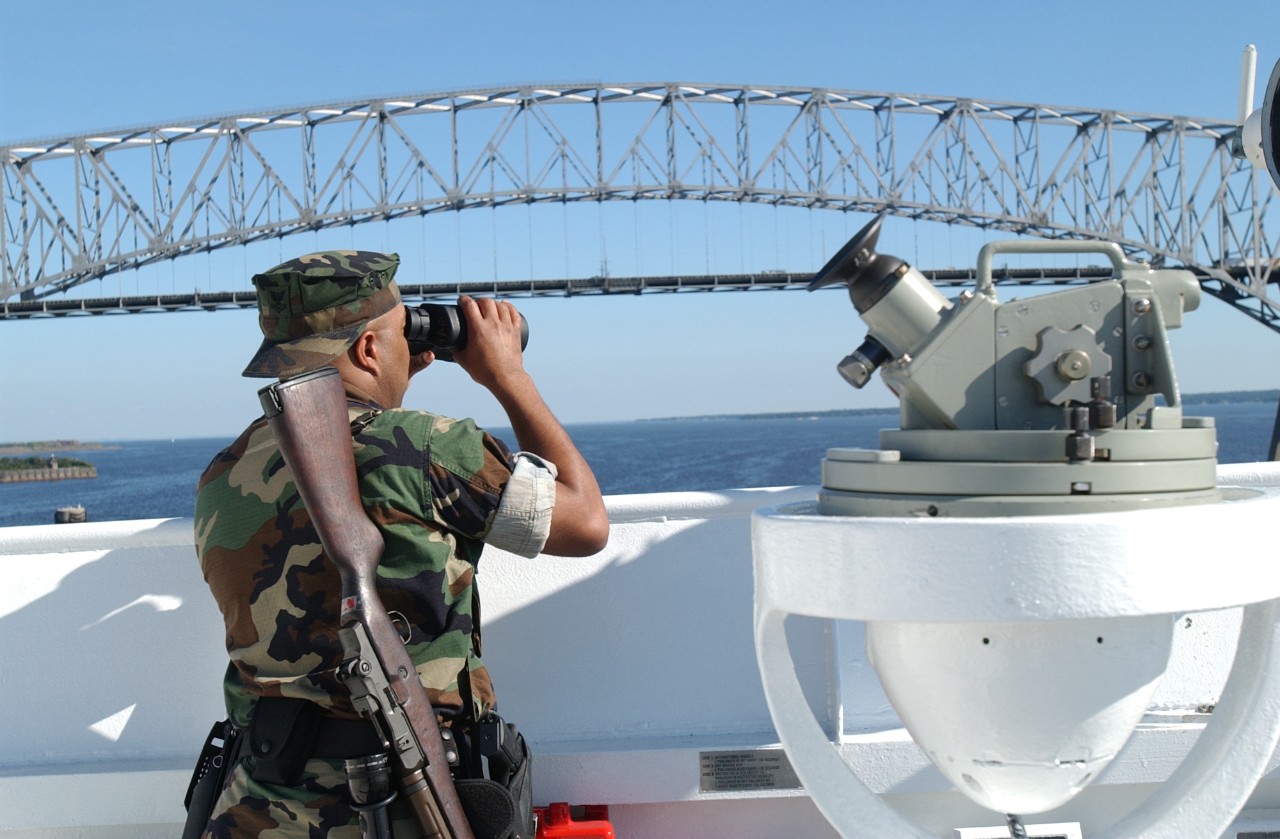
Standing watch on the bow of USNS COMFORT about to pass under the Francis Scott Key Bridge in Baltimore Harbor on September 12. After the terrorist attacks, we implemented measures to protect the bridge from explosive devices, truck bombs and sabotage. In 2024, however, the bridge faced a different threat. It collapsed after a container ship accidentally collided with one of its supporting piers. (Photo Credit: Folder 7, Box 3, AR/643 DET 206: Documenting the U.S. Navy in New York City After 9/11, Navy Archives, Naval History and Heritage Command, Washington, D.C.)

Sailors aboard USNS COMFORT fed firemen, policemen, and volunteers working at the World Trade Center site. Photo Credit: Folder 7, Box 3, Navy Archives.
Virtually every one of these actions cut across jurisdictional and legal authority lines and were a reminder that the trust built ahead of time from personal working relationships made the difference in getting organizations to respond without hesitation. One example that stands out is an early conversation with Southwest Airlines (BWI’s major carrier) CEO Herb Kelleher. With one phone call, he agreed that when the new requirements were known, the airline and MDOT would find a way to accomplish the required tasks together.
A bomb threat to Ft. Meade and the Maryland State House (Capitol) was phoned in mid-day on 9/11; the perpetrator of this hoax was later caught, but it triggered an early exodus to the state’s National Guard-hosted Emergency Operations Center. The Governor was evacuated by State Police helicopter and the Lt. Governor separately by ground convoy to preserve the line of succession. Lt. Governor Townsend arrived at the Emergency Ops Center considerably ahead of Governor Glendening, whose helicopter had been ordered to land immediately while en route—one example of the confusion and contradictory orders in the fog of early events.
Getting BWI Reopened
Airlines and airport staff found hotels for stranded passengers and the airport property was clear by late afternoon. The areas designated for private and general aviation were also secured. At 6:00 PM, for likely the first time in its history, there was not a single vehicle on the terminal roadways nor even one passenger or airline employee on the Arrivals or Departure Levels of the terminal. It was obvious that air travel would never be quite the same.
In the airport operations center, on the third floor of the terminal, the priority was working with the FAA to determine how to prepare the airport and its surroundings for the new operational and security requirements. The goal was to have BWI ready when the FAA gave permission to the airlines to restart service.
The focus quickly became how to secure the perimeters of the airport, allow safe access to the public areas of the terminal and limit access to the airline concourses and gates to ticketed passengers only. A 300-foot radius temporary security perimeter was established around the terminal in accordance with interim FAA guidance, which resulted in the garage closest to the airport being partially closed and parked vehicles within that perimeter being towed. Curbside parking was prohibited and any unattended vehicles were immediately towed. The garage was also cleared of suspicious vehicles. All fencing throughout the airport property was checked and brought up to new standards where required. Light rail access to the airport was suspended.
Numerous law enforcement agencies worked together, led by the FAA Security Officer and the Maryland Transportation Authority Police. The Maryland National Guard and United States Marshals were on site by the next day. The cooperation among these entities was amazing – everyone was focused on the mission of making the air travel safe again. Extra canine units were brought in by the various law enforcement agencies and were our best insurance both inside and outside the airport.
FAA Administrator Garvey and her team held multiple conference calls to outline the interim security requirements and share the latest information. As requirements were received from the FAA, meetings were held with the airlines as a group and again, all the airline station managers worked together, willing to share gates or other leased space– whatever was necessary– to get the airport operational under the safest conditions possible. Law enforcement patrols of the perimeters and procedures for access to the airport and related transportation facilities (rental car parking, offsite parking lots, general aviation) were accomplished within two days.
Establishing new security protocols within the airport was more challenging. Prior to 9/11, private security companies were hired and managed the security checkpoint process using Magnetometers (walk-through metal detectors) and basic X-ray machines. Anyone could access the airline concourse and gate areas at BWI after passing through the security checkpoints. While obvious weapons such as firearms and knives were not permitted, small items such as scissors and pocketknives were. Anyone wishing to accompany friends and family to or from the airline gates could do so after going through security. Airport and airline personnel including pilots and airline flight attendants could bypass the security checkpoints by flashing airport-issued badges. Now, only ticketed passengers could access the boarding areas and the protocols for the checkpoints were much stricter in accordance with the new interim FAA guidance. Overnight, the trend to renovate airports into large public use spaces and shopping malls behind the security checkpoints came to a halt and the terminal “throat” areas were far too small for the new security lines.
The FAA was ready to allow early repositioning flights by the evening of September 12th, subject to individual flight approval by the Department of Defense, which had controlled the airspace for two days. Three Continental Airlines planes were repositioned from BWI to Newark (EWR) on the 12th. A reported two hundred planes stranded in Canada were the top priority and airlines were permitted to move aircraft in preparation of restored air service.
By September 13, BWI had completed the FAA requirements and was ready for operation at 11:00 AM that day. BWI was among the first few airports approved to restart air service and was described as the “leading edge” of readiness by the FAA. Due to its proximity to the U.S. Capitol and the White House, Washington National Airport (DCA) remained closed until early October.
Now the real challenges began. Screening was a much slower and more diligent process. The new requirement to check tickets for anyone passing through security as well as perform advanced security procedures such as thorough bag and luggage checks for random passengers led to long lines. Passengers and airline personnel were fearful and confused. Items previously permitted on carry-on luggage were now required to be placed in checked baggage. The list of forbidden items grew almost daily. (Shoe removal was not required until after the “shoe bomber” incident in December.) Invariably, many passengers entered the security lanes with now forbidden items from nail clippers to previously forbidden items such as knives and handguns. Mailboxes were sealed off and clear trash barrels with transparent bags replaced all metal trashcans throughout the airport. The decorative planters were removed when airport police saw passengers hiding handguns in the planters. As a result, Amnesty Barrels were installed ahead of the checkpoints so passengers who forgot to leave forbidden items could properly dispose of them. Over the next several weeks, thousands of knives and handguns were collected and stored in a secure warehouse off airport property.
MDOT’s fleet manager was a retired Navy Chief Petty Officer—a group of individuals widely regarded as some of the most resourceful scroungers and requisitioners of materials anywhere. He was asked to procure the largest American flags he could find. Within days, BWI airport, the World Trade Center Baltimore and other facilities had huge, multi-story flags draped over their entrances. We have no idea where he got them. John still has the American flag from the front of the terminal at BWI; it covers his entire roof on the 4th of July.
As air service at BWI returned to the new normal, new lessons were learned frequently and operational procedures continued to evolve. Curbside baggage check-in returned. The contractors operating the security checkpoints were trying to increase throughput while carefully monitoring the screens for suspicious items. (A ‘suspicious’ item could shut down a checkpoint for hours.) Passengers were learning to come to the airport two hours in advance of their flights. Local performers, from musicians to celebrity impersonators, were hired in an effort to ease the anxieties of passengers waiting in the long security lines. Airlines were modifying boarding procedures. Friends and family were learning to say a quick goodbye and drop off passengers at the curb. Some airlines suspended service at BWI, while others began new service.
Multiple airlines had their debt downgraded; others deferred or cancelled new aircraft deliveries, and suspended pilot and flight attendant training classes. War Risk Insurance became a prohibitive cost item for the airlines and Congress eventually agreed to pay the War Risk Insurance premiums for the airlines.
Prior to September 11, MDOT was planning a $1.6 billion terminal expansion which also included a new parking garage and car rental facility. Throughout the fall, many people expressed surprise that the expansion plans were not curtailed or delayed. Pier A construction for Southwest Airlines began on November 5 and all other projects continued on schedule.
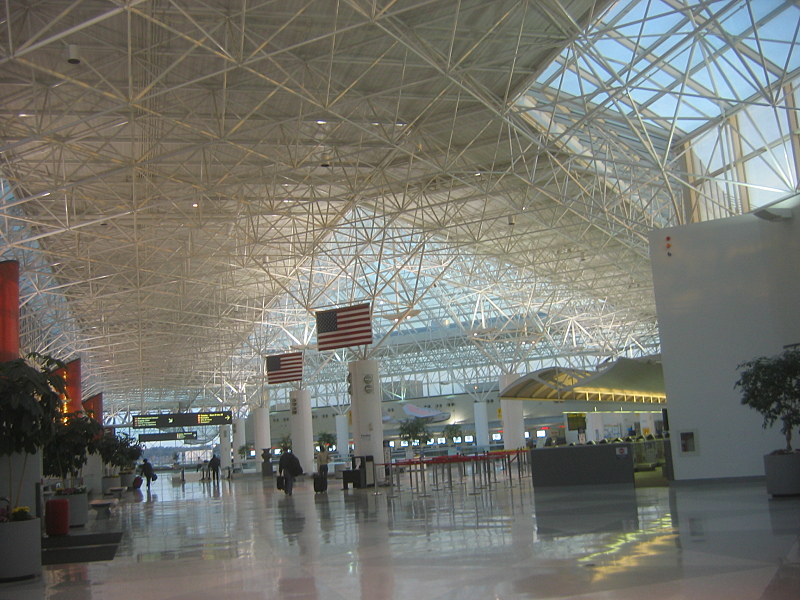
BWI concourse for international flights in 2005. Photo credit: Joseph Barillari, Wikimedia.
In early 2002, BWI became the nation’s pilot for new checkpoint procedures. In April 2002, following passage of the Aviation and Transportation Security Act, BWI became the first commercial airport in America to operate federally-staffed screening checkpoints.
The terrorist attacks of September 11, 2001 were an experience shared by every American alive on that day. Being in the shadow of the nation’s capital meant that our transportation system faced unique needs for real-time collaboration across jurisdictions. Quick decision-making, immediate sharing of resources and capabilities, and an extraordinary “can-do” attitude by virtually everyone involved brought out the best in a state DOT team—and its sister DOTs in the District of Columbia and Virginia.