Transportation Security: What Lessons Have We Learned Since 9/11
Stuff happens. Learn from it. That blunt command could have been the motto for the research program at the Mineta Transportation Institute (MTI) on public surface transportation security. As the nation sadly remembers that fateful date 25 years ago when hijackers took over four commercial jets to carry out what turned out to be the deadliest attack in the annals of terrorism, it is an occasion to review some of the lessons learned from that research.
Obviously, the 9/11 attacks would profoundly affect the future of aviation security, but 9/11 and the continuing terrorist attacks that followed would also have an effect on surface transportation. Norman Mineta, then Secretary of Transportation, brought transportation operators together on October 1, just 20 days after the attacks, for a summit meeting to examine the security challenges of the post-9/11 environment. Fortunately, MTI’s research on surface transportation security had begun five years before, so we had some bullets in our bandolier.
Summarizing three decades of work, sixty reports, numerous articles, Congressional testimony, briefings, and a database of more than 9,000 incidents would require more space than we have here. (My wingman Bruce R. Butterworth and I are currently working on a retrospective volume to do that.) Here are a few of the highlights.
History and highlights
The 9/11 attacks, of course, led to fundamental changes in aviation security, which has advanced significantly since 9/11. Historically, aviation security always took precedence over surface transportation security, largely because hijacking or sabotaging airliners had remained a terrorist obsession since the 1960s. However, even while serving as a member of the White House Commission on Aviation Safety and Security in 1996-1997, I reminded my fellow commissioners, which included Secretary of Transportation Federico Peña, of the growing terrorist threat to trains and buses.
It did not require prescience on my part to spot the trend. The Irish Republican Army and Spain’s Basque extremists had been bombing trains for decades. In 1995, members of the Aum Shinrikyo cult spilled sarin nerve gas on Tokyo’s subways, Algerian terrorists set off a bomb at a commuter rail station in Paris and later attempted to derail a high-speed passenger train, and someone calling themselves “Sons of the Gestapo” derailed the Sunset Limited in Arizona. In 1996, Algerian terrorists carried out another deadly bombing at a Paris commuter rail station. The threat was real.
The International Institute for Surface Transportation Policy Studies (the institute’s name before becoming the Mineta Transportation Institute), which had already conducted two symposia on terrorism in surface transportation, was selected to conduct a research effort focusing on the terrorist threat. MTI later asked me to lead the project.
Empirical research was essential. We began by creating a chronology of terrorist attacks on transportation targets. Over the years, this grew into a sophisticated, computerized database containing detailed information on more than 9,000 incidents. Until its shutdown in 2025, the MTI database was a major source for analysis by the Transportation Security Administration. At the same time, MTI conducted detailed case studies of terrorist campaigns, tactics, and specific terrorist attacks (including what could be learned from the experience of New York City’s transit system in the 9/11 attacks.) The research also sought to identify security lessons learned and identify best practices.
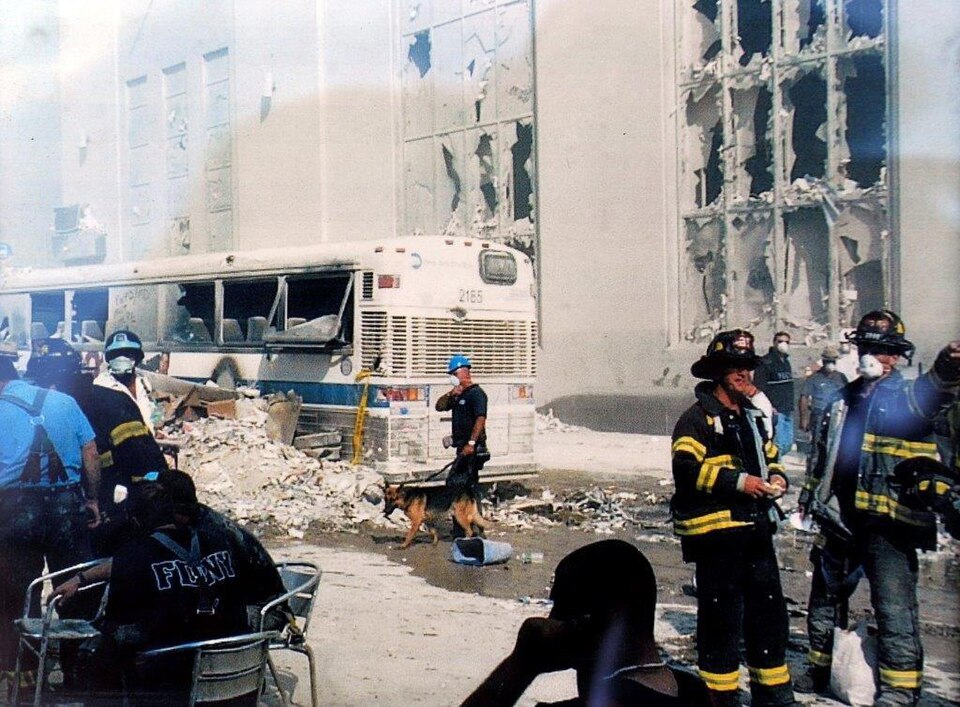
NYC bus covered with dust, ash and falling debris on September 12. Photo Credit: MTA.
Lessons Learned
Protecting public transportation targets was more difficult than protecting commercial aviation in several respects. First, volume: Over the years, on average between 2 and 3 million passengers daily board commercial airliners in the U.S. In contrast, New York City’s subway system alone sees an average of 4 million passengers each weekday. According to the American Public Transportation Association, Americans board public transit systems about 30 million times each weekday.
Second, configuration: To move so many passengers around cities requires many stations––New York alone has 472 subway stations with multiple access points. Boarding must allow hundreds of people to quickly get off or board trains in 15-30 seconds. The nation’s approximately 500 airports are designed to receive large numbers of passengers from connected rail systems or at curbside and put them in lines for security screening. Ultimately, we board airplanes single file.
Third, security: Boarding airplanes requires a ticket specific to each passenger, making advance screening possible. Boarding trains and buses can still be anonymous, although that pattern is changing with the increased use of mobile wallets, debit cards, or the purchase of multi-ride passes. The passenger volumes make security screening impossible. Pilot projects to randomly screen subway passengers provoked pushback.
Fourth, costs: The current flat fee of $5.60 which is automatically added to each one-way fare for aviation security only covers a fraction of the total cost of per-passenger screening. Taxpayers pay the rest. Adding anything like that amount to a subway or metro ride would destroy public transportation. Protecting commercial aviation is seen as part of national security. Protecting public transportation is a local matter.
The difficulties of prevention push surface transportation security to mitigation and response measures. Aviation security is front-loaded to prevent attacks. Security for surface transportation must define security broadly to include what can be done in advance to mitigate casualties through station design and construction, and even the manufacture of rail cars, and what can be done once an attack occurs to quickly neutralize the threat or facilitate rapid evacuation.
Terrorists saw surface transportation targets as killing fields. For terrorists seeking high body counts, surface transportation offers easy access to crowds in confined environments. Terrorist bombers killed 209 people aboard a train in Mumbai, 191 train passengers in Madrid, 85 at a train station in Bologna, 68 on a train in India, 52 in London, and 40 in Moscow. Gunmen killed 62 at the train station in Mumbai. A fire caused by an arsonist killed 198 at a subway station in South Korea, and a train derailment and subsequent ground attack killed 252 in Angola.
 Newspapers outside the Waterloo station in July 2005. Photo Credit: Ellwa in Wikimedia.
Looking at the years immediately before the 9/11 attacks, we saw that two-thirds of the attacks were clearly intended to kill and 37 percent succeeded in doing so. In contrast, around 20 percent of terrorist attacks overall involved fatalities. Public transportation targets were arenas for slaughter.
Some attackers instead sought widespread disruption. Environmentalist and anti-nuclear extremists and criminal extortionists aimed primarily at creating widespread disruption through communicated threats, non-lethal sabotage, cyberattacks, or human blockades. The 2024 Paris Olympics and the 2026 Winter Olympics in Italy saw attacks aimed at disrupting high-speed rail traffic.
All transportation employees are part of the security system and must share a security mindset––passengers can also be enlisted. Transportation workers are familiar with the environment and can recognize and report suspicious anomalies. Research also showed that “see something, say something” campaigns work. But only if certain requirements are met. Exhortation alone through signage and public announcements is not effective. There must be a readily-available means of reporting suspicious activity or incidents. And there must be a visible response. Cell phones and apps opened up new possibilities.
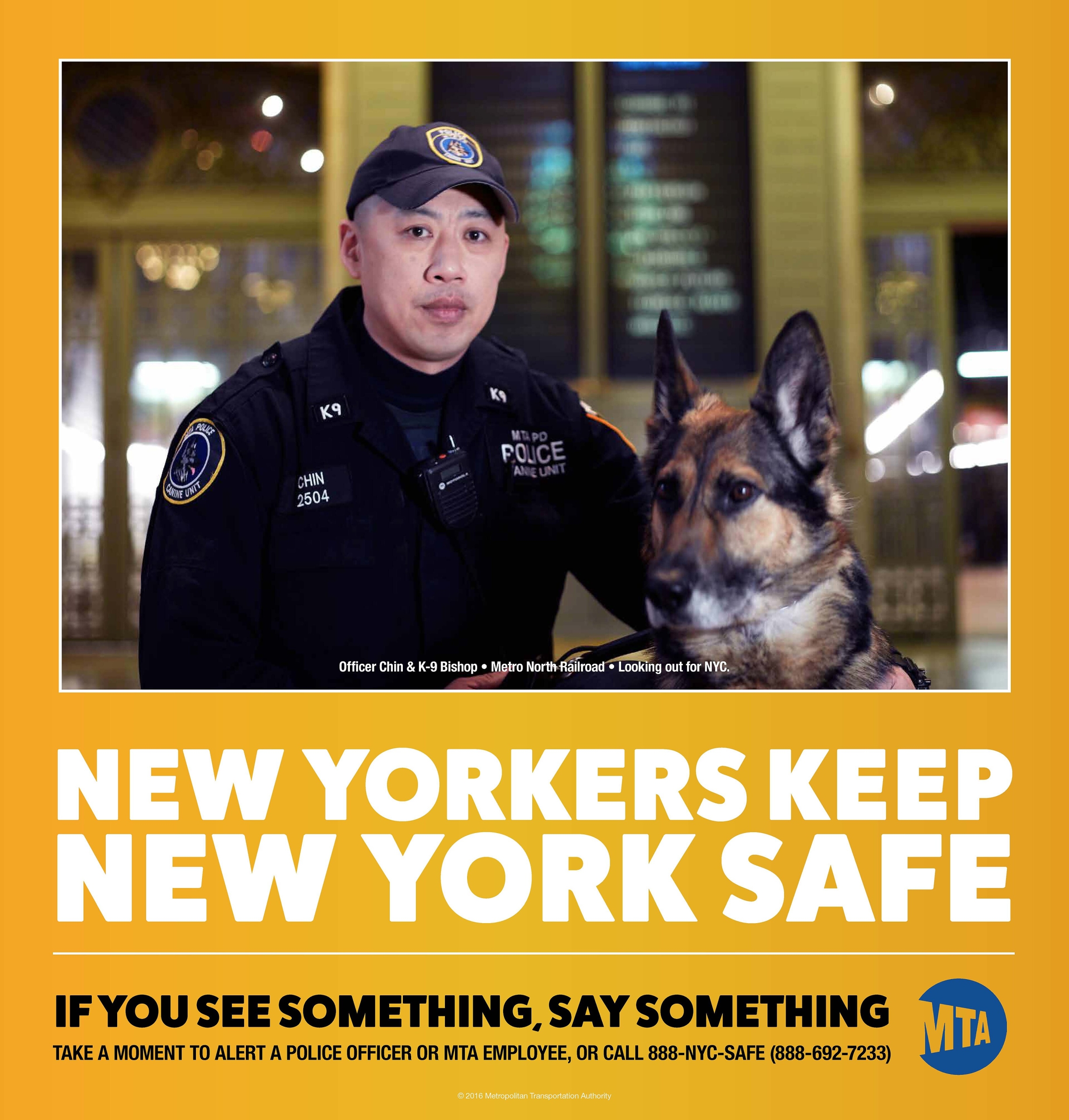 A 2016 New York safety campaign poster. Photo Credit: MTA.
Employees have to be empowered to make frontline decisions. On the morning of 9/11, train traffic was quickly suspended. This was a mandated shutdown, not one necessitated by destruction. Shutting down a transportation system is not an easy decision and contrary to the mindset of keeping the trains running. Coincidentally, in early 2001, the MTA had conducted a table-top exercise at Grand Central Station, which explored this issue. The scenario was drawn from the experience of the Tokyo Subway incident, when the trains carrying sarin kept running, exposing additional passengers to the chemical, and it was designed to force management to examine when it might decide to halt the trains. One of the takeaways from the exercise was that it was not easily done.
Just minutes after the first plane struck the North Tower, Vicky Kelly, the Deputy Director of the PATH train system, which had the station immediately below the World Trade Center, got to a phone at the Center and called the PATH control center at Jersey City to tell them to stop sending trains to the World Trade Center. An incoming PATH train was instructed to keep its doors closed and not unload passengers, but to loop around and return to New Jersey without stopping. The Port Authority sent a single empty train to the World Trade Center to evacuate stragglers.
Meanwhile, one New York subway motorman pulling into the Cortlandt Street station felt the train shake violently as the first plane hit the tower above the station. Instead of waiting the standard 30 seconds, he held the doors open to accommodate as many fleeing people as the train could hold, then floored the train out of the station. The motorman of another train pulling into the station instructed his conductor to hold the doors open until the platform was cleared of fleeing people, then transported them out of the danger zone.
A motorman was driving a third subway train at the nearby Fulton Station when the first tower went down. Told by police that passengers could not get out through the station, he explained the situation to the passengers to keep them calm and called his supervisor for permission to operate his train from the rear. With the system on lockdown, the train stopped every fifty feet, but he got far enough to get one car into the Wall Street Station. Manually opening the doors between the cars, the motorman and a fireman walked passengers through the cars and into the station where they could exit and walk toward the Brooklyn Bridge. These actions saved hundreds of lives. Remarkably, not a single person was killed in the trains or stations beneath the collapsing towers.
Metropolitan Transportation Authority (MTA) buses were sent to help evacuate people from Lower Manhattan who were stranded by the temporary shutdown of the subway system and PATH trains. They had to improvise routes and clear streets to get through. New York ferries also picked up people at piers along Manhattan island.
Regular simulations and exercises are essential. Security plans gather dust on shelves unless utilized in actual events or exercises. The scenario selected for an exercise does not have to exactly match the event that occurs. Assembling crisis management teams or field operators is itself useful, and many of the lessons learned in an exercise can be applied in other circumstances. This was amply demonstrated on 9/11.
Real-time monitoring of the security environment allows dynamic security adjustments. In the past, information about attacks had to be collected, assembled, and sometimes cleared before it could be shared. The process was accelerated by the creation of the Transit and Rail Intelligence Awareness Daily Report (TRIAD) in 2011. Transportation operators want faster access to information in order to take appropriate countermeasures to discourage copycat events and reassure apprehensive passengers. One current project uses AI-assisted monitoring of security-related incidents to provide immediate alerts and continuous updates to facilitate rapid assessments. The 2026 FIFA World Cup matches were used as a test project.
Threats are evolving––so must security measures. Continuing collection of attack information enabled MTI researchers to identify trends that have security consequences. Al Qaeda’s reduced capabilities to conduct centrally-directed terrorist operations led to remote recruiting as the group sought to inspire and instruct self-selecting operatives to carry out terrorist operations on their own. This resulted in an increasing number of low-level attacks involving primitive tactics––for example, stabbings and vehicle-ramming attacks. These resulted in fewer casualties than terrorist bombings––a positive development. But, they were also harder to anticipate and prevent because these attacks often involved individuals acting alone. Their seemingly random nature also caused public alarm.
Vehicle-ramming attacks, although not strictly in the realm of public transportation security, were promptly identified as a trend, leading to a new stream of research that informed security at public events.
Passenger-on-passenger and passenger-on-transit staff violence is a recent trend. We are seeing a significant increase in violent assaults on transportation staff, especially bus drivers and public-facing staff at stations. These are not ideologically-motivated and differ from ordinary crime. They appear to be part of a general trend toward increasing violent social aggression, or aggro. Their increase reflects a broader societal problem of global proportions, and it requires a rethink of security strategy. Security measures––protective barriers surrounding bus drivers and more police are needed, but by themselves are inadequate. Research has uncovered some interesting patterns, but incomplete reporting and inadequate data impede evaluating alternate strategies.
Security measures face multiple constraints. Security measures impose costs on the operating systems and on society in general. They can also add systemic friction and impede operations. Perceptions of risk are not always accurate reflections of reality. Nonetheless, passengers who feel unsafe will avoid public transportation if possible, reducing total ridership and revenue. Yet at the same time, passengers will push back on measures they regard as intrusive or inconvenient. This brings us to the final challenge.
The next frontier
Although the 9/11 attacks and subsequent 25 years of experience have improved our analysis and advanced our thinking about security issues, transportation security still tends to be tactical. Passengers and public officials demand visible responses to the last televised attack. Failure to do so risks provoking criticism and losing ridership. It also increases liability exposure. These are real requirements, but they impede strategic thinking, which requires adequate information, level-headed threat assessments, a broad definition of what security comprises, a systems analysis approach to achieving it, and effective enlistment of the public through communications and education.