250 Years Later: Five Transportation Themes that Haven’t Changed
After the U.S. secured its independence from Great Britain, the Founding Fathers inherited a country that had to decide what role the government should play in building roads, supporting commerce, protecting ships, and encouraging new technologies.
Transportation was one of the central issues facing the early presidents (Washington, Adams, Jefferson, Madison, and Monroe) because moving goods and people was slow, expensive, and dangerous. Transportation improvements were also needed to create a more cohesive country, both physically and politically.
These Founding Fathers disagreed over constitutional authority, federal spending, and the proper role of the federal government regarding transportation. Many of these issues are still debated, today.
Five lessons stand out.
#1. Transportation has always been central to the country’s growth.
George Washington’s presidency showed how basic transportation investments could help a young country function. One of the first laws passed by the new Congress authorized federal support for lighthouses, beacons, buoys, and public piers. These projects helped ships move safely in and out of American ports at a time when maritime trade was essential to the economy.
The issue was so important that Congress acted on lighthouses before it created the federal courts, established the post office, or set the president’s salary. The federal government assumed responsibility for the 12 original colonial lighthouses and funded new projects including lighthouses in Virginia, New York, and Maine.

The 72-foot-high Portland Head Lighthouse in Maine was lit with 16 whale oil lamps. President Washington personally approved the appointment of the first light keeper, a Revolutionary War veteran.
John Adams understood the importance of funding post roads to help people, mail, and political information move across the new republic. Traveling from his home in Massachusetts to the nation’s capital in Philadelphia could take about two weeks, depending on weather, ferries, and the condition of the roads.
#2. Debates over the federal role are nothing new.
Thomas Jefferson supported building a national road from Maryland to the Ohio River, but only because it would be financed through the sale of public lands and approved by the states it crossed. James Madison was even more supportive of new roads and canals. He argued that the economic benefits of transportation improvements would far outweigh their costs.
However, Madison was even more circumspect about the federal government’s role. In his last official act in office, he vetoed legislation to fund roads and canals because he believed Congress lacked the constitutional authority to do so. Madison, who played a leading role in drafting the Constitution, believed a constitutional amendment was necessary before the federal government could undertake construction. (The Supreme Court later ruled that Congress did have the power to authorize such projects.)
#3. Transportation has always affected commerce, defense, communication, land use, and safety.
The founding fathers understood that roads, ports, and waterways affected commerce, communication, settlement, and public safety. The U.S. Constitution explicitly gave Congress the power to establish post offices and post roads. These roads helped move mail, newspapers, and government documents across the country.
Adams also recognized that the federal government had a role in maintaining transportation routes far from the 13 states. In 1798, American ships were being seized in the Caribbean by French privateers, disrupting trade and threatening the incomes of farmers, merchants, shippers, and shipowners. Adams responded by sending U.S. naval ships to protect American commerce.
The economic stakes were large. American farmers and merchants were sending goods to the West Indies, London, Lisbon, China, and North Africa. The seizure of ships slowed imports and exports, raised insurance costs, and threatened tariff revenues that the federal government depended on.
At the same time, the U.S. was beginning a period of major canal construction that would reshape the country. Jefferson thought that building a 350-mile-long canal between Albany and Buffalo was a “fine project” that might be built “a century hence.” Rather than the federal government taking the lead, however, the State of New York did so. The 40-foot-wide Erie Canal transformed New York City into an international manufacturing, trade, and financial powerhouse, and it also made the Great Lakes region more accessible and economically prosperous.
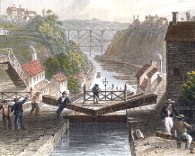
Erie Canal in 1839.
#4. New technologies create new opportunities and problems.
In the early 19th century, steam-powered engines and canals created enormous new opportunities. When James Monroe became the first U.S. president to travel on a steamboat in 1817, steam power was beginning to revolutionize transportation and the economy.
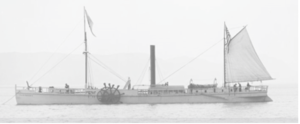
Replica of an 1807 steamboat that operated on the Hudson River.
Before steamboats, boats could move downstream with the current, but getting upstream was slow and difficult. Crews often pushed boats upstream using poles or ropes. Steam made river travel faster and more reliable, and helped communities along the Mississippi, Ohio, and Hudson grow.
But, steam technology also raised major concerns. Boilers could explode, releasing deadly steam, boiling water, and shrapnel. Steamboats disrupted the business of established shipbuilders, ports, merchants, and routes. Since they required large amounts of wood for fuel, they also contributed to deforestation along rivers. And, governments had to grapple with monopoly, regulation, and interstate issues.
Today, newer technologies such as autonomous vehicles, electric vehicles, and drones raise similar opportunities and policy concerns.
#5. Government capacity matters.
Transportation goals are always easier to announce than deliver. The country had to build the legal authority, technical expertise, and institutions needed to support transportation improvements. Washington’s lighthouse program required federal funding, federal responsibility, construction oversight, and decisions about where safety improvements were most needed. President Washington was personally involved in many of these details, including dealing with complaints about delayed payments.
Monroe expanded the federal government’s technical capacity. When he was a lieutenant colonel in the Revolutionary War, he was a strong advocate for expanding the role of the U.S. Army Corps of Engineers to improve transportation infrastructure. The Corps played key roles in the Revolutionary battles at Bunker Hill, Saratoga, and Yorktown. In 1802, the Corps was reestablished and given the responsibility for founding and operating the U.S. Military Academy at West Point, as well as constructing and repairing fortifications.
In 1824, Monroe signed the General Survey Act, which directed the Army Corps to survey important potential roads and canals. The Corps was one of the only sources of formally trained engineering expertise in the country. Congress also authorized work to improve navigation on the Mississippi and Ohio Rivers by removing trees and other obstructions.
Government agencies needed engineers, planners, funding programs, legal authority, and maintenance responsibilities to improve the nation’s transportation system. The early presidents did not inherit those tools. They had to build them.

To read more, see Eno’s Presidential Series on Transportation Innovations.