
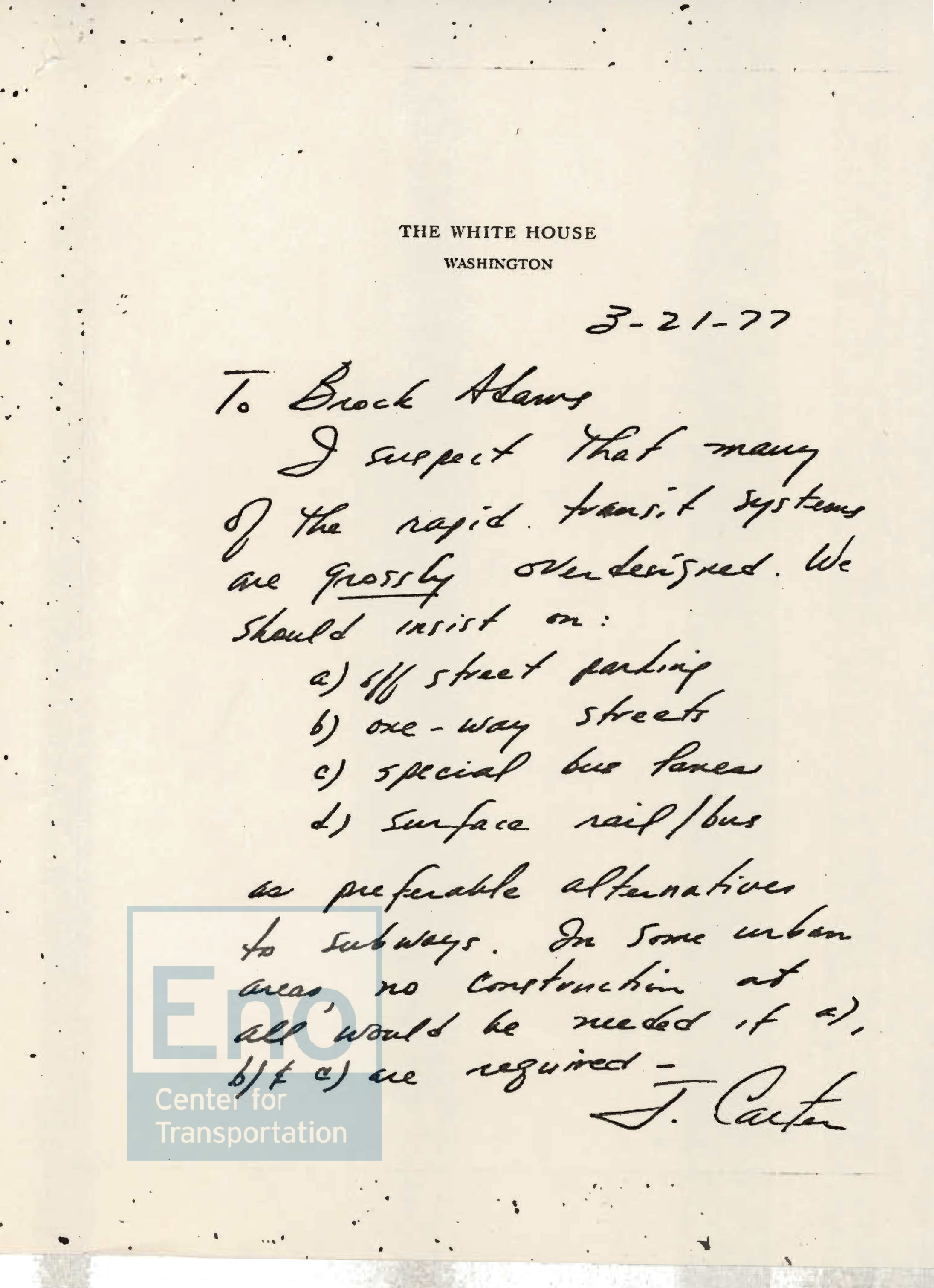
 https://enotrans.org/wp-content/uploads/2023/02/membersOnly-1977-03-21-Carter-to-Adams-handwritten-transit-letter-pdf.jpg
1295
939
ENO CENTER FOR TRANSPORTATION
https://enotrans.org/wp-content/uploads/2022/12/Eno-Logo-2.png
ENO CENTER FOR TRANSPORTATION2015-03-24 22:43:072023-04-28 14:08:421977 President Carter Handwritten Note to Sec. Adams Opposing New Subway Systems
https://enotrans.org/wp-content/uploads/2023/02/membersOnly-1977-03-21-Carter-to-Adams-handwritten-transit-letter-pdf.jpg
1295
939
ENO CENTER FOR TRANSPORTATION
https://enotrans.org/wp-content/uploads/2022/12/Eno-Logo-2.png
ENO CENTER FOR TRANSPORTATION2015-03-24 22:43:072023-04-28 14:08:421977 President Carter Handwritten Note to Sec. Adams Opposing New Subway SystemsRailroads have been a vital presence in American transportation for nearly 200 years moving both passengers and freight efficiently and effectively. Freight railroads in the United States are mostly owned by private companies, who maintain and operate their own networks. Passenger systems, whether through Amtrak or various commuter railroads, require public assistance and either operate on their own track or pay to use freight railroad-owned track.
https://enotrans.org/wp-content/uploads/2023/02/membersOnly-1977-03-21-Carter-to-Adams-handwritten-transit-letter-pdf.jpg
1295
939
ENO CENTER FOR TRANSPORTATION
https://enotrans.org/wp-content/uploads/2022/12/Eno-Logo-2.png
ENO CENTER FOR TRANSPORTATION2015-03-24 22:43:072023-04-28 14:08:421977 President Carter Handwritten Note to Sec. Adams Opposing New Subway Systems https://enotrans.org/wp-content/uploads/2022/12/Eno-Logo-2.png
0
0
Paul Lewis
https://enotrans.org/wp-content/uploads/2022/12/Eno-Logo-2.png
Paul Lewis2015-02-19 17:11:582023-04-17 07:13:56Funding for freight can be a critical element for the next transportation bill
https://enotrans.org/wp-content/uploads/2022/12/Eno-Logo-2.png
0
0
Karen Price
https://enotrans.org/wp-content/uploads/2022/12/Eno-Logo-2.png
Karen Price2014-12-25 17:34:242023-04-14 14:21:232015: Year of Opportunity for Federal Transportation Policy?
https://enotrans.org/wp-content/uploads/2022/12/Eno-Logo-2.png
0
0
Jeff Davis
https://enotrans.org/wp-content/uploads/2022/12/Eno-Logo-2.png
Jeff Davis2014-12-11 13:45:272023-04-14 14:22:13FY 2015 Omnibus Appropriations Up For House Vote Today
https://enotrans.org/wp-content/uploads/2022/12/Eno-Logo-2.png
0
0
Jeff Davis
https://enotrans.org/wp-content/uploads/2022/12/Eno-Logo-2.png
Jeff Davis2014-12-09 17:05:402023-07-28 02:12:11Overview of Final FY 2015 USDOT Appropriations
https://enotrans.org/wp-content/uploads/2022/12/Eno-Logo-2.png
0
0
Jeff Davis
https://enotrans.org/wp-content/uploads/2022/12/Eno-Logo-2.png
Jeff Davis2014-12-08 12:30:042023-04-14 14:22:41Update – The Week Ahead
https://enotrans.org/wp-content/uploads/2022/12/Eno-Logo-2.png
0
0
Jeff Davis
https://enotrans.org/wp-content/uploads/2022/12/Eno-Logo-2.png
Jeff Davis2014-12-02 11:00:382023-04-14 14:39:20Congress Returns For Hectic Final Session
https://enotrans.org/wp-content/uploads/2022/12/Eno-Logo-2.png
0
0
Paul Lewis
https://enotrans.org/wp-content/uploads/2022/12/Eno-Logo-2.png
Paul Lewis2015-02-19 17:11:582023-04-17 07:13:56Funding for freight can be a critical element for the next transportation bill
https://enotrans.org/wp-content/uploads/2022/12/Eno-Logo-2.png
0
0
Karen Price
https://enotrans.org/wp-content/uploads/2022/12/Eno-Logo-2.png
Karen Price2014-12-25 17:34:242023-04-14 14:21:232015: Year of Opportunity for Federal Transportation Policy?
https://enotrans.org/wp-content/uploads/2022/12/Eno-Logo-2.png
0
0
Jeff Davis
https://enotrans.org/wp-content/uploads/2022/12/Eno-Logo-2.png
Jeff Davis2014-12-11 13:45:272023-04-14 14:22:13FY 2015 Omnibus Appropriations Up For House Vote Today
https://enotrans.org/wp-content/uploads/2022/12/Eno-Logo-2.png
0
0
Jeff Davis
https://enotrans.org/wp-content/uploads/2022/12/Eno-Logo-2.png
Jeff Davis2014-12-09 17:05:402023-07-28 02:12:11Overview of Final FY 2015 USDOT Appropriations
https://enotrans.org/wp-content/uploads/2022/12/Eno-Logo-2.png
0
0
Jeff Davis
https://enotrans.org/wp-content/uploads/2022/12/Eno-Logo-2.png
Jeff Davis2014-12-08 12:30:042023-04-14 14:22:41Update – The Week Ahead
https://enotrans.org/wp-content/uploads/2022/12/Eno-Logo-2.png
0
0
Jeff Davis
https://enotrans.org/wp-content/uploads/2022/12/Eno-Logo-2.png
Jeff Davis2014-12-02 11:00:382023-04-14 14:39:20Congress Returns For Hectic Final Session https://enotrans.org/wp-content/uploads/2023/02/2014initatives.png
1093
1051
Jeff Davis
https://enotrans.org/wp-content/uploads/2022/12/Eno-Logo-2.png
Jeff Davis2014-11-10 20:20:162023-06-28 07:12:01Election Gives Mixed Message For Trans. & Infra.
https://enotrans.org/wp-content/uploads/2023/01/Untitled4.png
491
878
Carter Templeton
https://enotrans.org/wp-content/uploads/2022/12/Eno-Logo-2.png
Carter Templeton2014-10-25 15:44:372023-06-28 07:12:32Devolving Surface Transportation Infrastructure Responsibilities to the States: What’s Past is Prologue
https://enotrans.org/wp-content/uploads/2022/12/Eno-Logo-2.png
0
0
Karen Price
https://enotrans.org/wp-content/uploads/2022/12/Eno-Logo-2.png
Karen Price2014-09-25 15:09:452023-04-14 14:56:53Improving Transportation Performance: Time to Focus on Operations
https://enotrans.org/wp-content/uploads/2022/12/Eno-Logo-2.png
0
0
Carter Templeton
https://enotrans.org/wp-content/uploads/2022/12/Eno-Logo-2.png
Carter Templeton2014-07-25 14:30:232023-04-14 14:58:39Crude Oil by Rail: The Industry is Changing
https://enotrans.org/wp-content/uploads/2022/12/Eno-Logo-2.png
0
0
Carter Templeton
https://enotrans.org/wp-content/uploads/2022/12/Eno-Logo-2.png
Carter Templeton2014-07-25 14:05:202023-04-14 14:58:42Infrastructure in the United States: The Dangers of Living Below Our Means
https://enotrans.org/wp-content/uploads/2023/02/2014initatives.png
1093
1051
Jeff Davis
https://enotrans.org/wp-content/uploads/2022/12/Eno-Logo-2.png
Jeff Davis2014-11-10 20:20:162023-06-28 07:12:01Election Gives Mixed Message For Trans. & Infra.
https://enotrans.org/wp-content/uploads/2023/01/Untitled4.png
491
878
Carter Templeton
https://enotrans.org/wp-content/uploads/2022/12/Eno-Logo-2.png
Carter Templeton2014-10-25 15:44:372023-06-28 07:12:32Devolving Surface Transportation Infrastructure Responsibilities to the States: What’s Past is Prologue
https://enotrans.org/wp-content/uploads/2022/12/Eno-Logo-2.png
0
0
Karen Price
https://enotrans.org/wp-content/uploads/2022/12/Eno-Logo-2.png
Karen Price2014-09-25 15:09:452023-04-14 14:56:53Improving Transportation Performance: Time to Focus on Operations
https://enotrans.org/wp-content/uploads/2022/12/Eno-Logo-2.png
0
0
Carter Templeton
https://enotrans.org/wp-content/uploads/2022/12/Eno-Logo-2.png
Carter Templeton2014-07-25 14:30:232023-04-14 14:58:39Crude Oil by Rail: The Industry is Changing
https://enotrans.org/wp-content/uploads/2022/12/Eno-Logo-2.png
0
0
Carter Templeton
https://enotrans.org/wp-content/uploads/2022/12/Eno-Logo-2.png
Carter Templeton2014-07-25 14:05:202023-04-14 14:58:42Infrastructure in the United States: The Dangers of Living Below Our MeansSafer Railroading: A Guide Toward Targeted Safety Policy

Railroads are among the safest modes of transportation for workers, riders, and the public. Strong federal standards for railroad track and operations, technological investments like positive train control, and communities’ infrastructure improvements have yielded significant gains. But most of these gains have plateaued and in some cases safety trends are moving in the wrong direction. A new strategy and framework is needed to address the most significant safety issues facing railroads. This report explores trends in railroad safety data and actionable recommendations for federal, state, local, and private sector actors to make a demonstrable improvement in railroad safety.