
 https://enotrans.org/wp-content/uploads/2023/01/CBO-Options-cover.png
408
646
Jeff Davis
https://enotrans.org/wp-content/uploads/2022/12/Eno-Logo-2.png
Jeff Davis2018-12-14 13:30:172023-04-17 08:25:10CBO Updates Savings Estimates from Spending and Tax Choices
https://enotrans.org/wp-content/uploads/2023/01/CBO-Options-cover.png
408
646
Jeff Davis
https://enotrans.org/wp-content/uploads/2022/12/Eno-Logo-2.png
Jeff Davis2018-12-14 13:30:172023-04-17 08:25:10CBO Updates Savings Estimates from Spending and Tax ChoicesRailroads have been a vital presence in American transportation for nearly 200 years moving both passengers and freight efficiently and effectively. Freight railroads in the United States are mostly owned by private companies, who maintain and operate their own networks. Passenger systems, whether through Amtrak or various commuter railroads, require public assistance and either operate on their own track or pay to use freight railroad-owned track.
https://enotrans.org/wp-content/uploads/2023/01/CBO-Options-cover.png
408
646
Jeff Davis
https://enotrans.org/wp-content/uploads/2022/12/Eno-Logo-2.png
Jeff Davis2018-12-14 13:30:172023-04-17 08:25:10CBO Updates Savings Estimates from Spending and Tax Choices https://enotrans.org/wp-content/uploads/2023/01/highway-construction-site-1891641_1280-e1494523430580.jpg
465
750
Jeff Davis
https://enotrans.org/wp-content/uploads/2022/12/Eno-Logo-2.png
Jeff Davis2018-12-11 19:07:182023-06-27 18:35:31DOT Announces $1.5 Billion in BUILD Surface Transportation Grants
https://enotrans.org/wp-content/uploads/2023/01/highway-construction-site-1891641_1280-e1494523430580.jpg
465
750
Jeff Davis
https://enotrans.org/wp-content/uploads/2022/12/Eno-Logo-2.png
Jeff Davis2018-12-11 19:07:182023-06-27 18:35:31DOT Announces $1.5 Billion in BUILD Surface Transportation Grants https://enotrans.org/wp-content/uploads/2023/01/Bush-ADA-signing.jpg
369
550
Alice Grossman
https://enotrans.org/wp-content/uploads/2022/12/Eno-Logo-2.png
Alice Grossman2018-12-07 16:19:202024-04-23 08:00:09Op-Ed: Remembering George H.W. Bush and the ADA
https://enotrans.org/wp-content/uploads/2023/01/Bush-ADA-signing.jpg
369
550
Alice Grossman
https://enotrans.org/wp-content/uploads/2022/12/Eno-Logo-2.png
Alice Grossman2018-12-07 16:19:202024-04-23 08:00:09Op-Ed: Remembering George H.W. Bush and the ADA https://enotrans.org/wp-content/uploads/2023/02/freight-train-363436_1280-e1475244722697.jpg
563
750
Jeff Davis
https://enotrans.org/wp-content/uploads/2022/12/Eno-Logo-2.png
Jeff Davis2018-12-06 20:55:272023-04-17 08:26:45Trump Nominates Remaining Two-Thirds of Railroad Retirement Board
https://enotrans.org/wp-content/uploads/2023/02/freight-train-363436_1280-e1475244722697.jpg
563
750
Jeff Davis
https://enotrans.org/wp-content/uploads/2022/12/Eno-Logo-2.png
Jeff Davis2018-12-06 20:55:272023-04-17 08:26:45Trump Nominates Remaining Two-Thirds of Railroad Retirement Board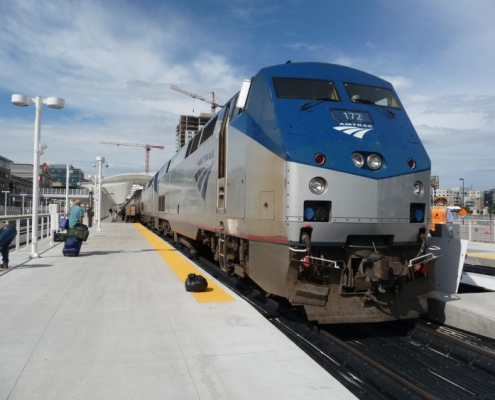 https://enotrans.org/wp-content/uploads/2023/01/train-1977197_1280-e1495717901683.jpg
563
751
Alexander Laska
https://enotrans.org/wp-content/uploads/2022/12/Eno-Logo-2.png
Alexander Laska2018-11-30 15:25:062023-04-17 08:27:05Q3 PTC Reports Show Some Railroads Still At Risk of Missing Deadline
https://enotrans.org/wp-content/uploads/2023/01/train-1977197_1280-e1495717901683.jpg
563
751
Alexander Laska
https://enotrans.org/wp-content/uploads/2022/12/Eno-Logo-2.png
Alexander Laska2018-11-30 15:25:062023-04-17 08:27:05Q3 PTC Reports Show Some Railroads Still At Risk of Missing Deadline https://enotrans.org/wp-content/uploads/2023/01/Untitled-1.png
312
469
Jeff Davis
https://enotrans.org/wp-content/uploads/2022/12/Eno-Logo-2.png
Jeff Davis2018-11-30 15:24:192023-04-17 08:29:17FTA Allocates Funding to L.A., Tempe, Minneapolis Transit Projects
https://enotrans.org/wp-content/uploads/2023/01/Untitled-1.png
312
469
Jeff Davis
https://enotrans.org/wp-content/uploads/2022/12/Eno-Logo-2.png
Jeff Davis2018-11-30 15:24:192023-04-17 08:29:17FTA Allocates Funding to L.A., Tempe, Minneapolis Transit Projects https://enotrans.org/wp-content/uploads/2023/01/iStock-492670742.jpg
483
724
Jeff Davis
https://enotrans.org/wp-content/uploads/2022/12/Eno-Logo-2.png
Jeff Davis2018-11-30 15:23:512023-04-17 08:29:21Tax Extenders Bill, Amended to Affect Transit and Parking Benefits, Pulled from House Schedule
https://enotrans.org/wp-content/uploads/2023/01/iStock-492670742.jpg
483
724
Jeff Davis
https://enotrans.org/wp-content/uploads/2022/12/Eno-Logo-2.png
Jeff Davis2018-11-30 15:23:512023-04-17 08:29:21Tax Extenders Bill, Amended to Affect Transit and Parking Benefits, Pulled from House Schedule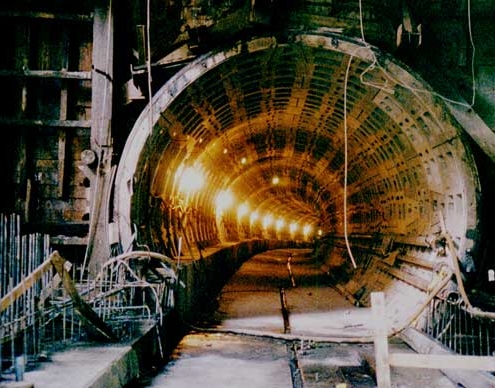 https://enotrans.org/wp-content/uploads/2023/02/DCSubwayConstruction.jpg
388
625
Jeff Davis
https://enotrans.org/wp-content/uploads/2022/12/Eno-Logo-2.png
Jeff Davis2018-11-28 18:34:282023-04-17 08:29:38Is the Mass Transit CIG Program Sitting on $1.4 Billion? Or Is the Program $5 Billion in the Red?
https://enotrans.org/wp-content/uploads/2023/02/DCSubwayConstruction.jpg
388
625
Jeff Davis
https://enotrans.org/wp-content/uploads/2022/12/Eno-Logo-2.png
Jeff Davis2018-11-28 18:34:282023-04-17 08:29:38Is the Mass Transit CIG Program Sitting on $1.4 Billion? Or Is the Program $5 Billion in the Red?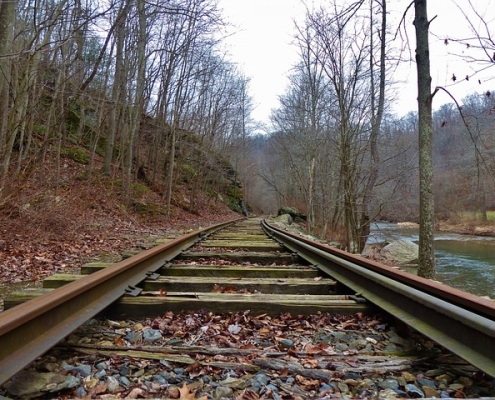 https://enotrans.org/wp-content/uploads/2023/01/railroad-314769_640.jpg
480
640
Jeff Davis
https://enotrans.org/wp-content/uploads/2022/12/Eno-Logo-2.png
Jeff Davis2018-11-27 13:54:372023-04-17 08:29:39Year-End Tax Package Would Reduce and Make Permanent Rail Maintenance Tax Credit; End BioDiesel Credit
https://enotrans.org/wp-content/uploads/2023/01/railroad-314769_640.jpg
480
640
Jeff Davis
https://enotrans.org/wp-content/uploads/2022/12/Eno-Logo-2.png
Jeff Davis2018-11-27 13:54:372023-04-17 08:29:39Year-End Tax Package Would Reduce and Make Permanent Rail Maintenance Tax Credit; End BioDiesel Credit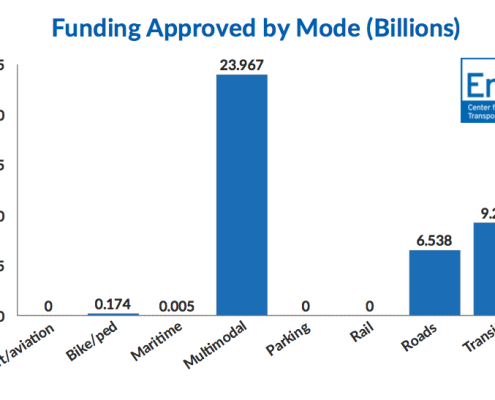 https://enotrans.org/wp-content/uploads/2023/01/funding-approved-by-mode-12-5-18.png
547
812
Alexander Laska
https://enotrans.org/wp-content/uploads/2022/12/Eno-Logo-2.png
Alexander Laska2018-11-16 16:44:262023-06-27 18:35:33How Did Different Transportation Modes Fare at the Ballot Box?
https://enotrans.org/wp-content/uploads/2023/01/funding-approved-by-mode-12-5-18.png
547
812
Alexander Laska
https://enotrans.org/wp-content/uploads/2022/12/Eno-Logo-2.png
Alexander Laska2018-11-16 16:44:262023-06-27 18:35:33How Did Different Transportation Modes Fare at the Ballot Box?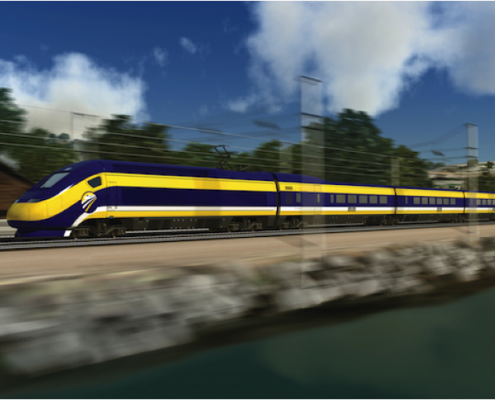 https://enotrans.org/wp-content/uploads/2023/01/CAHSR-train-e1501873171613.png
508
750
Jeff Davis
https://enotrans.org/wp-content/uploads/2022/12/Eno-Logo-2.png
Jeff Davis2018-11-16 16:02:512023-06-27 18:35:33California Auditor Questions Completion Timetable for High-Speed Rail Project
https://enotrans.org/wp-content/uploads/2023/01/CAHSR-train-e1501873171613.png
508
750
Jeff Davis
https://enotrans.org/wp-content/uploads/2022/12/Eno-Logo-2.png
Jeff Davis2018-11-16 16:02:512023-06-27 18:35:33California Auditor Questions Completion Timetable for High-Speed Rail Project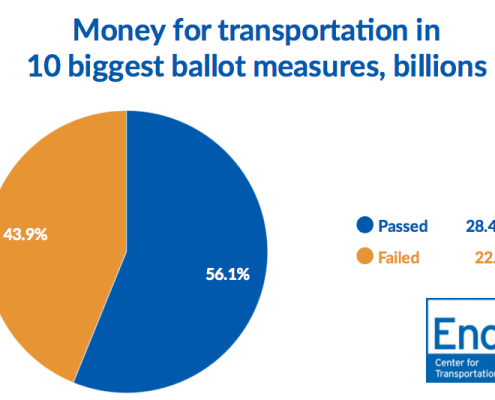 https://enotrans.org/wp-content/uploads/2023/01/10-biggest-ballot-measures-12-3-18.png
533
741
Alexander Laska
https://enotrans.org/wp-content/uploads/2022/12/Eno-Logo-2.png
Alexander Laska2018-11-08 23:10:422023-06-27 18:35:34Voters Pass Six of 10 Biggest Transportation Ballot Measures
https://enotrans.org/wp-content/uploads/2023/01/10-biggest-ballot-measures-12-3-18.png
533
741
Alexander Laska
https://enotrans.org/wp-content/uploads/2022/12/Eno-Logo-2.png
Alexander Laska2018-11-08 23:10:422023-06-27 18:35:34Voters Pass Six of 10 Biggest Transportation Ballot MeasuresSafer Railroading: A Guide Toward Targeted Safety Policy
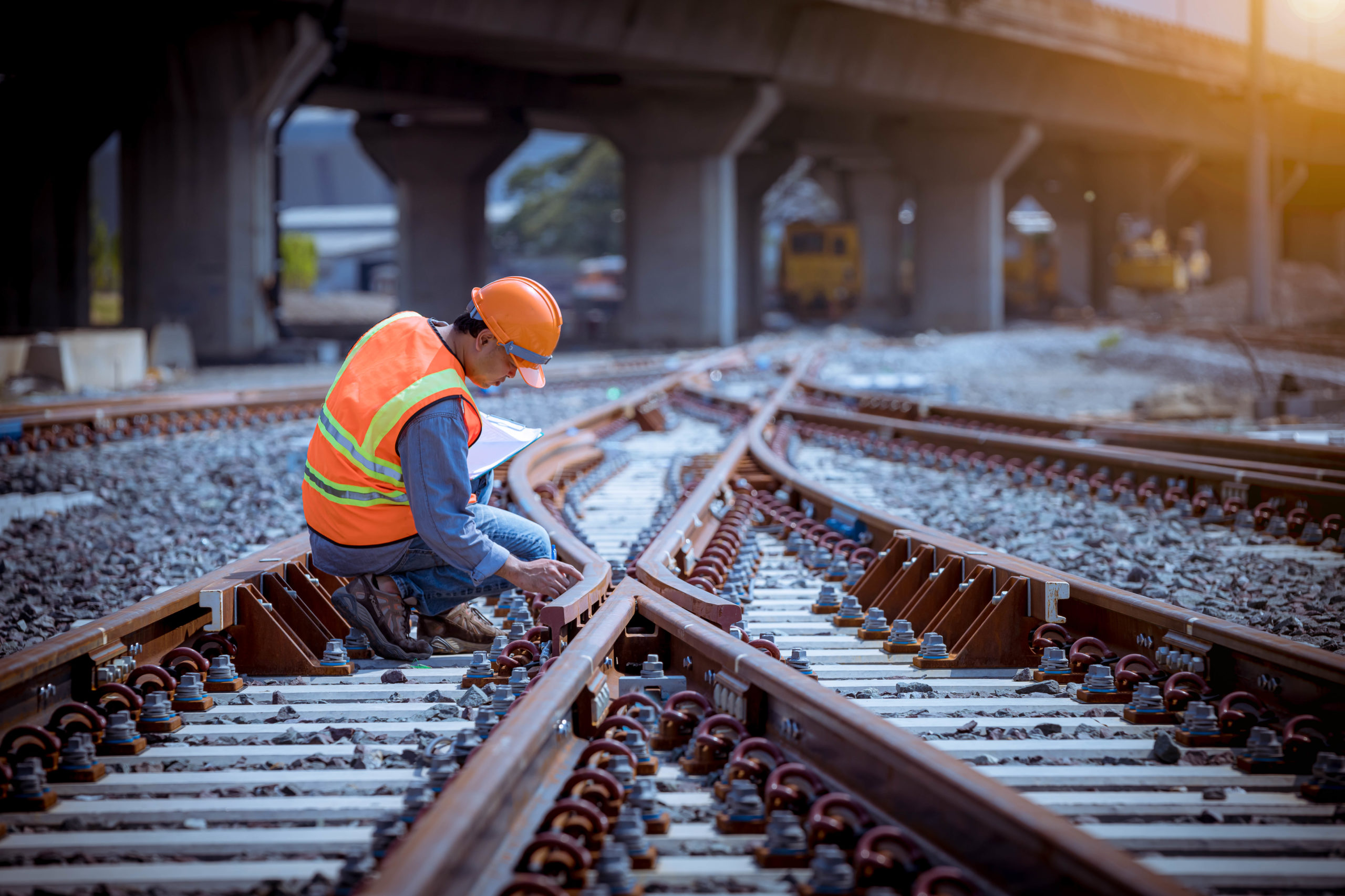
Railroads are among the safest modes of transportation for workers, riders, and the public. Strong federal standards for railroad track and operations, technological investments like positive train control, and communities’ infrastructure improvements have yielded significant gains. But most of these gains have plateaued and in some cases safety trends are moving in the wrong direction. A new strategy and framework is needed to address the most significant safety issues facing railroads. This report explores trends in railroad safety data and actionable recommendations for federal, state, local, and private sector actors to make a demonstrable improvement in railroad safety.