
John Tyler (1841-1845): In Our Immigration Era
This article is a part of our series From Lighthouses to Electric Chargers: A Presidential Series on Transportation Innovations
With the death of President William Henry Harrison after a mere 31 days in office, Vice President John Tyler became the first person elevated to the presidency after a president’s death and is largely responsible for the precedent that exists today of a vice president being sworn in as president. At the time, the Constitution was unclear on whether Tyler should serve the rest of Harrison’s term or if a new election should be held, as well as whether Harrison should have the title of vice president, acting president, or president.
Tyler insisted that he take on all powers of an elected president which was met with skepticism and some pushback from many –ultimately earning him the endearing nickname of “His Accidency.” Although the assumption of presidential duties was not initially entirely problematic to his fellow Whig party members, things quickly unraveled, and it would ultimately be a conflict over national bank legislation that would lead to the expulsion of Tyler from the Whig party and the first presidential impeachment effort in the House of Representatives.
Despite the many clashes with both parties in Congress, as well as his presidential cabinet, Tyler was still able to accomplish some of his important political goals. Tyler was responsible for the “Log Cabin” bill which allowed settlers to claim 160-acre plots of land prior to the land being listed publicly and later pay just $1.25 per acre. He settled a land dispute in the northeast with Canada. And while President Polk is largely credited with the annexation of Texas, Tyler was the one who signed the resolution for the annexation of Texas in 1845 – two days prior to his departure from office. He extended the offer for immediate annexation on his final day in office.
Beyond the changing geography and settlement of the U.S. during his presidency, the country was also changing demographically. The attraction of available land in the U.S., coupled with crises abroad such as the beginning of the Irish Potato Famine, brought many immigrants into the country in search of new opportunities.
Early Life and Presidency
Born into a wealthy and politically connected Virginia family, Tyler served as a Virginia legislator, a member of the U.S. House and Senate, and Virginia governor before he was elected vice president in 1840. His strict interpretation of the Constitution and his fervent support of states’ rights, led to a somewhat tumultuous political career. He opposed policies which he perceived as bolstering the north at the expense of the south, programs that centralized power (such as a national bank), and what he considered an overreach of federal authority (such as determining whether a state should be of a slave-owning or free state upon admittance to the Union).
But Tyler was also a traditional politician who strongly opposed the populist appeals of President Andrew Jackson and considered Jackson’s strong-handed federal approach as an unconstitutional abuse of power. Tyler decided to leave Jackson’s Democratic Party in the 1830s, aligning himself with the newly formed Whig Party and its presidential candidate, William Henry Harrison.
Immigration and Westward Expansion
In the 1840s, the availability of better infrastructure along with the federal government’s financial and land incentives, greatly encouraged migration to the west. Simultaneously, the country was experiencing major population changes due to immigration from northern Europe. During Tyler’s presidency, U.S. population increased by 18 percent with a marked increase in urban population. For example, during the 1840s, New York’s population increased from 327,000 to 590,000, and the number of residents in St. Louis increased from 36,000 to 105,000.
Irish citizens fleeing the 1845 Potato Blight made up nearly half of total immigrants to the U.S. in the 1840s. Emigrating across the Atlantic was a perilous journey on vessels known as “coffin ships.” Because steam ships were not widely used for transatlantic crossings until later in the 19th century, immigrants traveled on sailing ships – a trek which required anywhere from 5 to 7 weeks (potentially more given unfavorable conditions). Ships were often packed beyond capacity and lacked sufficient sanitary facilities and rations for the entire journey. Between the unsanitary conditions, overcrowding, and other factors, it was not uncommon for more than 20 percent of passengers to perish on a journey – with some journeys losing as many as 50 percent of passengers. It was also highly common for immigrants to arrive in poor health and later die due to the poor conditions and frequent outbreaks of diseases like Typhus and Cholera.
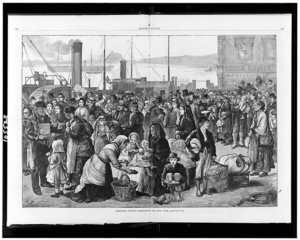
Emigrants leaving Queenstown for New York / M.F. (Library of Congress)
Upon arrival to the U.S., a large portion of these immigrants were impoverished and limited in their ability to relocate. Many settled in these eastern cities, such as Boston, New York, Philadelphia, and Jersey City, where they often took employment opportunities in low-skilled, dangerous jobs and lived in less than favorable conditions. But for some immigrants with the ability to do so, the system of canals connecting the U.S. inland waterway system provided the opportunity to move inland for a more rural lifestyle to which they were
The Erie Canal, which was constructed between 1817 and 1825 and originally spanned 363 miles to connect Albany and Buffalo, linked the coastal ports of New York and New Jersey to the Great Lakes via the Hudson River. At the time, it was the longest artificial waterway in the country, and the canal carried more immigrants west than any other trans-Appalachian canal. This connectivity west led to settlement in different parts of western Pennsylvania, as well as Midwest settlement in states like Illinois, Ohio, and Iowa.
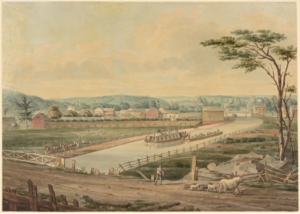
View on the Erie Canal”(New York Public Library Digital Collections)
After settling in these midwestern states, often along the Mississippi River, some immigrants tried their hands at farming. But as the western expansion of the railroad was taking off in this period, many took opportunities in railroad construction. The availability of this immigrant labor was pivotal in the development of American infrastructure and settlement, particularly to the west, for years to come, but these opportunities were not without cost. The jobs were so treacherous that it was often said “an Irishman was buried under every tie.”
This article is a part of our series From Lighthouses to Electric Chargers: A Presidential Series on Transportation Innovations
Search Eno Transportation Weekly
Happening on the Hill
Related Articles
 https://enotrans.org/wp-content/uploads/2026/03/Screenshot-2026-03-06-133311.png
595
709
Rebecca Higgins
https://enotrans.org/wp-content/uploads/2022/12/Eno-Logo-2.png
Rebecca Higgins2026-03-06 15:30:262026-03-06 15:30:26Tracking Transportation Impacts from Military Engagement in Iran
https://enotrans.org/wp-content/uploads/2026/03/Screenshot-2026-03-06-133311.png
595
709
Rebecca Higgins
https://enotrans.org/wp-content/uploads/2022/12/Eno-Logo-2.png
Rebecca Higgins2026-03-06 15:30:262026-03-06 15:30:26Tracking Transportation Impacts from Military Engagement in Iran https://enotrans.org/wp-content/uploads/2026/02/Shipbuilding.jpg
1500
2000
kferrell
https://enotrans.org/wp-content/uploads/2022/12/Eno-Logo-2.png
kferrell2026-02-20 15:27:242026-02-20 15:27:24Trump Envisions “Maritime Golden Age” through Investments, Fees, and Deregulation
https://enotrans.org/wp-content/uploads/2026/02/Shipbuilding.jpg
1500
2000
kferrell
https://enotrans.org/wp-content/uploads/2022/12/Eno-Logo-2.png
kferrell2026-02-20 15:27:242026-02-20 15:27:24Trump Envisions “Maritime Golden Age” through Investments, Fees, and Deregulation https://enotrans.org/wp-content/uploads/2025/12/Coast-Guard.jpg
1414
2121
kferrell
https://enotrans.org/wp-content/uploads/2022/12/Eno-Logo-2.png
kferrell2025-12-19 14:59:172025-12-19 15:48:29The Coast Guard’s Ongoing Experience with New Technology
https://enotrans.org/wp-content/uploads/2025/12/Coast-Guard.jpg
1414
2121
kferrell
https://enotrans.org/wp-content/uploads/2022/12/Eno-Logo-2.png
kferrell2025-12-19 14:59:172025-12-19 15:48:29The Coast Guard’s Ongoing Experience with New Technology https://enotrans.org/wp-content/uploads/2025/10/maritime.jpg
1498
2000
kferrell
https://enotrans.org/wp-content/uploads/2022/12/Eno-Logo-2.png
kferrell2025-10-24 15:18:312025-10-24 16:18:01Senate Commerce Committee Holds Hearing on Maritime-Related nominations
https://enotrans.org/wp-content/uploads/2025/10/maritime.jpg
1498
2000
kferrell
https://enotrans.org/wp-content/uploads/2022/12/Eno-Logo-2.png
kferrell2025-10-24 15:18:312025-10-24 16:18:01Senate Commerce Committee Holds Hearing on Maritime-Related nominations https://enotrans.org/wp-content/uploads/2025/09/Maritime-Fuel-scaled.jpg
1440
2560
kferrell
https://enotrans.org/wp-content/uploads/2022/12/Eno-Logo-2.png
kferrell2025-09-12 16:10:312025-09-12 16:10:31Maritime Decarbonization – US Moves Pale Next to IMO’s
https://enotrans.org/wp-content/uploads/2025/09/Maritime-Fuel-scaled.jpg
1440
2560
kferrell
https://enotrans.org/wp-content/uploads/2022/12/Eno-Logo-2.png
kferrell2025-09-12 16:10:312025-09-12 16:10:31Maritime Decarbonization – US Moves Pale Next to IMO’s https://enotrans.org/wp-content/uploads/2025/05/cargo-theft-scaled.jpg
1707
2560
kferrell
https://enotrans.org/wp-content/uploads/2022/12/Eno-Logo-2.png
kferrell2025-05-02 14:42:202025-05-02 16:00:17Roundtable: Combatting Cargo Theft: Stakeholder Perspectives
https://enotrans.org/wp-content/uploads/2025/05/cargo-theft-scaled.jpg
1707
2560
kferrell
https://enotrans.org/wp-content/uploads/2022/12/Eno-Logo-2.png
kferrell2025-05-02 14:42:202025-05-02 16:00:17Roundtable: Combatting Cargo Theft: Stakeholder Perspectives  https://enotrans.org/wp-content/uploads/2025/04/Shipbuilding.jpg
1500
2000
Jeff Davis
https://enotrans.org/wp-content/uploads/2022/12/Eno-Logo-2.png
Jeff Davis2025-04-11 15:28:302025-05-01 11:38:19Trump Signs Shipbuilding Executive Order
https://enotrans.org/wp-content/uploads/2025/04/Shipbuilding.jpg
1500
2000
Jeff Davis
https://enotrans.org/wp-content/uploads/2022/12/Eno-Logo-2.png
Jeff Davis2025-04-11 15:28:302025-05-01 11:38:19Trump Signs Shipbuilding Executive Order https://enotrans.org/wp-content/uploads/2023/02/port-authority-of-new-york-and-new-jersey-freight-maritime-sea-scaled-2.jpg
1707
2560
Jeff Davis
https://enotrans.org/wp-content/uploads/2022/12/Eno-Logo-2.png
Jeff Davis2025-02-07 14:14:262025-02-07 14:14:26House Maritime Subcommittee Sets Sail into 119th
https://enotrans.org/wp-content/uploads/2023/02/port-authority-of-new-york-and-new-jersey-freight-maritime-sea-scaled-2.jpg
1707
2560
Jeff Davis
https://enotrans.org/wp-content/uploads/2022/12/Eno-Logo-2.png
Jeff Davis2025-02-07 14:14:262025-02-07 14:14:26House Maritime Subcommittee Sets Sail into 119th https://enotrans.org/wp-content/uploads/2023/01/cargo-supply-chain-freight-port-maritime-boat-shipping.jpg
1396
2146
Jeff Davis
https://enotrans.org/wp-content/uploads/2022/12/Eno-Logo-2.png
Jeff Davis2024-12-13 14:24:142024-12-13 14:24:14Water, Defense/Maritime Bills Advance in House
https://enotrans.org/wp-content/uploads/2023/01/cargo-supply-chain-freight-port-maritime-boat-shipping.jpg
1396
2146
Jeff Davis
https://enotrans.org/wp-content/uploads/2022/12/Eno-Logo-2.png
Jeff Davis2024-12-13 14:24:142024-12-13 14:24:14Water, Defense/Maritime Bills Advance in House https://enotrans.org/wp-content/uploads/2023/02/inland-waterways-water-ohio-river-dam.jpg
1413
2121
Jeff Davis
https://enotrans.org/wp-content/uploads/2022/12/Eno-Logo-2.png
Jeff Davis2024-12-06 13:45:112024-12-06 13:45:11Biennial WRDA Bill Transfers $2B in Unused Highway TIFIA Funding to States
https://enotrans.org/wp-content/uploads/2023/02/inland-waterways-water-ohio-river-dam.jpg
1413
2121
Jeff Davis
https://enotrans.org/wp-content/uploads/2022/12/Eno-Logo-2.png
Jeff Davis2024-12-06 13:45:112024-12-06 13:45:11Biennial WRDA Bill Transfers $2B in Unused Highway TIFIA Funding to States https://enotrans.org/wp-content/uploads/2023/07/iStock-1415497169-scaled.jpg
1707
2560
Jeff Davis
https://enotrans.org/wp-content/uploads/2022/12/Eno-Logo-2.png
Jeff Davis2024-10-04 11:56:412024-10-04 11:56:41East Coast Port Strike Suspended Until January
https://enotrans.org/wp-content/uploads/2023/07/iStock-1415497169-scaled.jpg
1707
2560
Jeff Davis
https://enotrans.org/wp-content/uploads/2022/12/Eno-Logo-2.png
Jeff Davis2024-10-04 11:56:412024-10-04 11:56:41East Coast Port Strike Suspended Until January https://enotrans.org/wp-content/uploads/2023/04/capitol-capital-congress-senate-house-scaled-2.jpg
1707
2560
Jeff Davis
https://enotrans.org/wp-content/uploads/2022/12/Eno-Logo-2.png
Jeff Davis2024-09-27 15:07:502024-09-27 15:07:50Senate Commerce Holds Final Nominations Hearing of 2024
https://enotrans.org/wp-content/uploads/2023/04/capitol-capital-congress-senate-house-scaled-2.jpg
1707
2560
Jeff Davis
https://enotrans.org/wp-content/uploads/2022/12/Eno-Logo-2.png
Jeff Davis2024-09-27 15:07:502024-09-27 15:07:50Senate Commerce Holds Final Nominations Hearing of 2024
