Never Forget. Always Learn.
“Never forget.” This maxim captures the sentiments of many who lived through the horrific events of September 11, 2001, and the difficult aftermath that followed.
With every year that passes, that reminder becomes more profound. The distance of time can stretch our memories of the particulars of the tragedy, the heroic responses, and the precious loved ones we lost. But remembering is only part of our responsibility as we move into the future. The greater challenge is to make the events of that day—and the lessons learned from them—relevant and meaningful today and for generations to come.
I am grateful that the Eno Center for Transportation has devoted this edition of Eno Transportation Weekly to 9/11 on its 25th anniversary. I hope the reflections in this publication inspire those in the transportation industry and beyond to act with unity and common purpose to develop infrastructure, systems, and operations that are resilient, reliable, and productive.
My entire 44-year career has been rooted in public service, including 33 years with The Port Authority of New York and New Jersey. Most of that time was devoted to bridges, tunnels, and bus terminals. These facilities were not destinations themselves; they were links in a larger regional network of facilities and services.
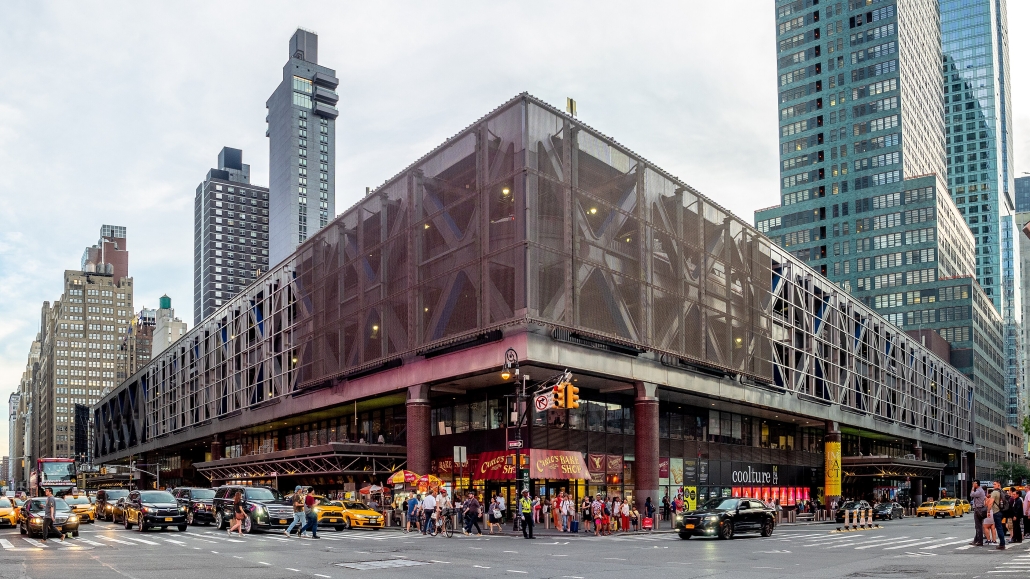 The Port Authority operates the world’s busiest bus terminal, show above, in Midtown Manhattan. Photo Credit: Ajay_Suresh per Wikimedia.
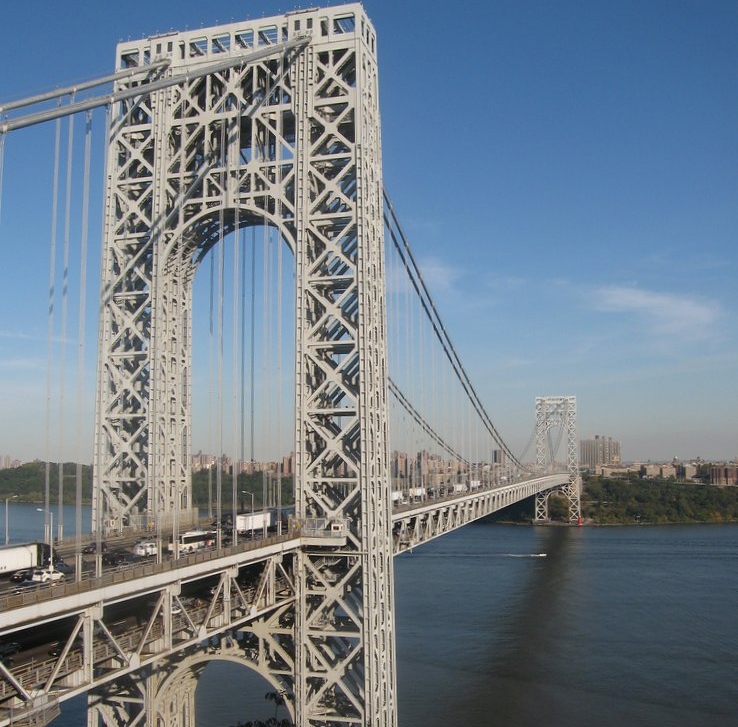
The Port Authority also operates the two-level George Washington Bridge, the busiest motor vehicle bridge in the world. Photo Credit: Hudconja per Wikipedia.
Operating a regional transportation system requires collaboration, communication, and coordination. Throughout my Port Authority career, I developed a deep appreciation for how network-level outcomes create far more value than the actions on any individual facility or by any single agency. Partnerships, integration, shared information, and coordinated decisions are essential to success. While these principles are important in day-to-day operations, they become even more critical during periods of significant disruption—and 9/11 took disruption to an unprecedented level.
The tragedy of 9/11 holds many lessons that have transformed how we manage transportation systems and protect public safety and critical infrastructure. I am pleased to share several transportation lessons that continue to resonate with me today.
Differentiated Responses. The policy tradeoffs between maintaining openness and accessibility and advancing effective terrorism prevention and protection are ultimately societal decisions. The transportation legacy since the 9/11 terror attacks is a fitting example of the tension of competing policy objectives in practice.
The need to differentiate responses across transportation systems has been paramount to preserving the fundamental mission of moving people and goods safely, reliably, and efficiently. The changes in aviation and airport security since 2001 are among the most visible post-9/11 responses. The creation of the Transportation Security Administration (TSA) and the evolution of aviation passenger and baggage screening represent a comprehensive, layered, and continuous focus on protection and prevention.
Highways, bridges, tunnels, and transit systems, however, are fundamentally different. They are open networks, and their very purpose and effectiveness depend on accessibility. They cannot be protected in the same manner as airports. As a result, surface transportation strategies have placed greater emphasis on deterrence, threat detection, surveillance, preparedness, and rapid response. By and large, I believe transportation has achieved a reasonable balance between preserving the openness we value as a free society and taking meaningful action to address vulnerabilities and risks.
Continual Vigilance and Challenging Conventional Wisdom. As an advanced and open society, we will never be able to defend everything, everywhere, all at once. We are inherently vulnerable. That reality makes intelligence and continuous assessment of risks, threats, and potential impacts essential.
It also underscores the importance of challenging our assumptions and avoiding complacency. Our assumptions are the lens through which we interpret available intelligence, and are subject to our biases, experience, and limitations. The terror attacks at the World Trade Center in 1993 and Oklahoma City in 1995 demonstrated the devastating potential of large truck bombs in targeting people and critical infrastructure. But the 9/11 attacks revealed a fundamentally different dimension of terrorism: the weaponization of four commercial aircraft, originating from three locations, against four targets in a coordinated and successive attack. The complexity of the plan—and the devastation, destruction, and disruption that followed—revealed vulnerabilities that had not been adequately anticipated in transportation systems and operations.
The lesson is clear: vigilance must be rooted not only in continuous risk assessments and exercises, but also in considering an unconstrained spectrum of possible threats. Effective preparedness requires out-of-the-box thinking about both threats and responses. Scenario planning has become an important tool in that effort. The challenge is formidable. The job is never done.
The Evolving Role of Risk Assessment. Since 2001, the role of risk assessment has been elevated and transformed. What was once primarily an engineering-driven practice focused on safety and reliability has evolved into a more systematic, multidisciplinary function that also addresses security, resilience, and the consequences of disruption.
Risk analysis increasingly examines critical assets and systems from several perspectives:
- Asset criticality and the consequences of loss
- Threats and vulnerabilities
- Risk-reduction
- Network-level impacts, including redundancy and recovery times
This broader approach continues to shape transportation planning, asset management, security, emergency management, operations, and infrastructure investment. Perhaps most importantly, risk assessment has become less about whether an individual facility can withstand a particular event and more about understanding how an entire network will respond when something goes wrong.
Physical Hardening, Access Control, and Resilience. The more deliberate use of risk analysis and threat assessments has helped transportation agencies prioritize investments and operating protocols to protect critical infrastructure and prevent or mitigate threats. Today, critical assets benefit from perimeter protections and parking restrictions designed to reduce close-proximity vehicle threats. Commercial vehicle routing and screening have become more sophisticated, helping to identify and inspect suspicious vehicles and reduce the potential for dangerous cargo to reach vulnerable facilities or confined operating environments. Technological advances have also enhanced surveillance and monitoring of restricted and critical spaces, including bridge towers and anchorages, suspension cables, and tunnel ventilation systems. New camera technology and video analytics have transformed the ability to identify anomalies, such as stopped vehicles and unauthorized pedestrians. Engineering practices have evolved as well, incorporating blast protection, advanced materials, and fire and heat protection to bolster the resilience of critical assets.
The objective is not simply to make individual facilities harder to attack. It is to reduce vulnerability, preserve operations, and enable the broader transportation network to recover more quickly when disruption occurs.
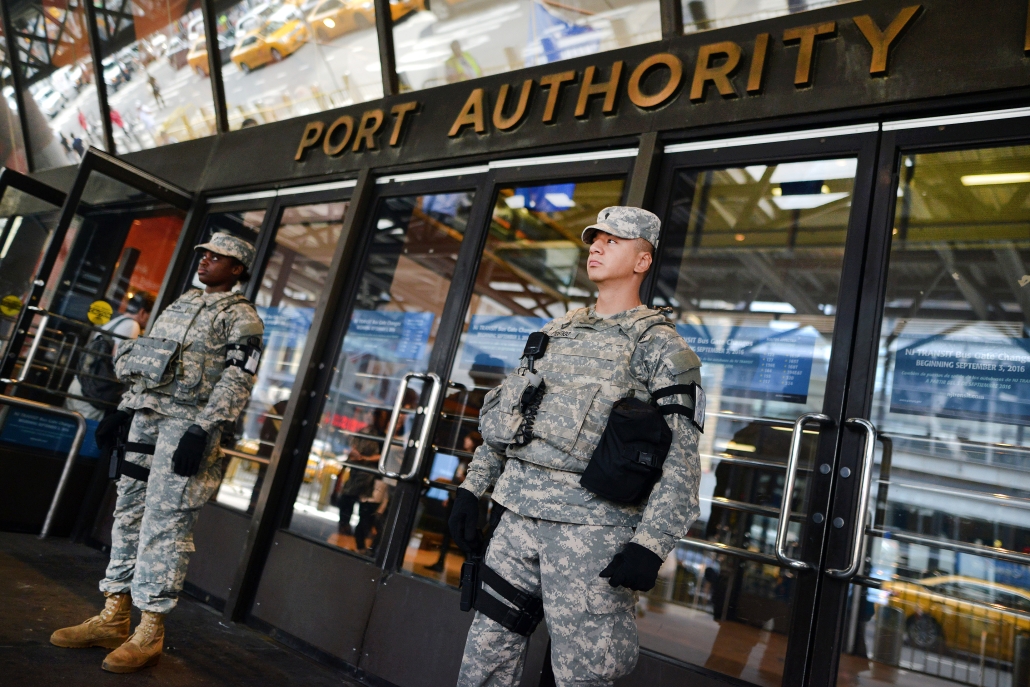
New York National Guards patrolling the Port Authority’s bus terminal in 2016. Photo Credit: Staff Sgt. Christopher Muncy, U.S. Department of War.
Communications, Coordination, and Unified Command. Immediately following the 9/11 attacks, the availability and reliability of communication networks were compromised by over-crowded communications channels struggling with high demand and lost capacity. This was exacerbated by a lack of interoperability among radio systems, confounding coordinated responses and first responder communications. The communications shortcomings exposed on 9/11 helped accelerate improvements in interoperability, shared networks, and emergency communications. Transportation operators, police, fire, and emergency management personnel are now better positioned to communicate and coordinate during major incidents.
Perhaps more importantly, 9/11 accelerated the development and use of integrated transportation management centers and unified command structures. These capabilities allow agencies to share information and intelligence, establish common situational awareness, and prioritize and coordinate emergency response actions across a regional transportation network. Unified incident command protocols, supported by technological advances, have strengthened both counterterrorism capabilities and broader emergency response practices.
The lesson extends beyond technology. Effective response depends on people and organizations being prepared to work together.
Lessons for Life and Our Shared Human Experience. Many of the lessons of the 9/11 tragedy for the transportation industry are about communication, collaboration, coordination, awareness, self-assessment, and resilience. It strikes me that as individuals and as a society, we can learn from these very same lessons to build a better world.
For me, this is deeply personal. By 2001, I had spent 13 years working in the World Trade Center. I have always approached my professional life and career with an all-in commitment. Over those 13 years, I probably spent more waking hours at the World Trade Center than I did at my own home. I worked in rail, port, and corporate finance and planning before joining the Tunnels, Bridges, and Terminals department in 1995. I had experienced many parts of the Port Authority and had many dear friends and colleagues there. So, the Port Authority was a family, and the World Trade Center was a home.
A total of 2,753 people died at the World Trade Center site on September 11, 2001. Among them were 84 employees of The Port Authority of New York and New Jersey. These were people from all walks of life and from a variety of professional disciplines that represent the tremendous diversity of the Port Authority’s staff and mission. They were all devoted public servants who helped make the New York-New Jersey region such a special place to live, work, and visit. I am grateful to their families and friends for sharing their lives with us. I hope the memories of their loved ones inspire all of us to make our own corner of the world a better place.
As I look back 25 years later, it is remarkable to me how things have changed. I am also struck by the contrast between the spirit of our country at the end of 2001 and the divisions we see in America today. In the aftermath of 9/11, there was a sense of unity and compassion. People came together to support, console, and comfort one another through unimaginable loss. There was common purpose, determination, grit, and resolve to recover and rebuild. And no matter where you stood in your beliefs and politics, there was a spirit of decency, mutual respect, empathy, and a feeling that together, we could accomplish anything.
The emotional wounds from 9/11 may have healed for many, but the scars of that terrible day remain. They serve as a constant reminder to “Never Forget.” Hopefully, the memories and lessons of that tragic day can also drive us forward to a better place and help us to “Always Learn.”
If we carry forward the lessons of September 11—about resilience, vigilance, collaboration, preparedness, empathy, and shared purpose—we can honor those we lost not only by remembering them, but by using what we learned to build a safer, stronger, and better world for those who come after us.