The Civic Sector’s Role in Rebuilding Lower Manhattan
A series of transportation and mobility investments played an important role in the successful reconstruction of the World Trade Center (WTC) and Lower Manhattan following the 9/11 terrorist attacks. Many of these investments were proposed by the Civic Alliance to Rebuild Downtown New York, a broad coalition of civic, business, community and environmental groups convened by Regional Plan Association in the aftermath of the 9/11 attacks.
These investments included creation of two new linked transportation hubs, transformation of the West Side Highway into a surface-level boulevard, redesign of the street grid and pedestrian circulation systems in the area and planning for a rapid transit link to Newark Airport. They were complemented by a broad range of other urban design improvements and public, private and philanthropic investments on the WTC site. These include four new office towers (with a fifth under construction), a new eight-acre public plaza and memorial fountains, the 9/11 Memorial & Museum, a performing arts center, and a church —all designed to create a lively new part of the city.
The Civic Alliance to Rebuild Downtown New York
At the time of the 9/11 attack, I was president of the Regional Plan Association (RPA), one of New York’s time-honored civic institutions. RPA was established in 1922 to prepare a regional plan for the New York metropolitan region —the first of its kind in the world. Since then, we had created two additional strategic plans for the region, in 1968 and 1996. On the afternoon and evening of September 11, I began to contact my peers in the civic community to discuss ways that we could help advance the rebuilding process —and make Lower Manhattan even stronger and more livable than it had been before the attacks. And on Friday, September 14, we convened a group of a dozen major civic and business groups to discuss how we might organize a collaborative planning process —this became the nucleus of the Civic Alliance to Rebuild Downtown New York.
RPA’s entire staff focused on this initiative for the next two years, led by project manager Petra Todorovich (now Petra Todorovich Messick). Other key leaders of the Alliance included Ed Blakely, Dean at the New School and Ron Shiffman, head of the Pratt Institute Center for Community and Environmental Development (PICCED), now called the Pratt Center for Community Development.
And then on Monday, September 17, I met with Stephen Heintz, president of the Rockefeller Brothers Fund —one of New York’s major philanthropies— to discuss how they might support an intensive civic and public engagement process to support this planning effort. Heintz committed his organization to this process and helped enlist the support of other philanthropies.
Listening to the City
Heintz also introduced me to Carolyn Lukensmeyer, CEO of America Speaks, a non-profit civic engagement organization established in 1995. Carolyn helped us organize a series of large public forums called “Listening to the City” culminating in a major public convening at the Javits Convention Center on July 20, 2002. Five thousand participants were carefully selected from among thousands of applicants so that they represented a cross-section of the New York region’s population, in terms of geography, race, gender, income and other attributes. At this event, 10 participants at each one of 500 tables debated a series of questions about the principles that should guide the rebuilding process. Coordinators at each table facilitated these discussions and transmitted key conclusions to a central coordinator, where they were compiled and then debated by the entire group.
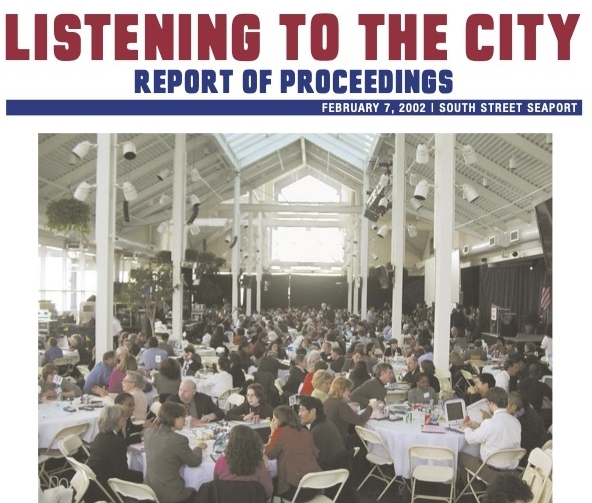
Above is the cover of the report prepared for the first Listening to the City event, held in February 2002. It included 600 participants. Link to report.
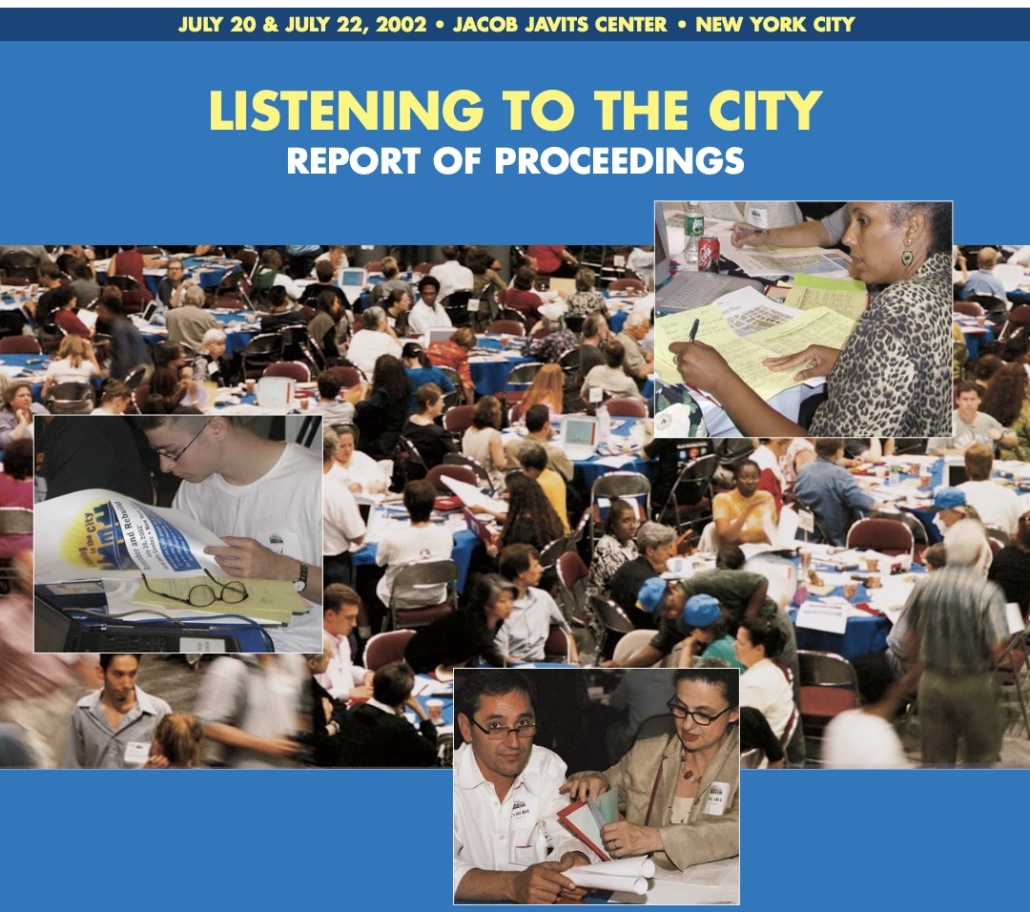
Above is cover of the report prepared for the second Listening to the City event, held in July 2002. Link to report.
At the July event, a broad set of principles was adopted for rebuilding the WTC and Lower Manhattan. Participants in this event included top level representatives of the governor and mayor, and the heads of the Lower Manhattan Development Corporation, Port Authority, Metropolitan Transportation Authority and other public agencies, along with all of the region’s print, broadcast and nascent electronic media.
Veteran Daily News reporter Pete Hamill summed up the meaning of this event in his column on July 22, 2002. He said, “All around this vast room, you heard citizens saying politely to others, ‘What do you think?’ and then listening, actually listening, to the replies. In this room ‘I’ had turned to ‘we’ …and it was absolutely thrilling.” He also wrote: “At each table, they debated in a sober, thoughtful, civil way. We have a word for what they were doing. The word is democracy.”
Among the principles agreed upon at this event were the following:
- The new WTC should be rebuilt with a broader set of activities and functions than its predecessor, including residential, cultural, retail and other activities and a museum commemorating the attack and people who died there;
- The WTC site should be re-integrated physically and functionally into the life of Lower Manhattan, and to the extent possible the pre-existing street grid should be re-established;
- The new WTC should be organized around a solemn memorial and public plaza;
- Rebuilding plans should encompass the entire district and its disparate residents, including those from the Financial District, Tribeca, Lower East Side and Chinatown; and,
- The district’s 11 subway lines and the PATH trans-Hudson rapid system should be rationalized in a new downtown transportation hub.
Outcomes
And for once, the public officials in the room listened and acted on these consensus recommendations —up to a point. That point was the lease to the WTC that developer Larry Silverstein had signed only six weeks prior to the terrorist attack. This lease never anticipated destruction of the entire complex, but nonetheless the developer and officials at the Port Authority and Lower Manhattan Development Corporation (the agency established by New York State to help plan and coordinate the rebuilding process) insisted on honoring Silverstein’s lease. This meant that the rebuild complex would be largely dominated by commercial office space.
However, the Civic Alliance —working closely with City officials— did succeed in convincing the Lower Manhattan Development Corporation to incorporate the transportation center, performing arts center, museum, memorial plaza, hotel, retail, church and other activities on an enlarged WTC site —making the new WTC much more than the isolated office park that its predecessor had been.
Looking Back A Quarter Century Later
In the immediate aftermath of the attacks, the Lower Manhattan business district lost nearly 60,000 jobs and 13 million square feet of office space —which could easily have become a permanent loss in the absence of these investments. It was also feared that if this trend continued the district could lose a critical mass of jobs in what had long been the city and metropolitan region’s second largest employment center. In the aftermath of the attacks, Lower Manhattan also lost thousands of residents who relocated to other parts of the city and region, reversing a population increase in the area that had begun decades earlier
The transportation investments proposed by RPA and the Civic Alliance played an important part in the larger effort to restore confidence in the long-term viability and attractiveness of Lower Manhattan as an employment and residential center. The rebuilt WTC site, and its pedestrianized street grid and memorial plaza have become vital public spaces that are fully incorporated into the life of the district, contrasting with the former windswept but mostly empty WTC plaza. The Center’s elegant new transportation center and its Santiago Calatrava-designed head house and retail activities have become a major tourist attraction, in addition to serving tens of thousands of daily commuters and Downtown residents.
And the MTA’s nearby Fulton Center has eased transfers among nine subway lines, creating a focal point for one of the region’s largest transit hubs. It should be noted, however, that the planned PATH transit extension to Newark Airport —which would provide a one-seat train ride from Lower Manhattan to the Airport—was deferred after years of bureaucratic delay. And our proposal to extend the Second Avenue Subway south to the Fulton Center has been quietly dropped by the MTA.

Photo, above, of the Fulton Center. The complex integrates five subway stations serving nine lines. Photo Credit: Ajay Suresh per Wikimedia.
 Interior of the spectacular World Trade Center Transportation Hub. Photo Credit: Anthony Quintano per Wikimedia.
All of these investments have sustained Lower Manhattan’s role as a major employment center, with a stronger and more diversified economy than it had prior to 9/11. While total employment in the district is now about 233,000, a reduction of 37,000 from the pre-9/11 level, the district has gained employment in business services, technology, hospitality, tourism, health care and personal services, while firms in financial services have continued their long-term exodus to Midtown Manhattan. However, importantly, a critical mass of major financial institutions, including the Federal Reserve Bank of New York, New York Stock Exchange, Goldman Sachs, American Express, Bank of New York, Citigroup, S&P Global, New York Mercantile Exchange and Moody’s all remain in the district.
An even more important transformation has occurred in the district’s role as a residential center. While Lower Manhattan had under 35,000 residents prior to 9/11, today more than 70,000 residents live there —more than doubling the district’s population. This growth in population has been accompanied by an increase in retail, education, tourism and other activities, creating more vital street life and making the district a 24-hour activity center. This is in strong contrast to the formerly empty streets that predominated after 6 pm on weekdays and weekends before 9/11.
In summary, transportation investments made since 9/11 and first proposed by Regional Plan Association and the Civic Alliance to Rebuild Downtown New York have played an important part in larger efforts to rebuild the World Trade Center and to sustain Lower Manhattan’s historic role as a vital employment hub for the Tri-state metropolitan region.