New Report Charts a Path to Lower Bus Costs, Improve Quality, and Speed Delivery
To help transit agencies purchase better buses at lower cost with shorter delivery times, Eno and CALSTART released a new report, today: “Customization, Competition, and Costs: Findings and Recommendations for the U.S. Transit Bus Industry.” Early reactions to the report appear at the bottom of this article.
| The Brookings Institution is hosting an event on June 25 with U.S. Representative Maxwell Alejandro Frost and industry leaders to discuss the report and related issues. You can attend in person or online via this event registration link. |
The Problems
The U.S. has a shrinking number of bus manufacturers. The problem is especially acute for 60-foot articulated buses and trolley buses, since only one U.S. company currently manufactures them. A market with a shrinking number of manufacturers and suppliers, and too little volume, leaves transit agencies more vulnerable to price increases, delivery delays, supply chain disruptions, and the loss of technical support and replacement parts.
This report also focuses on another problem: customization. It is one of the most important but least understood factors shaping the U.S. transit bus market. Unlike automobiles, which are produced in large volumes with limited variation, U.S. transit buses are often manufactured in small batches to meet agency-specific requirements.
Transit agencies customize nearly every aspect of a bus, from screws to seating configurations. Customization is not inherently bad. A bus that works well in one region may not meet the needs of another. The issue is that transit agencies are specifying so many non-standard components that manufacturers must manage more engineering work, more suppliers, more parts, and more risk. These inefficiencies are ultimately reflected in higher bus prices, quality issues, and longer delivery times.
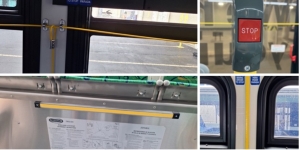
Instrument panels are customized.

Agencies prefer a variety of ways for customers to request the next stop (pull cord, stop button, and touch strip).
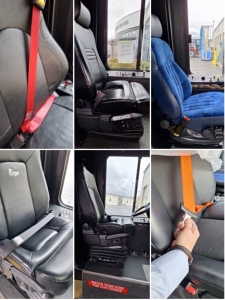
Agencies have detailed specifications about seats (including color, fabric, and type).
Customization is not inherently bad. A bus that works well in one region may not meet the needs of another. Transit agencies in Phoenix, Boston, and San Francisco must account for very different climates and topographies. Agencies also have legitimate reasons to specify bus components already used in their existing fleets: consistency can lower inventory costs, minimize additional training requirements, and make new buses easier to integrate with an agency’s existing hardware and software systems.
Reasonable agency-level decisions are creating large industry-wide costs. When transit agencies specify non-standard components, manufacturers must manage more engineering work, more suppliers, more parts, and more risk. Manufacturers often must adjust tools, materials, and work processes throughout production to reflect each agency’s specifications. That slows down production and increases the likelihood of errors.
These inefficiencies are ultimately reflected in higher bus prices, longer delivery times, and quality issues. They can also lead to fewer bids and a market that is harder for new manufacturers to enter. Customization creates another, less visible problem: it reduces demand for more standardized products, making it harder for industry to achieve economies of scale.
Solving the Problems
Resources already exist to help reduce procurement burdens and encourage more standardized approaches. The American Public Transportation Association publishes the Standard Bus Procurement Guidelines, commonly known as the White Book, which suggests model specifications, as well as model terms and conditions, for federally funded bus purchases. State contracts allow agencies to purchase buses without issuing their own requests for proposals.
But these resources have not been sufficient to minimize unnecessary customization. Many agencies understand the benefits of standardization but remain skeptical of it. They worry that standardization could increase maintenance and training costs, or force them to accept components that have not worked well in their fleets. As one interviewee put it, “Everybody wants a standard as long as it’s their standard.”
The bus market’s structure in the U.S. makes these problems especially difficult to solve. The U.S. transit bus market is small compared with the automobile industry; fewer than 5,000 heavy-duty transit buses are sold in the U.S. in a typical year compared to nearly 16 million cars, SUVs, and light trucks. It is further divided by bus length and propulsion type (diesel, compressed natural gas, hybrid electric, battery-electric, and hydrogen fuel cell buses).
The research team’s pricing analysis shows changes in bus prices over time and how these prices vary by propulsion type. Between 2015 and 2025, transit agencies paid a median price of $501,000 for diesel buses, $553,000 for CNG buses, $727,000 for diesel-hybrid buses, and $995,000 for battery-electric buses (these prices are normalized to 2023 dollars). While the team’s procurement dataset cannot isolate the cost of individual specifications, it does highlight the importance of improving price transparency and making procurement data easier to compare across agencies and vendors.
Other countries have figured out how to purchase buses at lower costs. For example, Italy’s national purchasing center is paying about $900,000 for a battery electric bus, while San Francisco’s Muni is paying about $1.4 million. Likewise, when five cities in India jointly purchased buses, they found the price difference was more than 30 percent lower than other bids for similar buses in India received during that time.
Less customization and larger bus orders work together to reduce bus costs. In Europe, many cities outsource bus operations and procurement to private operators, which often have greater purchasing power and can purchase the same or similar buses for use across multiple cities and countries. European manufacturers also benefit from greater economies of scale because the European bus market is about nine times larger than the U.S. market.
This report does not recommend eliminating all customization or creating a one-size-fits-all bus. Instead, it presents the following six broad recommendations to reduce unnecessary transit bus customization, lower costs, improve delivery, and strengthen competition in the U.S. bus manufacturing market.
- Federal Transit Administration (FTA) should help agencies build stronger procurement capacity through education, training, and workforce development.
- FTA should increase transparency in pricing and its programs.
- FTA should require agencies to disclose major departures from standard practice and summarize their cost implications.
- Congress and the U.S. Department of Transportation should support ongoing industry standardization efforts and advance new initiatives to develop bus, technology, and interface standards.
- Federal laws and policies should give transit agencies financial incentives to purchase more standardized buses.
- Other promising policy options should be explored in future research.
These recommendations are complementary and intended to work together. Education and transparency will provide agencies with information they need to make more informed procurement decisions. Disclosure requirements will encourage agencies to identify and justify major departures from standard practice. Developing shared specifications will create common standards for buses, while changes in federal law will reward agencies that adopt those standards and use more efficient procurement approaches. The report identifies other policy options that are promising but require further research and analysis.
The U.S. transit bus market is too small and fragile to absorb unnecessary complexity indefinitely. As buses become more technologically complex, if left unchecked, customization is likely to become more extensive, and its consequences more significant. Since no single entity can solve the problem alone, implementing these recommendations will require coordinated action by Congress, U.S. Department of Transportation, Federal Transit Administration, American Public Transportation Association, transit agencies, and manufacturers.
| Link to Full Report |
Early Reactions to the Report
“As someone who cares deeply about the health of American transit, I found this report to be an invaluable resource. It approaches a difficult subject with rigor and balance, and its recommendations offer practical, achievable steps that can benefit every stakeholder in the industry — from the smallest transit agency to the largest manufacturer.” Buddy Coleman, Chief Customer Officer at Clever Devices
“It was an honor to work with industry and academic leaders to identify the drivers of rising bus costs and develop actionable recommendations. While the issue is complex, the report outlines a clear path forward, grounded in transparency and consistent reporting to help decision makers identify cost drivers and incentivize standardization. This approach is especially effective when paired with future assessments of the impact of implemented actions and further refinements, as necessary.” Omar Elmessalamy, Director of Equipment Design and Engineering at NJ Transit
“This report offers a timely and practical perspective on one of the key considerations shaping the U.S. transit bus industry: how customization influences cost, competition, and delivery. Drawing on insights from both transit agencies and manufacturers, it highlights actionable steps toward more consistent and cost-effective procurement approaches. The result is a well-grounded resource that can help leaders at the federal, state, and local levels better align bus transit investments to deliver meaningful outcomes for the traveling public.” K. Jane Williams, Senior Vice President, HNTB (and former senior advisor at the U.S. Department of Transportation and FTA acting administrator)
This report reflects a significant and thoughtful effort, led by Eno, to address the critical issue of customization in the transit bus market. I appreciate the collaboration that went into producing such a timely and valuable contribution.” Leroy Jones, Executive Vice President and Chief Operating Officer at Washington Metropolitan Area Transit Authority
While the number of transit vehicles purchased in the United States in any given year is relatively small, each purchase is complex for a variety of reasons. The research shows that customization is required to some extent to meet local needs and, at the same time, needs to be done strategically so that costs can be managed. This research takes a close look at this complexity and offers valuable recommendations to make these purchases more efficient and cost effective.” Doran J. Barnes, Chief Executive Officer at Foothill Transit
The health and welfare of transit bus manufacturing in the US is critical to meeting the ongoing need to provide safe, clean, reliable, and comprehensive public transportation services. Increasing capital and operating costs have caused agencies to cut back on transit service, which is counter to their mission and the public good. This report provides an understanding of the complexities that impact bus costs and the challenges of changing the current system to reduce costs. Industry stakeholders should carefully consider the findings and recommendations identified in the report as a step toward implementing change for market stabilization and the health of the nation’s public transportation systems. Stephen Clermont, Managing Director of Planning & Deployment at Center for Transportation and the Environment
Having worked across transit manufacturing, fleet operations, and aftermarket support, I have seen firsthand how excessive customization drives cost, complexity, and delivery risk. The recommendations in this report provide a practical roadmap to improve affordability, reliability, and competitiveness for transit agencies and manufacturers alike. John Walsh, Advisor at Power Parts and former President of PhoenixEV
This report is a valuable contribution to the discussion on how to improve efficiency, transparency, and competitiveness in the U.S. transit bus market. While Nova Bus closed its U.S. manufacturing facility in 2025, we continue to actively supply buses and support customers throughout the United States from our Canadian operations. This reflects the highly integrated nature of the North American bus industry. We strongly support the report’s focus on more consistent procurement practices and greater standardization as key enablers of a stronger and more sustainable market.” Christos Kritsidimas, Vice President at Nova Bus
We have heard from transit leaders across the country that the rising costs of buses and delays in delivery represent a real threat to the industry — making it more difficult to maintain a state of good repair and ultimately hurting their ability to provide affordable and reliable service. We are grateful for Eno’s efforts to shine a light on this issue and present solutions to get to the heart of the problem. Ed Redfern, Executive Director of the Bus Coalition