
Lyndon B. Johnson (1963-1969) Launching Dreams: How LBJ’s Vision Empowered My Journey
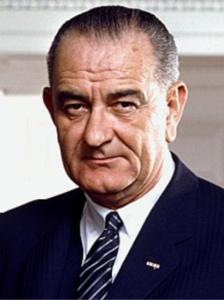
President Johnson’s official portrait.
Lyndon B. Johnson (1963-1969)
Launching Dreams: How LBJ’s Vision Empowered My Journey
By Charles F. Bolden Jr.
As I look back on my life and career, one event stands out as the turning point: the day I received my nomination to the U.S. Naval Academy. At that time, South Carolina, my home state, was still very much entrenched in segregation. No Congressman or Senator from my state was willing to nominate me for the Naval Academy simply because of the color of my skin. It was a harsh reminder of the systemic barriers that existed for Black Americans, even those of us aspiring to serve our country.
Knowing that I was also eligible for a Vice- Presidential appointment to the Academy, I had been writing to Vice President Lyndon Johnson since my sophomore year in high school in hopes that he would provide me an appointment. This dream was crushed on November 22, 1963, when I learned that President John Kennedy had been assassinated; Lyndon B. Johnson was now President of the United States, and I wasn’t eligible for a Presidential appointment.
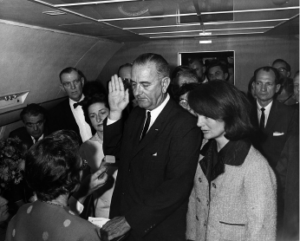
Johnson sworn in as president, two hours after Kennedy’s assassination. Standing on his left, Kennedy’s widow looks on somberly.
Yet, my path took a monumental turn when I decided to write directly to President Johnson. I was just a teenager with a dream, hoping that someone, somewhere, would see the potential in me. That someone was President Johnson who took a personal interest in my letter and decided to send a retired federal judge, Judge Bennett of Washington, DC, around the country in pursuit of young Black and Hispanic students who could qualify for appointments to the service academies.
At the same time, a Navy recruiter mysteriously appeared at my door and asked if I was the young man who wanted to go the Naval Academy. The next thing I knew, I received a nomination from a congressman in Chicago, Representative William Dawson (D-IL). That singular act by President Johnson to get the ball rolling, in my view, set my future trajectory in ways I could never have imagined.
Although I had no idea I’d end up in the race for transportation to space – the Moon and eventually to Mars – President Johnson had set me on a course I would have never otherwise envisioned.
But why did President Johnson intervene? What made him respond to the plea of a young Black man from South Carolina at a time when racial divisions seemed insurmountable? The answer lies in a broader story – one that stretches beyond my individual experience and taps into the vision President Johnson had for a more just and equitable America.

LBJ and the Civil Rights Movement
Lyndon B. Johnson was, without a doubt, a complex figure. He came from the deeply segregated South, yet his presidency became one of the most transformative periods in the struggle for civil rights in America. The Civil Rights Act of 1964, a landmark piece of legislation, is one of his most enduring legacies. It outlawed discrimination based on race, color, religion, sex, or national origin, dismantling the legal framework that had upheld segregation for generations.
President Johnson’s push for the Civil Rights Act was both pragmatic and deeply moral. He knew the risks it carried politically, especially for a Southern president. Yet, his leadership was driven by a belief that the Nation could not truly progress unless it addressed the injustices faced by its Black citizens and other marginalized communities. The Civil Rights Act did not just benefit Americans of African descent; it laid the groundwork for broader equality across all facets of American society.
For someone like me, a Black teenager in the 1960s, President Johnson’s push for civil rights resonated deeply. It told me that perhaps there was a place for me in the American dream, even if I couldn’t see it at that moment. His actions, although indirect, began breaking down the systemic barriers that had kept people like me from accessing opportunities that were available to others.
A Personal Connection to LBJ’s Legacy
When President Johnson acted on the receipt of my letter – indirectly facilitating my nomination to the Naval Academy, he wasn’t just helping a single individual. He was embodying the principles of his civil rights agenda – creating avenues of opportunity for those who had been historically excluded. I often wonder if my life would have taken the same trajectory without that nomination.
Would I have become a Marine Corps pilot, flying over 100 combat missions in Vietnam? Would I have been selected as a NASA astronaut, or become the first American of African descent to ascend to become the Administrator of NASA? The truth is, without that critical intervention, my life could have been dramatically different.
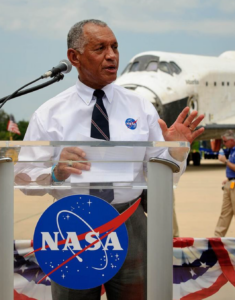
Bolden, NASA administrator, addressing, a crowd in front of the space shuttle Atlantis.
President Johnson’s actions remind me that leadership, at its best, creates possibilities for others. His support for civil rights wasn’t just symbolic; it manifested in tangible opportunities for people like me and countless others. He understood that creating a more just society meant doing more than passing laws; it meant directly and intentionally empowering individuals and communities to break through systemic barriers.
Expanding the American Dream
The ripple effect of LBJ’s efforts cannot be overstated. The Civil Rights Act of 1964 and his broader commitment to civil rights helped open the doors to higher education, professional careers, and public service for marginalized communities across the country. It wasn’t an overnight change, but it was a profound one. For Americans of African descent, women, and other disadvantaged groups, the idea that they, too, could participate fully in the American dream became more than just a dream – it became a real possibility.

Civil rights leaders at a 1964 meeting in the Oval Office with President Johnson. (Martin Luther King, Jr, is seated to the president’s right).
In my role at NASA, I often thought about how far we had come since those early days of the civil rights struggle. When I led the agency, I saw firsthand the diverse and talented individuals who had the opportunity to contribute to space exploration – our most advanced form of transportation today – individuals whose presence in those rooms and on those missions was made possible by the civil rights movements that President Johnson championed.
President Johnson’s legacy is one that, despite its complexities, reminds us of the power of policy to reshape society. The Civil Rights Act didn’t erase prejudice or racism, but it laid a legal and moral foundation upon which future generations could build. It created the conditions for marginalized Americans to rise, contribute, and redefine what it means to achieve the American dream.
A Future Made Possible
As I reflect on my journey – from a young boy in segregated South Carolina to a Major General in the U.S. Marine Corps and a leader at NASA – I see the thread that connects my personal achievements to LBJ’s broader vision for America. His response to my letter was an act of personal leadership, but it was also a reflection of his larger belief that government could and should be a force for good in the lives of all its citizens, regardless of their race or background.
There are countless others like me – men and women who were given the chance to contribute to society, not because the doors were opened easily, but because leaders like President Lyndon B. Johnson helped dismantle the walls that once kept us out. The push for civil rights didn’t just change laws, it changed lives, mine included.
In the end, LBJ’s legacy is not just about the laws he helped pass, it’s about the lives he helped transform. For that, I remain eternally grateful. His actions, both direct and indirect, helped bring me and so many others closer to the American dream and his legacy will always live on in the stories of those of us who benefited from his vision of a more just and equitable society.

Apollo 11 astronauts Neil Armstrong and Buzz Aldrin train for the first manned lunar landing in 1969 at Houston’s Manned Spacecraft Center, now known as the Lyndon B. Johnson Space Center.

Johnson, six months after leaving office, watching the liftoff of Apollo 11 in 1969.
A graduate of the U.S. Naval Academy, Charles Bolden, Jr. flew over 100 combat missions during the Vietnam War. He later served as a test pilot and a NASA astronaut on four Space Shuttle missions, logging over 680 hours in space. He also served as an Assistant Commandant at the Naval Academy, and a Marine Corps Commanding General. In 2009, President Barack Obama appointed Bolden to be the 12th NASA Administrator.
To explore other aspects of President Johnson’s transportation policies, see these collections of documents from the LBJ Library hosted on the Eno website:
Search Eno Transportation Weekly
Happening on the Hill
Related Articles
 https://enotrans.org/wp-content/uploads/2026/03/Debra-Calhoun-lg-header.png
500
2096
Rebecca Higgins
https://enotrans.org/wp-content/uploads/2022/12/Eno-Logo-2.png
Rebecca Higgins2026-03-31 13:28:382026-03-31 15:20:23Making More Visible the Often-Invisible Inland Waterways
https://enotrans.org/wp-content/uploads/2026/03/Debra-Calhoun-lg-header.png
500
2096
Rebecca Higgins
https://enotrans.org/wp-content/uploads/2022/12/Eno-Logo-2.png
Rebecca Higgins2026-03-31 13:28:382026-03-31 15:20:23Making More Visible the Often-Invisible Inland Waterways https://enotrans.org/wp-content/uploads/2026/02/a-boat.jpg
1499
2000
Sohail Husain
https://enotrans.org/wp-content/uploads/2022/12/Eno-Logo-2.png
Sohail Husain2026-03-20 12:41:262026-03-20 12:41:26House Judiciary Committee Meets to Discuss Antitrust Exemption in Maritime Shipping
https://enotrans.org/wp-content/uploads/2026/02/a-boat.jpg
1499
2000
Sohail Husain
https://enotrans.org/wp-content/uploads/2022/12/Eno-Logo-2.png
Sohail Husain2026-03-20 12:41:262026-03-20 12:41:26House Judiciary Committee Meets to Discuss Antitrust Exemption in Maritime Shipping https://enotrans.org/wp-content/uploads/2026/03/Screenshot-2026-03-06-133311.png
595
709
Rebecca Higgins
https://enotrans.org/wp-content/uploads/2022/12/Eno-Logo-2.png
Rebecca Higgins2026-03-06 15:30:262026-03-06 15:30:26Tracking Transportation Impacts from Military Engagement in Iran
https://enotrans.org/wp-content/uploads/2026/03/Screenshot-2026-03-06-133311.png
595
709
Rebecca Higgins
https://enotrans.org/wp-content/uploads/2022/12/Eno-Logo-2.png
Rebecca Higgins2026-03-06 15:30:262026-03-06 15:30:26Tracking Transportation Impacts from Military Engagement in Iran https://enotrans.org/wp-content/uploads/2026/02/Shipbuilding.jpg
1500
2000
kferrell
https://enotrans.org/wp-content/uploads/2022/12/Eno-Logo-2.png
kferrell2026-02-20 15:27:242026-02-20 15:27:24Trump Envisions “Maritime Golden Age” through Investments, Fees, and Deregulation
https://enotrans.org/wp-content/uploads/2026/02/Shipbuilding.jpg
1500
2000
kferrell
https://enotrans.org/wp-content/uploads/2022/12/Eno-Logo-2.png
kferrell2026-02-20 15:27:242026-02-20 15:27:24Trump Envisions “Maritime Golden Age” through Investments, Fees, and Deregulation https://enotrans.org/wp-content/uploads/2025/12/Coast-Guard.jpg
1414
2121
kferrell
https://enotrans.org/wp-content/uploads/2022/12/Eno-Logo-2.png
kferrell2025-12-19 14:59:172025-12-19 15:48:29The Coast Guard’s Ongoing Experience with New Technology
https://enotrans.org/wp-content/uploads/2025/12/Coast-Guard.jpg
1414
2121
kferrell
https://enotrans.org/wp-content/uploads/2022/12/Eno-Logo-2.png
kferrell2025-12-19 14:59:172025-12-19 15:48:29The Coast Guard’s Ongoing Experience with New Technology https://enotrans.org/wp-content/uploads/2025/10/maritime.jpg
1498
2000
kferrell
https://enotrans.org/wp-content/uploads/2022/12/Eno-Logo-2.png
kferrell2025-10-24 15:18:312025-10-24 16:18:01Senate Commerce Committee Holds Hearing on Maritime-Related nominations
https://enotrans.org/wp-content/uploads/2025/10/maritime.jpg
1498
2000
kferrell
https://enotrans.org/wp-content/uploads/2022/12/Eno-Logo-2.png
kferrell2025-10-24 15:18:312025-10-24 16:18:01Senate Commerce Committee Holds Hearing on Maritime-Related nominations https://enotrans.org/wp-content/uploads/2025/09/Maritime-Fuel-scaled.jpg
1440
2560
kferrell
https://enotrans.org/wp-content/uploads/2022/12/Eno-Logo-2.png
kferrell2025-09-12 16:10:312025-09-12 16:10:31Maritime Decarbonization – US Moves Pale Next to IMO’s
https://enotrans.org/wp-content/uploads/2025/09/Maritime-Fuel-scaled.jpg
1440
2560
kferrell
https://enotrans.org/wp-content/uploads/2022/12/Eno-Logo-2.png
kferrell2025-09-12 16:10:312025-09-12 16:10:31Maritime Decarbonization – US Moves Pale Next to IMO’s https://enotrans.org/wp-content/uploads/2025/05/cargo-theft-scaled.jpg
1707
2560
kferrell
https://enotrans.org/wp-content/uploads/2022/12/Eno-Logo-2.png
kferrell2025-05-02 14:42:202025-05-02 16:00:17Roundtable: Combatting Cargo Theft: Stakeholder Perspectives
https://enotrans.org/wp-content/uploads/2025/05/cargo-theft-scaled.jpg
1707
2560
kferrell
https://enotrans.org/wp-content/uploads/2022/12/Eno-Logo-2.png
kferrell2025-05-02 14:42:202025-05-02 16:00:17Roundtable: Combatting Cargo Theft: Stakeholder Perspectives  https://enotrans.org/wp-content/uploads/2025/04/Shipbuilding.jpg
1500
2000
Jeff Davis
https://enotrans.org/wp-content/uploads/2022/12/Eno-Logo-2.png
Jeff Davis2025-04-11 15:28:302025-05-01 11:38:19Trump Signs Shipbuilding Executive Order
https://enotrans.org/wp-content/uploads/2025/04/Shipbuilding.jpg
1500
2000
Jeff Davis
https://enotrans.org/wp-content/uploads/2022/12/Eno-Logo-2.png
Jeff Davis2025-04-11 15:28:302025-05-01 11:38:19Trump Signs Shipbuilding Executive Order https://enotrans.org/wp-content/uploads/2023/02/port-authority-of-new-york-and-new-jersey-freight-maritime-sea-scaled-2.jpg
1707
2560
Jeff Davis
https://enotrans.org/wp-content/uploads/2022/12/Eno-Logo-2.png
Jeff Davis2025-02-07 14:14:262025-02-07 14:14:26House Maritime Subcommittee Sets Sail into 119th
https://enotrans.org/wp-content/uploads/2023/02/port-authority-of-new-york-and-new-jersey-freight-maritime-sea-scaled-2.jpg
1707
2560
Jeff Davis
https://enotrans.org/wp-content/uploads/2022/12/Eno-Logo-2.png
Jeff Davis2025-02-07 14:14:262025-02-07 14:14:26House Maritime Subcommittee Sets Sail into 119th https://enotrans.org/wp-content/uploads/2023/01/cargo-supply-chain-freight-port-maritime-boat-shipping.jpg
1396
2146
Jeff Davis
https://enotrans.org/wp-content/uploads/2022/12/Eno-Logo-2.png
Jeff Davis2024-12-13 14:24:142024-12-13 14:24:14Water, Defense/Maritime Bills Advance in House
https://enotrans.org/wp-content/uploads/2023/01/cargo-supply-chain-freight-port-maritime-boat-shipping.jpg
1396
2146
Jeff Davis
https://enotrans.org/wp-content/uploads/2022/12/Eno-Logo-2.png
Jeff Davis2024-12-13 14:24:142024-12-13 14:24:14Water, Defense/Maritime Bills Advance in House https://enotrans.org/wp-content/uploads/2023/02/inland-waterways-water-ohio-river-dam.jpg
1413
2121
Jeff Davis
https://enotrans.org/wp-content/uploads/2022/12/Eno-Logo-2.png
Jeff Davis2024-12-06 13:45:112024-12-06 13:45:11Biennial WRDA Bill Transfers $2B in Unused Highway TIFIA Funding to States
https://enotrans.org/wp-content/uploads/2023/02/inland-waterways-water-ohio-river-dam.jpg
1413
2121
Jeff Davis
https://enotrans.org/wp-content/uploads/2022/12/Eno-Logo-2.png
Jeff Davis2024-12-06 13:45:112024-12-06 13:45:11Biennial WRDA Bill Transfers $2B in Unused Highway TIFIA Funding to States
