Highway Construction Costs Stayed Stable in Final Quarter of 2025
The Federal Highway Administration recently updated its estimate of changes in highway construction costs, showing that such costs decreased by 2.2 percent in the October-December 2025 quarter (based on the prior quarter), but on a seasonally adjusted basis, costs increased by 1.2 percent. Either way, it represented a stabilization from the rapid growth in that index from 2021 to 2024.
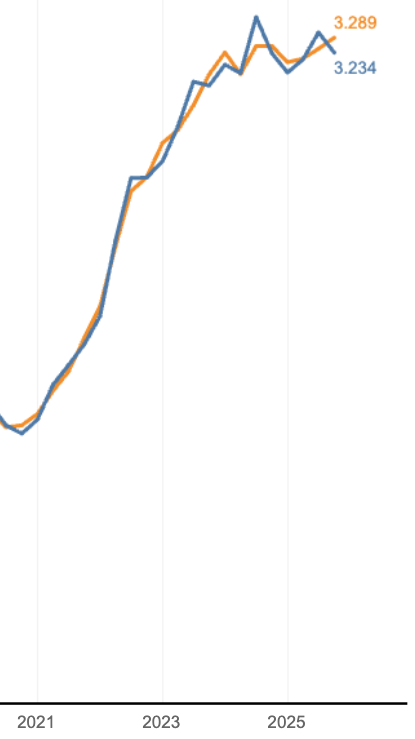
NHCCI. The blue line is raw and the orange line is seasonally adjusted.
The National Highway Construction Cost Index (NHCCI) was set at 1.0000 in the January-March 2003 quarter.It took 18 years for the raw NHCCI to go from 1.0 to 2.0 (the April-June 2021 quarter), but at that point it began accelerating so that it crossed the 3.0 threshold just 27 months later, in the July-September 2023 quarter. It peaked at 3.3079 in the July-September 2025 quarter.
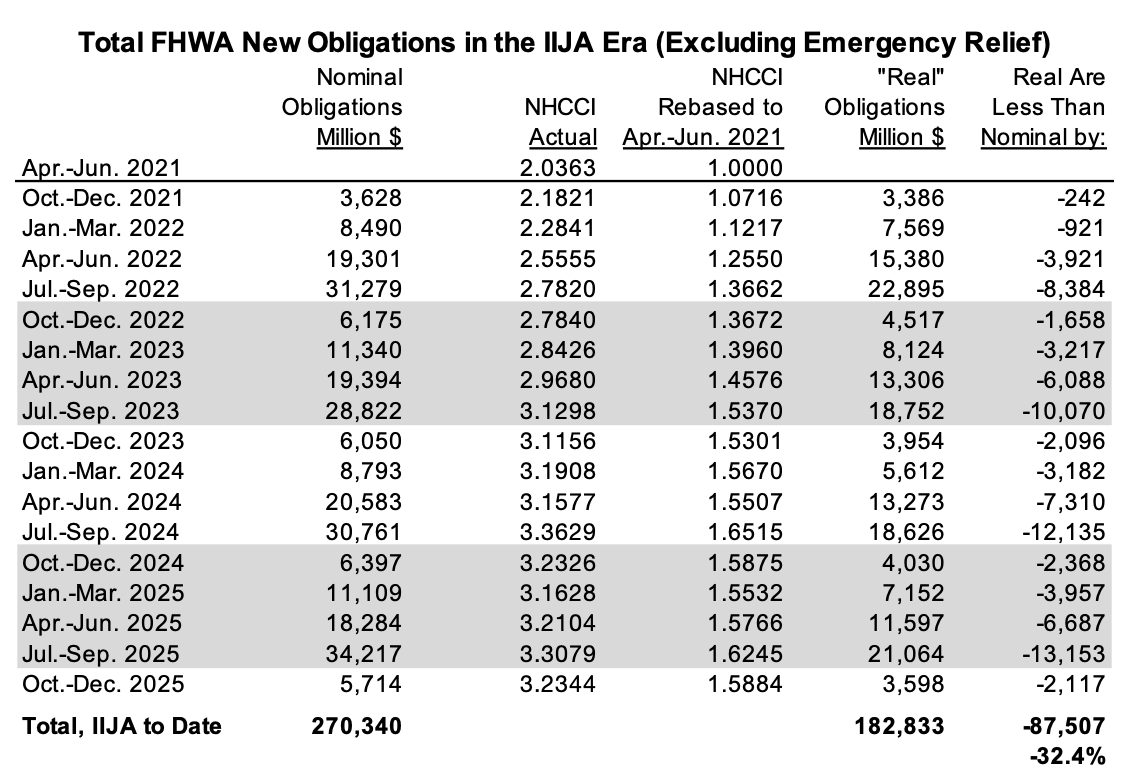
But looking back, in the April-June 2021, NHCCI had doubled to 2.0363, and by coincidence, that quarter was when the Senate was cutting the deals on the size of the spending package in the IIJA infrastructure law, so it provides a useful point to “re-base” our own index. If we re-base in April-June 2021 and use that as the starting point for lost value of IIJA highway funding dollars (based on what Senate leaders and the White House thought they were spending in the bill), the raw cost index has risen 58.8 percent since that time (from a rebased 1.0000 to the October-December 2025 adjusted 1.5584).
That allows to update our table and translate percentage changes in the index to actual dollars lost. The actual amount of new spending obligations incurred (contracts and project agreements signed) by FHWA is available on usaspending.gov. Under the IIJA to date, there have been $270 billion in such FHWA obligations (excluding the emergency relief program).
But once you reduce each quarter’s spending level by the amount that NHCCI has risen since the IIJA was written, the total amount of obligations drops below $183 billion, a reduction of $87.6 billion, or 32 percent, of the buying power of the funding provided to FHWA by the IIJA to date.
We expect the NHCCI to move significantly in the next two updates, which will reflect higher crude oil prices from the Iran War and thus large jumps in the NHCCI components for diesel fuel and for asphalt pavements.