Great Managers Share Their Insight on Delivering High Stakes Projects
Talented and experienced managers are essential to keeping large transportation projects on schedule, controlling costs, and meeting stakeholder expectations. At an Eno webinar this week, three accomplished transit agency executives – Richard Clarke, Peter Rogoff, and Alicia Vap – discussed the challenges project managers face and the skills, experience, and support needed to succeed. (The webinar was held in conjunction with the release of Eno’s report, The People Behind Major Transit Projects: Recruiting, Training, and Retaining Project Managers.)
Richard Clarke
 Richard Clarke, former chief program management officer at LA Metro and assistant general manager at Denver’s Regional Transportation District, emphasized the importance of selecting a highly experienced and skilled leader to manage major projects.
Since a 10 percent overrun on a billion-dollar project is $100 million, Clarke explained that even a modest cost overrun can create severe financial pressures for transit agencies. While most project managers and their teams are generally technically competent, he noted that many of them need to hone their soft skills such as those relating to decision-making, negotiating, and risk assessment.
Because project managers interact with a wide range of stakeholders, Clarke stressed the importance of developing strong communication skills. He referred to local jurisdictions, project team members, other internal agency departments, the public, chief executive officers (CEOs), agency boards, city councils, contractors, and consultants — each of whom can determine whether a project succeeds or fails.
Clark noted that a major constraint in a transit agency’s ability to recruit and retain staff is its capacity to maintain a stable pipeline of capital projects. He said, “Given the career risks being taken by project employees, agencies need to ensure that adequate compensation and incentives are in place to retain them.”
Peter Rogoff
 Peter Rogoff, principal at Contorta Group, served as administrator of the Federal Transit Administration under President Barack Obama. From 2016 to 2022, he was chief executive officer of Seattle’s Sound Transit, the agency undertaking the most ambitious transit expansion in the country.
Rogoff said, “Everyone needs to remember that once you get out of planning and well along in design with a contractor on board, there is a very expensive meter running all the time. The challenge is to keep that meter from running out of control.” He warned, “Cost growth may have to be tolerated for a variety of reasons but runaway costs speak to systemic failures.” He recommended the following steps to avoid these failures:
- Ensure up-to-date and accurate flow of information across all corners of the project team.
- Prevent decisions from languishing at any level.
- Bring together talent across an entire project team to solve major project challenges.
- Quash the concept of the project hand-off. Every part of the project team should be responsible for the cost effective and timely delivery of the project from beginning to end.
- Staff who only want to execute their small part of the project and not identify with the goals of the entire project team “should be invited to work elsewhere.”
Alicia Vap
 Alicia Vap is the project director for the Blue Line light rail extension project at Metro Transit in Minneapolis.
Vap said project managers need to be experienced jugglers. “First and foremost, your role in leading large, complex projects is to provide confidence to your leaders, elected officials, staff, and industry contractors while juggling the hundreds of balls in the air that keep large, complex projects advancing. Community outreach, real estate, utilities, political support, funding, contracting – these are all critical balls to keep moving while making decisions to keep the project moving forward.”
She said it is important to “be decisive and stand behind your decisions.” Referring to costly delays, she admitted, “I feel like we all learned early in our careers to be decisive, the hard way.” She added, “At the end of the day your ability to make a decision is critical to your project’s success and confidence of your team.” Another way to instill confidence is by admitting mistakes. Vap noted, “It’s hard to do, it’s not pleasant, but it’s important for maintaining trust with your team and leaders.”
According to Vap, “project managers need to read the tea leaves. It takes experience and practice, but being able to think strategically and read the room is a critical skill. Pay attention to local elections, read the local newspapers, and develop relationships with your stakeholders.”
CEO’s Role
Clarke said, “The agency’s CEO is an important part of your team. The CEO may need to engage in solving major issues, especially those involving boards and elected officials. He warned, “Make sure you are transparent with the CEO and keep them involved in the project; there should be no major surprises.”
Emphasizing the importance of agency leaders, Clarke said, “There will be times when they have to go to bat for you, so you need to maintain their support, keep the information flowing up, and know what level of information they need.” Echoing Clarke’s advice, Vap said, “Never let them hear of bad news from a reporter but hear from you.”
Rogoff said CEOs must fully appreciate that they — not just their project managers — are responsible for delivering projects on budget and on time. He recommended that CEOs speak candidly with the public, elected officials, and board members about difficult project tradeoffs on the horizon. He said CEOs must not be baited into making false promises about recouping lost time or staying within budget. “You can’t spend down contingency and project float three times over,” he explained.
Rogoff added, “It is impossible for the CEO to overcommunicate with impacted local officials on project progress.” He noted that the mayor should hear about lane closures directly from the CEO at the same time city staff hear about them from the project team.
Recognize Your Rock Stars
When an agency wants to find the right project manager, Clarke said looking within one’s own agency has many benefits. “They know the people, culture, and processes of the agency and local area.” He added, “If you can grow the talent in-house, that’s probably the way I would prefer because those people know the culture of the agency and the stakeholders. They know how to get things done.” He continued, “It’s critical to recognize your rock stars and advance them.
Rogoff said when he was Sound Transit’s CEO, “It was rather common for people within the organization to recognize rock stars and steal talent from different lines of business. I would have executive directors come into my office and periodically complain that some other executive director had stolen their rock star. I would express my concern and the requisite amount of sympathy, and say that we’re going to do a good job of replacing that person. Then, when the door shut, I would celebrate because I knew the agency benefited massively from people moving through the organization and learning other disciplines.”
Future Project Managers
When asked whether he had any advice for young transportation professionals interested in managing large projects, Clarke said, “I would encourage them to reach out to project leaders and let them know they are interested in moving up and ahead.”
Vap added that when managers talk to younger staff, they should encourage them to say “yes” to opportunities. Sometimes, an opportunity might not appear to be a perfect fit, but it can help someone become more well-rounded. During COVID, when her project slowed down, Vap was assigned to other Metro Transit projects. That turned out to be one of her best experiences at the agency because she learned about upgrading and maintaining the types of facilities she would later construct.
Pay Disparity
One of the challenges that transit agencies face in hiring and retaining talented project managers is their inability to match private sector salaries. Depending on where they live and are willing to go, many project managers can earn 50 percent or more in the private sector compared to the public sector. Rogoff noted that transit agencies constrained by their state government’s pay scales are particularly challenged.
Clarke said, “The transit agencies I’ve been involved with realize that’s a challenge. As a project manager, you know you’re not going to make private sector wages, but if it can be somewhat close, there are offsetting benefits to working at a transit agency.” He noted that consultants are often not involved in the decision-making; that’s a responsibility usually left to agency staff.
Rogoff said public sector staff can take great pride in “delivering a project and being able to drive your kids by the construction site and say, ‘That’s what Mom’s working on’ or ‘That’s what Dad’s working on.’” Vap said, “I would agree that there’s a lot of pride that comes with working for an agency and influencing decision-making. There’s just nothing more rewarding than seeing your project completed when you’re out and about in your community.”
Eno’s New Report
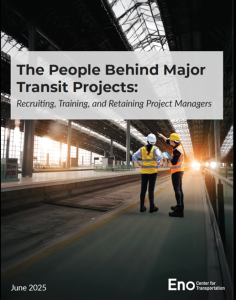
Simultaneously with this webinar, Eno released a new report, funded by the Federal Transit Administration, titled The People Behind Major Transit Projects: Recruiting, Training, and Retaining Project Managers. This report is designed to help agencies more effectively recruit, train, and retain the professionals who manage large transit projects. Not only will it help transit agencies adopt a more strategic approach to hiring, training, and retaining staff, but it can also help future project managers chart their own career paths.
Clarke, Rogoff, and Vap encouraged the webinar attendees to read the report. Many other transportation industry leaders have also praised it:
- Robert L. Lund, former Deputy General Manager at SEPTA, said the report “provides an insightful look into the challenges faced by the nation’s transit agencies.”
- Jeff Paniati, former Executive Director and CEO of Institute of Transportation Engineers (ITE), said it is “a must read for transit agency leaders, funders and stakeholders.”
- Bruce Podwal, author of the book The Engineering Is Easy: Memoir of a Project Manager, said the report “addresses a significant gap in creating the team needed to execute projects.”
- Karen Rae, senior strategic advisor at STV, said “This report offers valuable insights into what drives successful project delivery.”
- Cheri L. Soileau, director of planning and program development at Capital Area Transit System, said “This report serves as a handbook for transit professionals—whether you’re new to the industry or a seasoned expert, and whether you’re hiring project managers or serving as one yourself.”
- Bill Goodrich, former senior vice president at MTA Capital Construction, said “A valuable source for information on how to select, develop, and retain critical personnel for lead project manager positions on large transit projects.”