
FAA Reauthorization of 2024: One Year Later
On Thursday, May 15, the U.S. House Committee on Transportation & Infrastructure met for a hearing entitled, “FAA Reauthorization Act of 2024: An update on implementation one year later.” Members called three long-time career civil servants from the Federal Aviation Administration (FAA) as well as a witness from the Government Accountability Office (GAO) to provide insights on the progress, issues, and impacts of the 2024 FAA Reauthorization.
Witness List
Jodi Baker, Deputy Associate Administrator of Aviation Safety, FAA
Wayne Heibeck, Deputy Associate Administrator of Airports, FAA
Frank McIntosh, Deputy Chief Operating Officer of Air Traffic Organization, FAA
Derrick Collins, Director of Physical Infrastructure, GAO
Overview of the 2024 FAA Reauthorization
The 2024 FAA Reauthorization, passed under the Biden administration, provides $105.5 billion for the FAA through a five-year period between fiscal years 2024 and 2028. Thursday’s hearing comes almost exactly one year after the signing of the reauthorization, which was signed by President Biden on May 16, 2024. The reauthorization includes a host of changes to the FAA and aviation policy. Some of the notable elements of the bill are highlighted below:
Air Traffic Control (ATC) Staffing. The legislation directs the FAA to develop a plan to increase ATC training capacity through increased recruitment, hiring, and retention of instructors. This policy is designed to ensure a sufficient number of fully qualified ATC operators. The bill also directs the FAA to review staffing standards.
Workforce Development. The legislation authorizes $20 million for each of the two existing aviation workforce development grant programs focused on aviation maintenance careers and authorizes $20 million for a third program focused on aviation manufacturing (these are all collectively known as the Aviation Workforce Development Programs). The authorized funding for these programs extends from FY24 to FY28. Beginning in 2027, the Aviation Workforce Development programs will be redesignated as the “Cooperative Aviation Recruitment, Enrichment, and Employment Readiness” (CAREER) Program and the responsibility to administer the program will transfer from the FAA to the Secretary of Transportation.
National Airspace Modernization. The act requires the FAA to close the NextGen office by the end of 2025. This office, which has led the work to modernize the national airspace for the past 15 years, will be replaced by a new Airspace Modernization Office responsible for ongoing upgrades to the National Airspace System (NAS). This new office will focus on building a more information-driven system, increasing automation, and supporting both traditional aircraft (civilian and military) and new technologies like drones and advanced air mobility (AAM).
The act also addresses the need to modernize infrastructure and address aging ATC towers and operations, by providing investments in airport development and ATC operation improvements. Funding is available to smaller airports, helping to better connect rural areas to the national airspace.
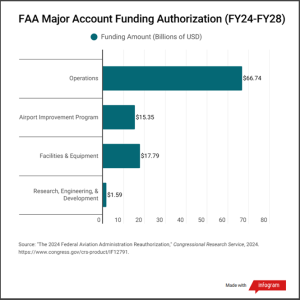
Figure 1 below provides a breakdown of authorized funding for each of the major FAA accounts.
Figure 1. FAA Major Account Breakdown
Insights from the Hearing
Both opening statements from Chair Sam Graves (R-MO) and Ranking Member Rick Larsen (D-WA) set the stage for the general themes heard throughout the hearing: workforce issues, airspace operations and safety, investments in infrastructure, and updates on program implementation. The Chair and Ranking Member wished to use the hearing as an opportunity to learn about the ongoing progress of implementing the 2024 FAA reauthorization. The Chair praised the bipartisan nature of the legislation, and the investments promised to improve the aviation network, including the first General Aviation title. The Ranking Member emphasized the recent incidents at Washington National Airport (DCA) and Newark Liberty Airport to present a sense of urgency in a swift implementation of the law. Additionally, Ranking Member Larsen voiced concern over workforce issues at the FAA in light of the new administration’s federal workforce actions.
Workforce Issues
Several members, including Rep. Henry Johnson (D-GA), Rep. Salud Carbajal (D-CA), and Rep. Laura Friedman (D-CA) voiced concerns about the impact of changing federal workforce policies on the ability of the FAA to implement programs. In February, as part of the firing of probationary employees and the Deferred Resignation program, 400 employees were removed from the approximately 45,000 FAA workforce. With these and other reductions in the federal workforce, the members expressed concern about the FAA’s ability to keep programs running. Baker and Heibeck responded to the concerns noting that some employees at FAA, including air traffic controllers and engineers, were exempt from any of the deferred resignation policies. McIntosh commented that he was not aware of any impacts on the FAA coming from federal workforce policies out of the Department of Government Efficiency.
Rep. Rick Crawford (R-AR) and Rep. Mark DeSaulnier (D-CA) inquired about ATC staffing shortages and what policies exist to expand opportunities at education centers. McIntosh pointed to several policies including a Collegiate Training Initiative, financial incentives, and the proposed ATC reform legislation, introduced by Transportation Secretary Sean Duffy. In early May, Secretary Duffy unveiled a plan to modernize the FAA ATC system by addressing aging infrastructure, installing new ATC towers and updated ATC software, addressing runway safety, and installing weather stations in Alaska.
Airspace Operations
Several members, including Representatives Jerry Nadler (D-NY), Steve Cohen (D-TN), Eleanor Holmes-Norton (D-DC), Scott Perry (R-PA), and Jeff Van Drew (R-NJ), among others, brought up concerns over airspace operations. Comments used the backdrop of recent events at DCA and Newark to inquire about what actions the FAA is taking to improve airspace operations. In response to the in-air collision at DCA, McIntosh noted that the FAA is working to identify facilities that have similar aircraft-helicopter mixed traffic operations and take corrective action to limit any instances where fixed-wing aircraft and helicopters are operating in the same airspace.
Infrastructure Investments
The FAA reauthorization provides funding for investments to improve airport and aviation infrastructure, and the witnesses took the opportunity to expand on what investments these programs are supporting and their progress to date. According to Heibeck, the FAA is moving along with the Airport Improvement Program (AIP). In FY2024, the FAA awarded $3.3 billion in AIP grants. On the air traffic control side, McIntosh pointed to the Tower Simulation System as an important investment in developing a state-of-the-art ATC operation system, where controllers can train in different operating scenarios in the simulation system. For new controllers, the system helps familiarize them with ATC operations and prepare controllers for different events.
Differing Perspectives
The FAA Reauthorization was a significant piece of legislation, that provided a large investment in the nation’s airspace and airport infrastructure. Members were grateful to the witnesses for their efforts in working towards implementing the legislation, but there was general discontent and frustration on the Democratic side. Whether on workforce issues, airspace operations, or infrastructure investments, Democrats consistently voiced their desire for, as Rep. Greg Stanton (D-AZ) put it, a “swift” implementation of the bill.
On the one hand, there was consensus in the room on the need to have an adequate number of trained ATC operators and staff at FAA to implement all the various programs outlined in the reauthorization, but on the other hand, this may be at odds with the federal policies aimed at reducing the federal workforce. For Democrats on the Committee, this was a cause for intense frustration towards the administration and top officials at USDOT and FAA. Rep. Marilyn Strickland (D-WA) made that frustration clear, pointing out that the witnesses were career civil servants and not the top appointed officials like the FAA administrator or Transportation Secretary.
On the Republican side, committee members took a more supportive tone towards the current administration policies regarding both workforce and ATC reform. Holding the hearing following Secretary Duffy’s proposed ATC plan provided an opportunity for Republicans to discuss the ongoing efforts at FAA to implement the 2024 legislation and underscore the value of USDOT efforts in transportation infrastructure. The choice to bring in career civil servants as witnesses was notable, and as mentioned, it was a point of frustration for some Democratic committee members, who would have preferred to conduct oversight of political appointees in the Trump Administration. On the other hand, the testimony of the expert witnesses facilitated understanding of the specifics of different FAA programs and timelines of when projects are getting completed. Members perceived the witnesses as tuned into the implementation process and thus sources of knowledge regarding when projects and studies will be completed. It is clear from the Administration’s new ATC plan, ongoing reductions in staffing, and recent aviation incidents, that despite our being just one year into the 5 year FAA reauthorization bill, there remains much to be done and members are seeking to understand the extent to which current programs in the FAA reauthorization can be used to address recent developments and needs in aviation.