Eno Center Releases Report on Autonomous Vehicles

Earlier this month, the Eno Center for Transportation published a report on autonomous vehicles (AVs), “Shared Roadways, Platforms, and Benefits: Integrating Autonomous Travel Choices.” The paper explores the factors that will shape AV deployment, including costs, market demand, technology conditions, and consumer choices, as well as the policy frameworks and technology company decisions that will also affect outcomes. Autonomous vehicles will be deployed in a variety of forms, both as fleets of robotaxis as well as personally owned vehicles. The paper argues that the effect of deployments on mobility, congestion, and labor will differ widely not only between robotaxis and personal AVs but also based on how robotaxis are deployed, whether on robotaxi-only platforms or on hybrid networks in which autonomous and human-driven vehicles operate together.
The report utilizes historical analogues of the adoption of autonomous and shared technologies to explore the likely shape of adoption for shared autonomous vehicles. Commercial deployment and adoption of technology is a social and economic function, derived from combined factors of technological reliability, functional value, consumer demand and preferences, and costs. New technologies will be deployed most quickly when they offer a compelling improvement in function or cost without requiring major changes in user behavior or business practice.
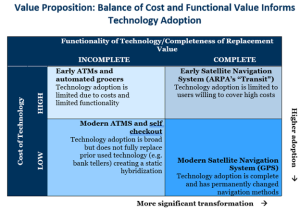
Current technological and economic conditions have allowed for expansion of geofenced robotaxi services in dense urban environments, where companies are competing for riders with other transportation network company drivers and also with transit services. Companies will face high fixed costs of AVs as well as costs to create the necessary digital infrastructure and will seek to recoup investments by maximizing robotaxi operations and minimizing downtime. This will make it difficult for robotaxis to fully meet peak levels of ride demand.
As a result of the different cost structures and functionality, and barring significant change in those costs and capabilities, this paper argues that neither personal AVs nor robotaxis are likely to fully displace personally owned human driven vehicles or human driven taxis and rideshare for some time. Instead, robotaxis, human-driven rideshare vehicles, and personally owned vehicles will share the roadways and each face provide distinct mobility services, and are therefore all likely to persist for some time as complementary rather than fully substitutable modes. The question is not whether these modes will coexist, but how this coexistence is structured. The integration of human-driven and robotaxi fleets on a single network will allow riders to choose between autonomous and human-driven vehicles, maximizing cost competition and expanding rider benefits. Human drivers will also benefit from maintaining access to rider demand in hybrid networks and being able to compete for trips.
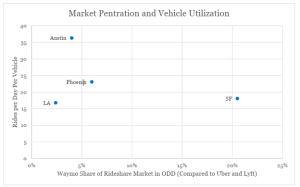
The paper explores early deployments of robotaxis in Phoenix, San Francisco, Los Angeles, and Austin. Cities with active deployments vary in the pace of their AV network growth, but share common patterns: slightly higher costs for autonomous rideshare, longer wait times for AVs relative to human-driven rideshare at peak hours, and continued utilization of human-driven rideshare, whether on a hybrid or separate network. Another consistent theme is the need for collaboration between city officials and AV operators to work through the challenges of integrating autonomous vehicles into existing roadway systems. While San Francisco has the greatest market share and number of vehicles, its number of daily rides per vehicle is comparable to Los Angeles and less than both Austin and Phoenix. Austin, the only representative of a hybrid network, displays the highest number of rides per day per vehicle. In comparison, data from the California Public Utility Commission from the September 2019-August 2020 period indicates that Uber drivers on average provided 15 trips per day and Lyft drivers provided 17 trips per day, working an average of 4-5 hours per day.
The paper also explores the potential impacts of autonomous vehicle adoption on labor, safety, equity, and vehicle miles traveled. Assuming robotaxis are introduced at levels that meet only the baseload of trip demand and not the peak periods of demand, the impact of robotaxi competition will be greatest on that minority of drivers working full time as TNC drivers. This paper argues that human drivers will play a key role in networks with autonomous vehicles, given their ability to respond to changing levels of demand; this flexibility should be supported rather than phased out of existing transportation networks. Decisions about network structures and incentives will determine whether the benefits of autonomous technology are spread across socioeconomic and geographic groups and help to fill in gaps in the existing transportation network.
In addition to exploration of the shape and impacts of robotaxi deployments, the paper explores the potential adoption of personal autonomous vehicles. While personal AVs will likely not be a part of transportation networks in the near and medium term, personal ownership of AVs in the long term has the potential to create large changes to mobility, congestion, and vehicle usages. In contrast to the limited operations of robotaxis within defined ranges, personal AVs will be expected to operate on any public and even non-public roadways, leading the vehicles to encounter more edge cases. Personal AVs will likely require subscription-based systems to cover mapping and remote and on-site assistance to navigate edge cases. Personal ownership of AVs will likely reduce demand for robotaxi services, and the potential dynamic deployment of personally owned AVs on rideshare networks could reduce the demand for human-driven rideshare vehicles.
The report provides policy recommendations to cities and states currently in the process of autonomous vehicle deployments or considering the impact of deployments on their transportation networks. These recommendations include ensuring responsiveness from companies to city officials including through formalized challenges of communication and data reporting based on safety goals. The report also recommends a compensation structure for fleet operators to defray the costs of emergency services provided to AVs in non-emergency scenarios to prevent local services from becoming a backstop for AV companies’ customer support. The report recommends clear expectations for AV driving behavior, at a minimum meeting the standards of roadway stewardship of human drivers, and for limitation of AV deadheading. The report calls for AV companies to design for accessibility and expanded transportation network access, including providing incentives to riders connecting to transit systems.
The outcomes of autonomous vehicle adoptions are not technological inevitabilities but rather stem from economic conditions, technological readiness, existing transportation options, consumer choice, and importantly, policy and design decisions. Decisions around the shape and requirements for deployments will help to ensure that autonomous mobility will promote safety and transportation access to the greatest extent possible.

 House to Vote on FY27 CR Which Does Not Extend IIJA
Scroll to top
House to Vote on FY27 CR Which Does Not Extend IIJA
Scroll to top