Deregulatory Review: DOT Rulemaking under the Second Trump Administration
Within the first two weeks of his second term, President Trump issued a bold promise: for every one new rule his administration promulgated, it would rescind ten existing federal regulations. The unprecedented scale of this deregulatory effort came as part of the government-wide initiative to implement Department of Government Efficiency, or DOGE, recommendations. Departments and agency heads were instructed to “review all regulations subject to their sole or joint jurisdiction for consistency with law and Administration policy” and take steps towards rescinding any rules out of step with administration priorities and not expressly required by statute. Appointees were further encouraged to bypass the standard Administrative Procedure Act using the “good cause” exemption to rescind rules deemed unlawful, in light of recent SCOTUS cases reining back the scope of executive branch regulatory discretion.
This article analyzes how DOT rulemaking efforts have reflected the administration’s deregulatory agenda, first through year-by-year comparisons with previous presidential administrations on the scale of deregulatory rulemaking, and second by unpacking major administrative actions by each DOT Operating Administration (OA). Data proves that the DOT has moved with unprecedented scope and speed during the second Trump administration to roll back federal regulations. However, rulemaking actions have varied widely in their actual significance, ranging from rapid changes to longstanding requirements to simple deletions of outdated and obsolete regulatory text.
Deregulatory Trends across Administrations
The Federal Register’s published list of proposed DOT rulemaking actions allows clear comparison of deregulatory efforts between the second Trump presidency and previous administrations. While there is no universal standard for which actions qualify as ‘deregulatory’, we can identify their approximate scale by filtering the hundreds of proposed DOT rulemaking actions for commonly-used deregulatory keywords. For the purposes of this analysis, we identify actions with the following terms within their Federal Register title or abstract as deregulatory: ‘withdraw’, ‘terminate’, ‘rescind’, ‘remove’, ‘repeal’, ‘deregulate’, ‘burden’, ‘outdated’, ‘unnecessary’, and ‘streamline’. (The FAA is excluded from this analysis, as it releases far more rulemaking actions than other OAs, and most of its proposals focus on technical or highly specific revisions to regulatory standards rather than meaningful policy change.)

Columns represent the number of total DOT rulemaking proposals published during each year of a presidential administration, measured from January 20th through January 19th of the subsequent calendar year.
Looking at the overall annual number of proposed DOT rulemaking actions, we detect a noticeable spike in (de)regulatory proposals during the first year of the second Trump administration. 127 proposals were published during the first year of Trump’s second term alone, more than double the number released during the final year of the Biden administration.
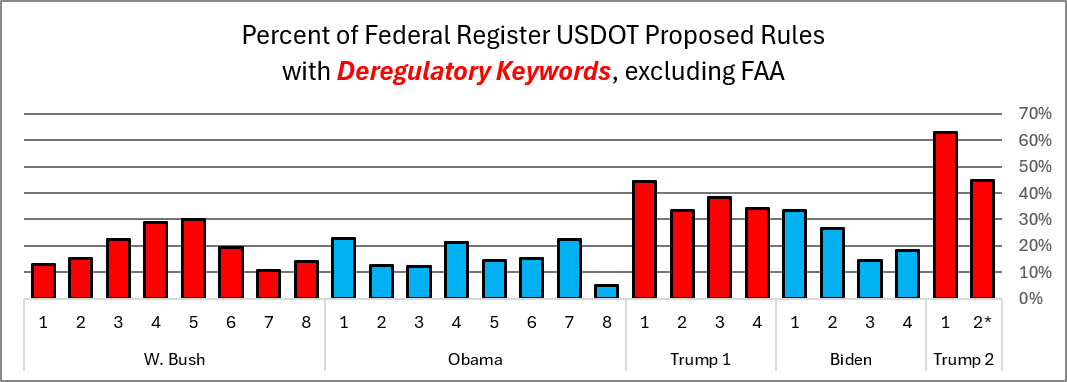
Columns represent the share of DOT rulemaking proposals containing deregulatory key terms, as a percentage.
Separating out those actions featuring the identified keywords, we see a similarly dramatic jump in the share of deregulatory proposals at the very outset of the second Trump administration. During the first Trump administration, deregulatory actions made up between 33% and 44% of DOT proposed rulemaking actions. These levels were maintained during the first year of the Biden administration – perhaps as new DOT leadership sought to reverse Trump-era rulemaking – but decreased significantly over the length of President Biden’s term. However, within the first year of Trump’s second term in office, the share of proposals containing clear deregulatory language surged to 63%, representing a clear majority of rulemaking actions.

The lower section of each column, in bright blue or bright red, represents the number of rulemaking actions including deregulatory keywords. The upper section of each column, in maroon or dark blue, represents the number of rulemaking actions that do not include deregulatory buzzwords.
This departure in federal rulemaking trends becomes even more stark when observing the aggregate number of DOT deregulatory actions. During the first year of the second Trump administration alone, the DOT issued 80 non-FAA rulemaking actions identified as deregulatory. This is, by far, the highest number of such actions taken within a single year over the last twenty-five years, coming in at more than double the runner-up, George W. Bush’s second year in office. In a single year, the second Trump administration released more deregulatory rulemaking actions than either the Biden administration or the first Trump administration published throughout their entire four-year terms.
Under Secretary Duffy, the DOT has certainly striven to follow through with the president’s deregulatory agenda, as set out in executive orders and prior campaign commitments. The surge of actions within the first year of the second Trump administration can likely be attributed to the short-lived efforts of DOGE, preparations made during the president’s four years out of office for day-one action, and the determination of DOT leadership to rescind Biden-era transportation regulations. The pace of deregulation has slowed somewhat more recently: only twelve deregulatory actions have been proposed by DOT during the first half of the Trump administration’s second year back in office. Still, at least 45% of this year’s proposals are clearly focused on deregulation, showing the DOT’s continued focus.
OA Rulemaking
While analyzing trends over time provides valuable insight into the scale of DOT deregulatory efforts, more thorough review is required to determine the true significance of changes to the Code of Federal Regulations (CFR). Examining rulemaking actions by each OA reveals that a surprising number of proposals labeled ‘deregulatory’ simply rescind obsolete text with little to no impact, including long-past phase-in requirements and rules for programs that have not received federal funding in over a decade. Others make minor deregulatory adjustments, such as expanding federal acceptance of electronic documents, consolidating paperwork, or pushing back compliance dates. Some of these efforts may be meant to placate administration pressure to aggressively cut red tape and, more specifically, meet the requirement of ten rules eliminated for each new regulation published.
Still, a fair number of DOT rulemaking actions have significantly overhauled regulatory requirements, including cuts to rules on safety, labor rights, and environmental protections. These efforts include withdrawals of proposed rulemaking processes initiated under the Biden administration, amendments to streamline regulatory text, and proposals to outright rescind both recently implemented and longstanding federal rules.
While recounting each one of the hundreds of proposed DOT rulemaking actions is beyond the scope of a single ETW article, the following review highlights some of the most notable actions and general trends in the rulemaking of each OA.
National Highway Traffic Safety Administration (NHTSA)
Perhaps NHTSA’s most dramatic regulatory action under the second Trump administration has been its changes to Corporate Average Fuel Economy (CAFE) standards. By dramatically reducing the average fuel economy levels that car manufacturers must achieve by 2031, NHTSA has rendered the federal government’s strongest method for encouraging electric vehicle production nearly obsolete.
NHTSA has likewise rolled back a number of vehicle safety related provisions. . After almost thirty years of debate, NHTSA removed a contested requirement for a Steering Control Rearward Displacement vehicle safety test, which was deemed ‘duplicative’ by automakers. It has likewise pushed back the compliance date on more stringent vehicle Event Data Recorder requirements, removed supposedly obsolete seat belt specifications, and withdrawn a Biden administration proposal to add preliminary screening requirements for motorcycle helmets.
Recently, NHTSA has proposed a regulatory overhaul of manufacturing standards for fully autonomous vehicles intended to operate without a driver. This would eliminate various requirements on features designed for human use, including brakes.
Federal Motor Carrier Safety Administration (FMCSA)
FMCSA, like NHTSA, has proposed rescinding a variety of vehicle manufacturing requirements, including regulations on license plate lamps, tank design standards limiting fuel capacity at 95%, and mandatory speed limiting devices on certain heavy vehicles.
Beyond vehicles themselves, FMCSA has focused on providing relief from regulations on driver behavior. For instance, it has proposed allowing trucks to pass railroad crossings without stopping when crossings are equipped with active warning devices. It has likewise proposed a pilot program to exempt drivers from required rest time in sleeper berths. Other actions have expanded automatic qualification of certain veterans for commercial driver licenses, lengthened the period of regulatory relief during states of emergency, and excluded x-rays from the definition of medical treatment needed to legally classify a roadway incident as an accident.
FMCSA has additionally sought to shrink its regulatory jurisdiction, removing its references to water carriers throughout the CFR and asserting that it only possesses statutory authority to regulate surface-based motor vehicles.
Federal Highway Administration (FHWA)
FHWA withdrew several notices of proposed rulemaking associated with Biden-era highway program initiatives, most notably updates to Highway Safety Improvement Program rules meant to incorporate vision zero, equity, and complete streets standards into the program, in addition to updating data management procedures. A number of withdrawals were announced for proposals that had never been publicly released in the Federal Register, leaving us guessing at to the regulatory changes that could have been.
In a similar vein, FHWA rescinded requirements focused on civil rights, claiming that the DOT’s efforts were duplicative with responsibilities already handled by the Department of Justice and Equal Employment Opportunity Commission. However, critics have noted that this regulatory change entirely eliminated the requirement for state DOTs to submit their own Equal Employment Opportunity plans, which is not mandated by any other federal entity.
More than other OAs, the FHWA has dedicated considerable effort to cleaning up CFR text in addition to eliminating substantive regulatory burdens. FHWA has targeted requirements for programs that have not been reauthorized or received appropriations in decades; for instance, it has sought to strike regulatory text on a long-dormant 1974 program to build bridges over federal dams.
At the same time, some proposals that claimed to merely eliminate duplicative or obsolete language have drawn considerable backlash for potential substantive impacts. For instance, a seemingly innocuous effort to strike requirements for intergovernmental collaboration around geodetic markers labeled ‘obsolete’ and no longer relevant drew over 300 public comments, suggesting greater potential ramifications than initially assumed or let on by FHWA.
Federal Railroad Administration (FRA)
A number of FRA rulemaking changes have moved to formally incorporate regulatory waivers, previously issued on a case-by-case basis, within the CFR. For instance, the FRA has proposed liberalizing certification requirements for engineers, allowing 3D simulations to satisfy hands-on training requirements, and allowing certain technical units to remain in usage after the emergence of irregular oil droplets – all changes in line with actions permitted by previous FRA waivers. It has likewise replaced the special approval process previously required for certain freight cars over fifty years old with uniform safety standards that can be met to allow continual operation.
The FRA has focused heavily on reducing paperwork and moving documents from physical to electronic systems. It has retired two alternate forms for railroad accident reporting, allowed railroads to post digital notices of injuries and occupational illnesses, and provided additional time for the submission of certain forms.
Other actions have broadly expanded railroad discretion, including on when to sound horns and how frequently to analyze bridge load capacity. The FRA has additionally issued a rule to clarify that the FRA Office of the Chief Counsel has discretion on when to decline or dismiss railroad violations, suggesting potentially lax enforcement of certain regulations.
Federal Transit Administration (FTA)
FTA has similarly sought to adopt a hands-off role in more circumstances. It has changed the reporting requirement for safety certification training from a semi-annual basis to once per year, eliminated the requirement for agencies to submit reports after receiving FTA waivers, and raised the minimum federal funding amount past which capital projects are subject to federal oversight. Similarly, it has withdrawn proposed rulemaking meant to institute fatigue-related safety protections for transit workers, with the justification that agency safety plans better meet individualized needs.
FTA has additionally released an amendment to revamp requirements for bus testing. The proposal seeks to both “increase the rigor of testing to address gaps” and “relax certain requirements to reduce the regulatory burden”, suggesting regulations would be increased in some testing areas of perceived deficiency and decreased in others. Despite this mixed-bag approach to substantive regulations, the FTA has described the proposal as a clear-cut ‘deregulatory’ action in justifying how it fits with the administration’s executive order on deregulation. This suggests that OAs may be adopting deregulatory language even when actions simply update, rather than removing, federal rules, calling into question the administration’s efforts to exclusively cut red tape.
Maritime Administration (MARAD)
Despite DOT’s recent focus on strengthening the maritime sector, MARAD has only issued a handful of rulemaking proposals over the last eighteen months, focused largely on streamlining citizenship verification for US flagged fishing vessels and modernizing claim filing processes.
Pipeline and Hazardous Materials Safety Administration (PHMSA)
PHMSA has moved rapidly and aggressively to reduce the regulatory burden on transport of oil, natural gas, and other hazardous materials, in line with the Trump administration’s ‘energy dominance’ agenda. Proposed changes include allowing remote sensing to satisfy right-of-way patrol requirements, making certain inspections less frequent, extending compliance timelines, lowering registration fees, exempting in-plant piping systems from gas pipeline regulations, rescinding hazardous material communication requirements, and harmonizing certain domestic regulations with international standards, among many other actions.
Office of the Secretary (OST) and Department-Wide
While FAA rulemaking actions are too particular (often focused on approval of a single aircraft or changes to a specific route) and technical to meaningfully analyze, OST has quickly moved to scrap Biden-era aviation consumer protections. This includes withdrawing proposed mandatory compensation for disrupted flights, as well as rescinding requirements that airlines display the total fare of a flight more prominently than its component parts. OST has additionally introduced performance-based regulations meant to expand operation of unmanned aircraft systems beyond the visual line of sight, part of the DOT’s effort to incorporate drones into the national airspace system.
Among the most significant DOT regulatory actions under the second Trump administration was a joint rule made by the FHWA, FRA, and FTA to narrow federal review requirements under NEPA. This rule limits consideration to “reasonably foreseeable impacts,” allows repurposing analyses from other programs for NEPA review under certain cases, and affords OAs more discretion in deciding which impacts qualify as ‘significant.’
Other OST proposals have simply relayed administration-wide political priorities to the DOT, such as implementing revised definitions of gender, adding new substances to required drug tests, and instituting Office of Management and Budget guidance on federal funding programs.
For more detailed information on DOT rulemaking and specific deregulatory actions, consult the Federal Register.