What Will Reauthorization Mean for Rail Funding and Policy
“Surface transportation” undoubtedly includes rail transportation, but with regard to the reauthorization thereof, historically, rail programs and policy have veered in and out of the fold. In 1998, TEA-21 included a railroads subtitle as part of a “miscellaneous” title near the end, and in 2005’s SAFETEA-LU, rail was afforded its own title (just above the miscellaneous title). Both these laws carried authorizations of appropriations for rail capital grants, as well as certain policy changes, but the major railroad policy and funding bill of that era was PRIIA, which moved separately in 2008 and authorized appropriations through FY2013. As a result, when MAP-21 was passed in 2012, the rail programs were still authorized through PRIIA, so MAP-21 didn’t include any specific rail provisions (although there were still many implications for rail in the railway grade crossings program, environmental review provisions, and the TIFIA loan program, among others.)
More recently, both the FAST Act in 2015 and IIJA in 2021 made rail a more central policy focus. The FAST Act authorized a combined total $10.3 billion of spending, subject to future annual appropriations for Amtrak and the discretionary grant programs at FRA. The IIJA nearly tripled that authorization to $36 billion subject to future appropriations, and also directly appropriated $66 billion as part of the authorization law through an “advance appropriation”, providing the FRA grants programs and Amtrak with long-term funding certainty for the first time.
How the next reauthorization will address rail needs remains an open question. Last July, in an op-ed penned for the Washington Times, T&I Chairman Sam Graves (R-MO) described an intent to “Return to Basics” and made no mention of rail in his call to action to pass “legislation focused specifically on improving our roads, bridges, and other surface transportation infrastructure.” More recently though, in his statement upon announcing his retirement, Mr. Graves called on the T&I Committee to “complete a vital surface transportation reauthorization bill to fund America’s roads, bridges, highway safety, transit, and rail transportation systems.”
Assuming the House T&I and Senate Commerce Committees do follow recent precedent and include a robust rail title, they have a bevy of policy and funding issues that could be included.
Rail Funding and Financing
Grant funding in both FAST and IIJA is divided into two categories: grants to Amtrak, and funding for FRA discretionary grants.
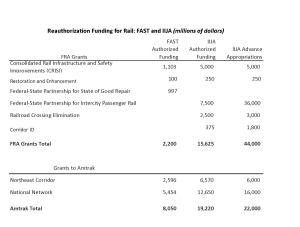
Both the IIJA authorizations and the Advance Appropriation expire on September 30; if Congress has not yet enacted a reauthorization bill and pursues an extension of the programs, they will also have to determine whether to extend only the program authorizations or also to extend (some or all of) the advance appropriations, which were designated as “emergency spending” in IIJA and therefore not subject to Congressional budgetary rules.
During the 2022-2026 IIJA authorization period, even though FRA discretionary grant programs were authorized at $15.625 billion, the programs only received a total appropriation $2.11 billion in that period (beyond the $44 billion made available in advance appropriation). This annual appropriation level was more similar to the prior authorized level of the FAST Act. Should Congress choose not to extend the advance appropriation, either in an extension or in the reauthorization, and should annual appropriations stay where they have been for these programs, it would be a 95% reduction in FRA’s discretionary grant funding for rail agencies, including the new corridors currently developing service plans under the Corridor ID program.
Outside of funding, reauthorization may also be a vehicle for financing mechanisms that are important to the rail industry. IIJA doubled the cap on Private Activity Bonds from $15 to $30 billion, nearly all of which is now allocated. PAB eligibility includes passenger rail—Brightline West received $2.5 billion in PAB allocation in 2024—as well as rail and intermodal transfer facilities. As tax-exempt bonds, increasing the PABs cap has an impact on tax revenue—in 2024 JCT estimated the 5-year cost for the highway and rail PABs at $1 billion.
Another rail tax provision with bipartisan support in the Senate and House is the Freight RAILCAR Act, introduced by Senators Jim Banks (R, IN) and Chris Coons (D, DE) and by Rep. Darin LaHood (R, IL) in the House, where the bill has 68 co-sponsors. The proposal would create a tax credit for replacing two old freight railcars with one new freight railcar that increases capacity or fuel efficiency by at least 8 percent. (The Senate version refers only to capacity increase, not fuel efficiency improvement.)
Rail Policy
Rail safety is likely to be a top issue for rail policy, with many provisions discussed in response to the East Palestine disaster still not enacted. The Railway Safety Act of 2023 that was developed last Congress by then-Ohio-Senators J.D. Vance and Sherrod Brown was never enacted. In the House, the Railway Safety Act has been re-introduced this Congress as a bipartisan bill led by Reps. Christopher Deluzio (D, PA), Nick LaLota (R, NY), Michael Rulli (R, OH), and John Garamendi (D, CA). The bill would add safety regulations for trains carrying hazmat and for the use of wayside defect detectors, which are discussed in FRA guidance but not required. The bill also establishes a statutory requirement for freight trains to have two-person crews.
Of these safety provisions, the two-person crews requirement has been perhaps the most divisive. Freight rail companies have progressively eliminated crew positions even as trains have gotten longer so now many trains will have a crew of only an engineer and a conductor. For the last decade, crew size has been a contentious issue. Companies have sought to cut costs and crews further, while derailments have put pressure on FRA to intervene and establish minimum crew sizes. Most recently, FRA proposed a regulation to require two-person train crews in 2022 and finalized that rule in 2024, such that all trains must have at least two crew members on board with only certain exceptions. The Deluzio-LaLota safety bill does maintain similar exceptions such as for low-speed trains and grandfathers in the train operators with existing exemptions before the date of enactment.
Several bills have also been introduced to address various other safety issues, including safety of Amtrak conductors, as well as cargo theft, which has become a high profile issue this Congress.
Another theme in introduced rail bills is the use of railroad right-of-way and tracks. In the House, competing bills have been introduced regarding passenger train preference, one of which would remove that preference in favor of freight rail movement, and the other of which would give Amtrak the right to bring civil actions in Federal district court to enforce the right. Other bills seek to capitalize on the linear corridors that railroads maintain, and could as easily be included in a permitting bill as in a transportation reauthorization. A bill from Rep. John Joyce (R, PA) would create a streamlined framework for building out broadband or telecom equipment in the railroad right-of-way. Another bill on rail and highway transmission planning would have the Department of Energy conduct a study on the potential benefits and challenges of placing high-voltage transmission lines on rail and highway corridors.
While FRA has become more integrated with highway and transit programs since 2015, including now being subject to joint regulations for environmental reviews, railroad industry regulatory policy became more separate in 2015, with the Surface Transportation Board Reauthorization Act of 2015 establishing STB as an independent agency outside of USDOT. STB’s authorities do not expire, but Congress could choose to use a surface transportation reauthorization to update the agency’s approach to rate disputes, merger reviews, or other authorities.
A bipartisan bill in the Senate introduced by Senators Baldwin (D, WI) and Marshall (R, KS) would seek to adjust the way that STB considers violations by rail carriers in providing reasonable transportation service, emphasizing the importance of “the shipper’s need for timely, efficient, and reliable rail service.”