Transportation on the Campaign Trail
This election season, transportation policy issues have arisen in a variety of forms in races across the country, most frequently tied to national affordability issues. The question of how to pay for transportation investments is never an easy one to answer and is made much more difficult when the focus is on reducing household costs. In general, candidates –particularly non-incumbents– in elections across the country appear largely aligned across parties in not wanting to expand user fees or taxes for transportation investments, and even wanting to suspend or repeal those already in place.
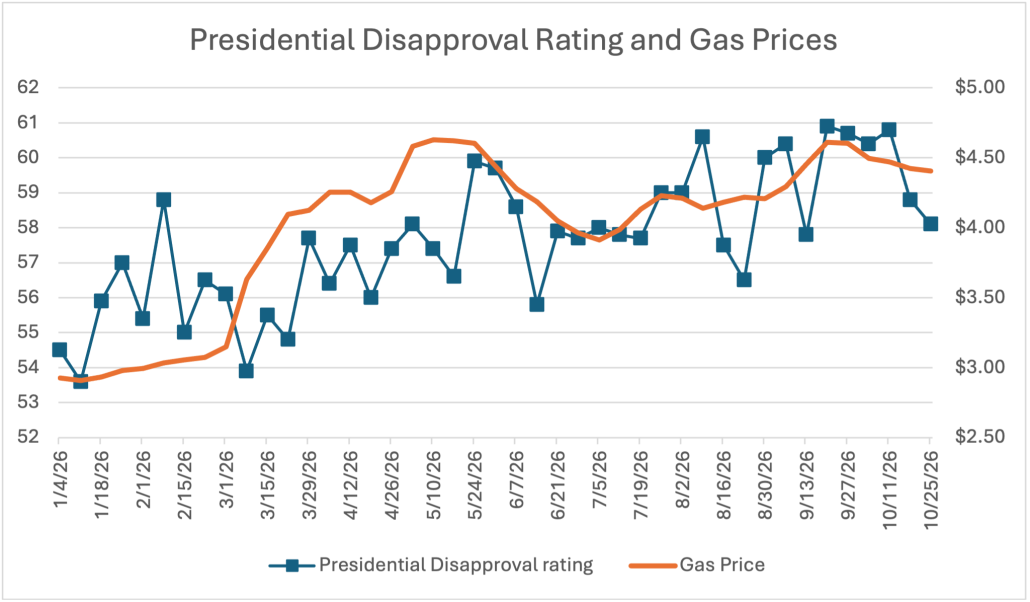
The cost of gas and diesel and related affordability challenges and the President’s disapproval ratings have both been central stories in election coverage this year. Graphing them together makes clear that the two issues are highly related.
Gas Taxes
Gas prices and gas taxes have been an issue in several U.S. Senate elections, with non-incumbent candidates often proposing to repeal or suspend federal gas taxes regardless of party. For instance in the Texas Senate race, both Republican candidate Ken Paxton and Democratic candidate James Talarico have called for gas tax relief (Paxton proposed permanent repeal while Talarico suggested a temporary suspension). Similarly in the Michigan Senate race, both Republican candidate Mike Rogers and Democratic candidate Abdul El-Sayed have supported suspending both state and federal gas taxes to provide households with price relief, as have Republican candidate Ashley Hinson and Democratic candidate Josh Turek in the Iowa Senate race.
In the North Carolina legislature, where Republicans control both chambers, Republican leadership proposed and passed a bill to suspend the state’s 41 cent gas tax in early October through the end of November. Many Democrats supported the bill while also deriding it as a campaign ploy by Republicans concerned about the possibility they will lose their veto-proof Senate majority.
Tolling, Pricing and other Road Funding
The question of tolling has come up in several gubernatorial races around the country. In the Illinois Governor’s race, in which incumbent Governor J.B. Pritzker is facing Republican challenger Darren Bailey. Bailey has made a campaign promise to eliminate tolls. The Illinois tollway board—all of whom are Pritzker appointees— has approved a 45-cent increase for motorists on Illinois toll roads along with a 30% increase for commercial vehicle tolls as part of a $1.3 billion statewide funding measure that will fund tollway construction projects along with public transit systems across Illinois.
A somewhat similar dynamic is playing out in the New York Governor’s race, where incumbent Governor Kathy Hochul has defended the success of the NYC congestion pricing and the funding it provides for MTA a signature accomplishment despite her initial misgivings and implementation delays. Her opponent, Republican gubernatorial candidate and Nassau County Executive Bruce Blakeman, has pledged he would end congestion pricing, potentially by simply ending enforcement, and has called congestion pricing a tax on the middle class.
Without an incumbent in the Rhode Island Governor’s race, the tolling debate has played out somewhat differently and could result in changes to the state’s planned resumption of tolling next year. In a televised debate between leading candidates including Republican Aaron Guckian and Democrat Helena Foulkes, all the gubernatorial candidates agreed they would choose not to reinstate the truck tolls out of concern about costs to businesses. The RI truck-only tolls were put into place in 2018 by then-Governor Gina Raimondo but collection was paused in 2022 after a court ruled that the truck-only taxes were unconstitutional. However, a new ruling issued in late 2024 cleared the path for reinstating the tolls if the per-day cap on tolls were removed, since that cap gave an advantage to local trucks. RIDOT has been pursuing reinstatement of the tolls through ongoing work to upgrade the gantry infrastructure and the billing system at a cost of $20 million set aside in the state’s FY27 budget, to be paid for by the revenues to be produced once the tolls resume. Unless a new governor changes the plans, tolls will be reinstated in Spring 2027 and are expected to generate roughly $40 million in annual revenue.
In the Wisconsin Governor’s race, Democrat David Crowley is running against Republican Tom Tiffany. On the debate stage on October 21, moderators asked the candidates about funding for transportation, including whether they’d support indexing the gas tax—to which both answered in the negative. Slightly more daylight emerged on the question of tolling, with Tiffany offering the same “No” to the question of tolling while Crowley indicated “we should be open” to the idea.
Republican Senator and gubernatorial candidate Marsha Blackburn declined to attend the Tennessee Governor’s race debate with Democratic nominee Jerri Green and other third-party candidates, but did respond to questions from the Tennessean that asked about the state’s $58 billion backlog in road maintenance and investment needs. Jerri Green pledged to raise revenues from taxing the growth and sale of cannabis to fund the backlog, and Blackburn promised to “complete a DOGE to remove waste, find savings and reduce what we spend” noting further that from there innovative solutions such as “choice lanes are one consideration”. The Tennessean also raised the question of support for debt financing or new taxes for transportation, to which Green responded “No” with regard to taxes but “leave all options on the table” with regard to debt. Blackburn declined to answer either question.
Transit
Public transportation issues have come up in only a few races. In the NY gubernatorial race, in which Republican candidate Blakeman has focused on the issue of crime on public transit.
In the Georgia Governor’s race, Democratic candidate Keisha Lance Bottoms has pledged “there should be dedicated state funding to transit statewide” including for MARTA as well as for other transit systems statewide, calling state funding “the missing piece” that would help transit systems expand in Atlanta and in the midsize cities that don’t currently have adequate transit.
EVs, Fuel Economy, and Restoration of Tax Credits
One issue that hasn’t gotten as much attention as you might expect—in an era of affordability concerns about high gas prices—is the topic of electric vehicles and fuel economy standards. Democratic Congressional leadership has been relatively silent on whether restoration of the EV tax credits that were repealed in the One Big Beautiful Bill would be back on the table in a Democratic-controlled Congress. Sales of EVs fell off sharply after repeal of the EV tax credits but this year, even without tax support, sales of EVs have grown steadily, presumably in response to high gas prices.
In the Michigan Senate Race, Mike Rogers’s campaign ads have accused Abdul El-Sayed of wanting to ban gas-powered vehicles—an accusation that various fact checkers and the El-Sayed campaign have rejected as untrue.
In the Nebraska Senate race, Senator Pete Ricketts is running for re-election after leading the effort to repeal California’s waiver for their clean cars rule and pledging support for eliminating cafe standards. His statements on the issue describe his support rooted in the desire to increase consumer choice and lower vehicle prices.
Meanwhile in the California Governor’s race, Democratic candidate Xavier Becerra has emphasized making EVs cheaper and improving the availability of charging infrastructure while Republican Steve Hilton has advocated rolling back state climate policies, including the rules affecting gasoline-powered vehicle.