Transportation at the Ballot Box 2026 Highlight: Connect Bay Area Transit
As soon as January 2027, riders in the Bay Area can anticipate serious transit service changes across the region—fewer trains and buses, station closures, and higher fares. But a proposed sales tax measure this November could prevent those changes from happening, depending on how voters respond at the ballot box. As part of Eno’s Transportation at the Ballot Box work, this week we take an in-depth look at the proposed sales tax, the legislation behind it, and what it means for Bay Area transit.
The Connect Bay Area Transit Measure would add a half-cent sales tax in Alameda, Contra Costa, San Mateo, and Santa Clara counties and a one-cent sales tax in San Francisco for 14 years. It would raise around $980 million annually, most of it to keep BART, Muni, Caltrain, and AC Transit running at current service levels. The measure comes out of Senate Bill 63 (SB 63) the Connect Bay Area Act, which the California legislature passed in 2025.
The measure is intended to provide financial support to the transit operators in the region. But it also tests a new piece of regional government. SB 63 created the Public Transit Revenue Measure District, a five-county taxing body run by the same people who govern the Metropolitan Transportation Commission (MTC), to collect the tax. The district could become the foundation for a more regional transit system. However, as written, the law leaves the region’s transit agencies as separate as they were before, and its main job is to keep them financially afloat.
Context
The Covid-19 pandemic severely impacted transit in the Bay Area. Riders who generally took transit every day for work found themselves at home. The rapid shift to remote work left transit operators without their ridership base.
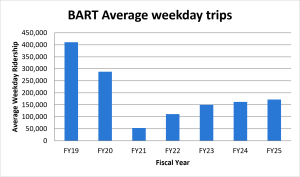
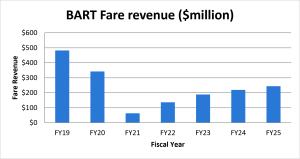
Take BART for example. In FY2019, BART averaged about 411,000 weekday trips and was a key transit connection for urban and suburban commuters alike in the Bay Area. The agency collected $483 million in fares, and fares covered nearly 70% of operating costs, one of the highest shares of any U.S. transit system. BART’s model relied on commuters, and the shift to remote work during the pandemic took those riders away, and with it, BART’s main source of revenue. Figures 1 and 2 show the dramatic change in ridership and fare revenue, with both plummeting in 2020 and not yet reaching pre-pandemic levels in FY2025.
BART was left in financial trouble. Federal aid filled the gap at first, with the agency receiving $1.6 billion in federal funding. In 2023, California added $5.1 billion for transit statewide. The region’s four largest transit operators, BART, Muni, AC Transit, and Caltrain, also cut more than $1 billion in costs between 2020 and 2026, according to an efficiency review required by SB 63. Still, those four agencies face a combined deficit of more than $800 million a year, and the emergency money is running out.
Figure 1 does show that ridership is recovering, but has not reached pre-pandemic levels. BART’s weekday ridership passed 200,000 in March 2026 for the first time since the pandemic. But the recovery has been slow. In FY2025, BART’s weekday ridership was 42% of its 2019 level, and its fare revenue was 51%. Ridership and fare revenues are not growing fast enough to fill the deficit gap by themselves.
Figure 1. Average weekday trips on BART rail services, FY19-FY25
Source: BART Ridership reports
Figure 2. Annual Fare Revenue (excluding parking), FY19-FY25
Source: BART Financial Reports
The state response
With federal aid running out, state lawmakers had to think of a solution for a long-term source of money. In 2024, SB 1031 proposed a nine-county measure raising up to $1.5 billion a year and called for a study to merge the region’s 27 transit agencies. The bill passed the Senate, but it was shelved amid disagreements over what kind of tax to use, how to split the money, and the idea of consolidating the transit agencies.
SB 63 took a narrower approach—the legislation started with Alameda, Contra Costa, and San Francisco counties and removed the consolidation study. San Mateo and Santa Clara counties joined later. The legislature passed the bill and Governor Gavin Newsom signed it into law in October 2025.
The law creates an independent oversight committee with members from each county, who will monitor spending. BART, Muni, AC Transit, and Caltrain must go through independent financial efficiency reviews and adopt plans based on the reviews, although each agency’s board can reject a recommendation if it finds the change would harm service or safety.
The legislation also created the new Public Transit Revenue Measure District, which will implement the new tax, should it be passed in November. Under the proposed November measure, the new sales tax would last 14 years, expire in 2041, and raise around $980 million annually. San Francisco’s rate of one cent compared to a half-cent for the other jurisdictions reflects the size of the deficits at the systems that San Francisco residents depend on most.
The new tax district has little flexibility in where the money goes. SB 63 spells out the split in a fixed formula and directs the district to pass the money along “with no discretion to withhold, reduce, delay, modify, specify the use of, or condition those revenues.” In practice, the district collects the tax and delivers it. The legislature has already decided who gets what.
About 63% of the money, roughly $617 million a year, would go directly to keep transit service running. BART would get about $310 million, Muni $155 million, Caltrain $70 million, and AC Transit $50 million, with smaller amounts for East Bay bus agencies, Golden Gate Transit, and SF Bay Ferry.
Another $322 million would return to the counties for local transportation priorities. That includes $245 million for VTA in Santa Clara County, $45 million for SamTrans in San Mateo County, about $25 million for the Contra Costa Transportation Authority, and $10 million for the Alameda County Transportation Commission. San Francisco county does not itself receive any money, with all its revenue going to BART, Muni, and Caltrain directly.
The remaining 5%, around $45 million, would go to the MTC for programs that cross agency lines: free and discounted transfers, accessibility improvements, maps and signage, and other projects.
If the measure fails
If voters reject the measure, the agencies have already spelled out what comes next—major service changes. BART’s reduced service plan would begin in January 2027, with the following cuts:
- Three lines instead of five
- Trains every 30 minutes
- 9 p.m. closing every night
- A 30% fare increase
By July 2027, as many as 15 stations could close, fares could rise 50%, and about 1,200 jobs would be cut. The other agencies face similar cuts. Muni would cut 20 routes and lay off up to 2,000 employees. Caltrain would eliminate weekend service, end service at 9 p.m., and close 30% of its stations. AC Transit would cut service by up to 16%. These cuts are significant. People rely on these services to get around, and the cuts would limit people’s mobility options at best. For some who only use transit, these cuts make it impossible to get around, severely impacting access to jobs, healthcare, recreation, food, and access to parks. If people cannot ride the system, the transit agency has failed in its primary mission: mobility options for the public.
If the measure passes
If voters approve the measure, the transit agencies in the region have a new source of funding. The four major transit providers carry more than 80% of the region’s transit riders. Passage would let the agencies provide service at their current levels and plan beyond 2027 without the fear of cutting service.
A key issue with the measure is timing. Collection would begin in April 2027, with the first payments to agencies expected in July 2027. If the measure passes, BART would not make its January 2027 cuts. Instead, it bridges the gap with $52 million in leftover state emergency funds and $89 million in borrowing. The state has also offered BART up to $285 million through a bridge loan, which BART says it would not use if the measure fails, because it would have no way to repay it. Passage would give BART a new source of funding, but that money does not start arriving until spring 2027.
There is also some opposition to the measure. The Committee for Affordable Bay Area Transit argues that a sales tax hits low-income residents hardest. The group sued over the ballot wording and lost. Supporters point to an EMC Research poll of 1,700 likely voters that found 54% support the measure, rising to 58% after voters heard about the potential service cuts.
The regional question
However voters decide, November 3 is the first test of the Public Transit Revenue Measure District. It is not the first time the Bay Area has shared transit money as a region—the MTC already distributes more than $1 billion a year in state and federal funds, and it oversees bridge tolls that help pay for transit projects. But this is the first time voters have been asked to approve a sales tax to maintain day-to-day transit service. On that front, the district and the tax are a real step forward.
Section 67740(g) of SB 63 says approval of the measure is based on the cumulative vote within the entire district, not separately within each county comprising the district. If the combined vote falls short, the tax fails in all five counties, even where most voters say yes. If it passes, the tax applies in every county, even where most voters say no. The Bay Area has voted as a region before. Regional Measure 3, the 2018 bridge toll increase, passed on a combined nine-county vote, even though Contra Costa and Solano voters rejected it. But bridge tolls are only paid for by drivers. The November 3 tax would be paid by everyone who shops in the five counties, including people who do not use transit.
The measure also provides dedicated money for integration. The $45 million set aside for MTC-run programs would pay for things riders experience as one system: cheaper transfers, common maps and signage, and more reliable bus and rail service. Some of that work is already visible. Clipper 2.0, launched in December 2025, takes up to $2.85 off a transfer to BART or Caltrain services and makes bus-to-bus transfers between agencies free and the measure would help to keep and expand those discounts.
But ultimately, the district and proposed sales tax are a way to fund transit, not a new way to run it. SB 63 does not merge, restructure, or change the governance of any transit agency. BART, Muni, Caltrain, AC Transit, and the other agencies keep their own board, budgets, and service plans. An earlier version of SB 63 would have required agencies receiving money to follow the MTC’s Regional Network Management policies on fares, transfers, maps, and schedules, but that requirement is not in the final law. The law even states that its funding formula is “not intended to set any precedent for future funding relationships or agreements.” The tax only lasts 14 years and expires in 2041. Any efforts to replace or extend the tax would require new legislation.
The Connect Bay Area Act and the proposed November sales tax are a rescue plan for the region’s transit agencies. Still, the new tax district could be a stepping stone. It gives the region an institution that can levy a new tax across county lines, a precedent for a combined vote on transit operations, and a steady, 14-year source of money for various MTC-run programs that benefit riders of multiple systems. Future legislation could build on SB 63 to give the district more responsibility or use it as a foundation for a stronger regional transit authority. But the success of the sales tax and any future opportunities beyond the financial rescue of transit agencies in the Bay Area hinge on the passage of the measure in November. The future of transit in the Bay Area is bright, but the clouds still need to part for the sun to shine.