Transportation at a Crossroad: User Fees, Emerging Technology, and the Value of Transportation
From the moment the first Model T rolled off the assembly line, the automobile has been more than just a machine in America – it’s been a symbol of who we are. Our cars represent movement, progress, and perhaps above all, freedom. In America, we don’t just drive – we define ourselves by what we drive and where we’re going. We are a nation that treasures the ability to go where we want, when we want – whether in a family sedan, a Harley on the interstate, or a vintage RV parked under the stars. Wherever we are going and whatever we are driving to get there, one thing Americans have in common is we rarely think about how the roads we’re using are funded.
Transportation is at a user-pays crossroad. For over one hundred years, the fuel tax collected at the pump has been the workhorse for transportation funding. When the fuel tax was introduced in 1919, the majority of the cars were the same exact model. Back then, when you drove a mile, you paid the same amount in fuel tax for that mile as everyone else. Each year the nation also drove more miles than it had the prior year, ensuring that gas tax revenues grew faster than inflation. Fast forward to today and there are nearly 300 vehicle models sold in America with a wide range of fuel economy and some vehicles not using any fuel at all, and total travel (and gas tax revenues) has flattened while inflation and highway spending continues to increase. The consequence is the link between using the roads and paying for them is broken, undermining our transportation revenue.
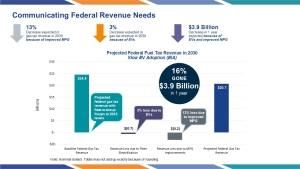
Based on projected fuel-efficiency gains, the federal gas tax revenue will lose $3.9 billion (16% decline) in 2030 alone. Over 80 percent of that loss in 2030 is because vehicles are going farther on a tank of gas. Although EVs are not the primary cause of the revenue problem we face today or in 2030, as EV adoption accelerates our ability to rely on fuel taxes will further erode. The billions lost is a jaw dropping number, but it is invisible to the users of the road as we never receive a bill for transportation cost. Rather, taxes on our fuel are baked into the price at the pump. As wrapped up as Americans are in driving, we are largely oblivious to how roads are paid for.
The key to reconnecting the link between use and payment is putting a spotlight on the value of transportation in our everyday lives whether it be getting to work, visiting friends, arriving at the doctors or receiving that package on our front door. Transportation is the foundation to our daily movement and the cornerstone of our local, national and global economy. Take the twenty eastern states stretching from Maine to Florida – together they account for 1,360 billion vehicle miles driven annually across 30% of the country’s total roads supporting $7.8 trillion in cargo movement. Just those 20 states alone comprise the world’s third largest economy. Each year, $8.2 billion in fuel tax is collected up and down this eastern corridor, which represents over 40% of the entire federal fuel tax revenue.
The public consistently says that they want transportation funds to maintain a safe and reliable system. There is an expectation that everyone should arrive at their destination in one piece and those working on our roads should go home at the end of their shift. But, with over 40,000 fatalities on our roads per year, it is no wonder the public doubts we are spending funds wisely. However, what is encouraging is technological advancements, our ability to turn data into actionable information and proven operational strategies that save lives.
Take the cell phone in your pocket – it has 7 million times more memory than the Apollo Lunar Module had to put men on the moon. Yes, our cell phones today estimate routes to our destinations and travel times, but they are also a key source of anonymized data to better manage our transportation systems. TSMO (Transportation Systems, Management, and Operations) professionals use this data to improve signal timing, build safer pedestrian and bicycle facilities, minimize the disruptions associated with lane closures, and even predict areas of likely crashes. TSMO is essential for keeping our system working by monitoring roadways clearing incidents and debris, assisting with evacuations, analyzing data for operational improvements, and notifying travelers of changes in roadway conditions. In addition, vehicles today have the potential to further improve safety through vehicle-to-infrastructure (V2X) technologies and Advanced Driver Assistance Systems (ADAS). The combination of data, technology and operational strategies means improved situational awareness resulting in secondary crashes being a thing of the past and the promise of declining fatalities.
There is much to cheer, but our discussions must return to the significant and complicated questions about how to pay for our system with decreasing fuel tax revenue. Funding alternatives like registration fees, kilowatt hour charges or distance-based fees are all worthy of attention and examination. Concerns over fairness, privacy and the cost of collection pose challenges but, continued real-world exploration provides opportunities to define a user-based system that can maintain and expand our transportation network for the needs of the future economy. We have more data than ever before on public attitudes toward transportation funding options. We can utilize that data to inform a national transportation education campaign asked for by Congress. Such a campaign is a much-needed next step to show transportation is worth paying for.
So here we are, at a bit of a crossroads. Which direction will we go? By focusing on what people are asking for – a safe reliable system – we can navigate the difficult discussions about funding transportation. Success of these debates and the decisions we will make will ensure the health of a national transportation system that will continue to support personal and economic freedom for all. By focusing both on the long-term system needs and understanding the deep relationship with transportation that we share we can find solutions. The upcoming reauthorization offers the opportunity to move forward.