Transit Revenue Crisis: SEPTA Enacts Doomsday Budget As Chicago Prepares to Follow
With mass transit ridership failing to return to pre-COVID levels in most cities, and with federal COVID aid finally getting spent out everywhere, state and local politicians around the country are being faced with tough fiscal choices for transit service. And in those areas that use a July 1 to June 30 fiscal year or thereabouts, the failure by legislators to make tough choices is now being felt.
In Philadelphia, mass transit ridership has only recovered to about 70 percent of pre-COVID levels:
|
SEPTA Annual Ridership (Unlinked Passenger Trips) |
|||
| NTD 2019 | NTD 2023 | APTA 2024 | |
| Bus | 153,956,354 | 101,457,440 | 111,043,900 |
| Heavy Rail | 90,754,189 | 57,976,426 | 59,009,800 |
| Other | 63,555,942 | 37,831,054 | 41,232,100 |
| Total | 308,266,485 | 197,264,920 | 211,285,800 |
This meant a cumulative hit of over $200 million per year in reduced operating income for the Southeast Pennsylvania Transportation Authority (SEPTA). The SEPTA Board of Directors met yesterday and adopted a new budget plan for fiscal year 2026. The resolution adopting the budget really sums it up:
WHEREAS, in spite of SEPTA’s best efforts to reduce its $240 [million] operating budget deficit via a stringent austerity plan, and due to the reality that no state funding solution is currently in place, SEPTA is facing a structural Operating Budget deficit of $213 million in Fiscal Year 2026; and
WHEREAS, in order to close the shortfall and achieve a balanced budget, SEPTA’s proposed Fiscal Year 2026 Operating Budget includes (i) a 21.5% fare increase beginning September 1, 2025, and (ii) a 45% reduction in transit service beginning August 24, 2025…
As far as specifics go, the service reductions will include:
- Elimination of fifty (50) bus routes, with 32 taking effect in August 2025 and the other 18 in January 2026,
- Conversion of the T1 line (63rd to Malvern-Overbrook) and G1 line (63rd-Girard to Richmond-Westmoreland) from trolley to bus, starting in January 2026,
- Closure of the heavy rail Broad Street Spur from Girard to 8th and closure of the Fairmont, Chinatown, and 8th St stations on the Orange Line, starting in January 2026,
- Closure of five of the thirteen Regional Rail lines (Chestnut Hill West Line, Cynwyd Line, Paoli/Thomdale Line, Trenton Line, and Wilmington/Newark Line) and closure of 63 of their stations, starting in January 2026,
- Reduced service everywhere else starting in August 2025,
- No more extra hours for sporting events and city celebrations, and
- 9:00 p.m. curfew on all rail service, effective January 2026.
The two-part phase-in of the cuts gives Keystone State politicians time to provide funds to head off the worst of the cuts before the end of this year. But Bloomberg CityLab quoted SEPTA General Manager Scott Sauer as saying the following during the meeting: “This budget will effectively dismantle SEPTA. Once this dismantlement begins, it will be almost impossible to reverse, and the economic and social impacts will be immediate and long-lasting for all Pennsylvanians, whether they ride SEPTA or not.”
However, the budget cycle is not yet over in the Pennsylvania legislature. The state House has passed a budget that increase the percentage of the state Sales and Use Tax that goes to the PUblic Transportation Trust Fund from 7.58 percent to 9.43 percent, which is estimated to put an additional $293 million in the fund for the upcoming fiscal year. That amount has to be split amongst all transit providers in the state, but the largest share would go to SEPTA and make a dent in that $213 million operating deficit, alleviating some of the proposed cuts.
Meanwhile, in the City with the Broad Shoulders, the ridership situation vis-à-vis pre-COVID is actually worse than in the City of Brotherly Love. Although total ridership last year was 66 percent of the pre-COVID level, on rail transit (CTA heavy rail and Metra commuter rail) recovery was only 57-58 percent.
|
Chicago-Area Annual Ridership (Thousand UPTs) |
|||
| APTA 2019 | APTA 2023 | APTA 2024 | |
| HR – CTA | 218,467 | 117,447 | 127,463 |
| CR – Metra | 61,457 | 31,895 | 34,878 |
| Bus – CTA | 237,276 | 161,699 | 181,734 |
| Bus – Pace | 26,186 | 14,919 | 16,957 |
| Total | 543,386 | 325,960 | 361,032 |
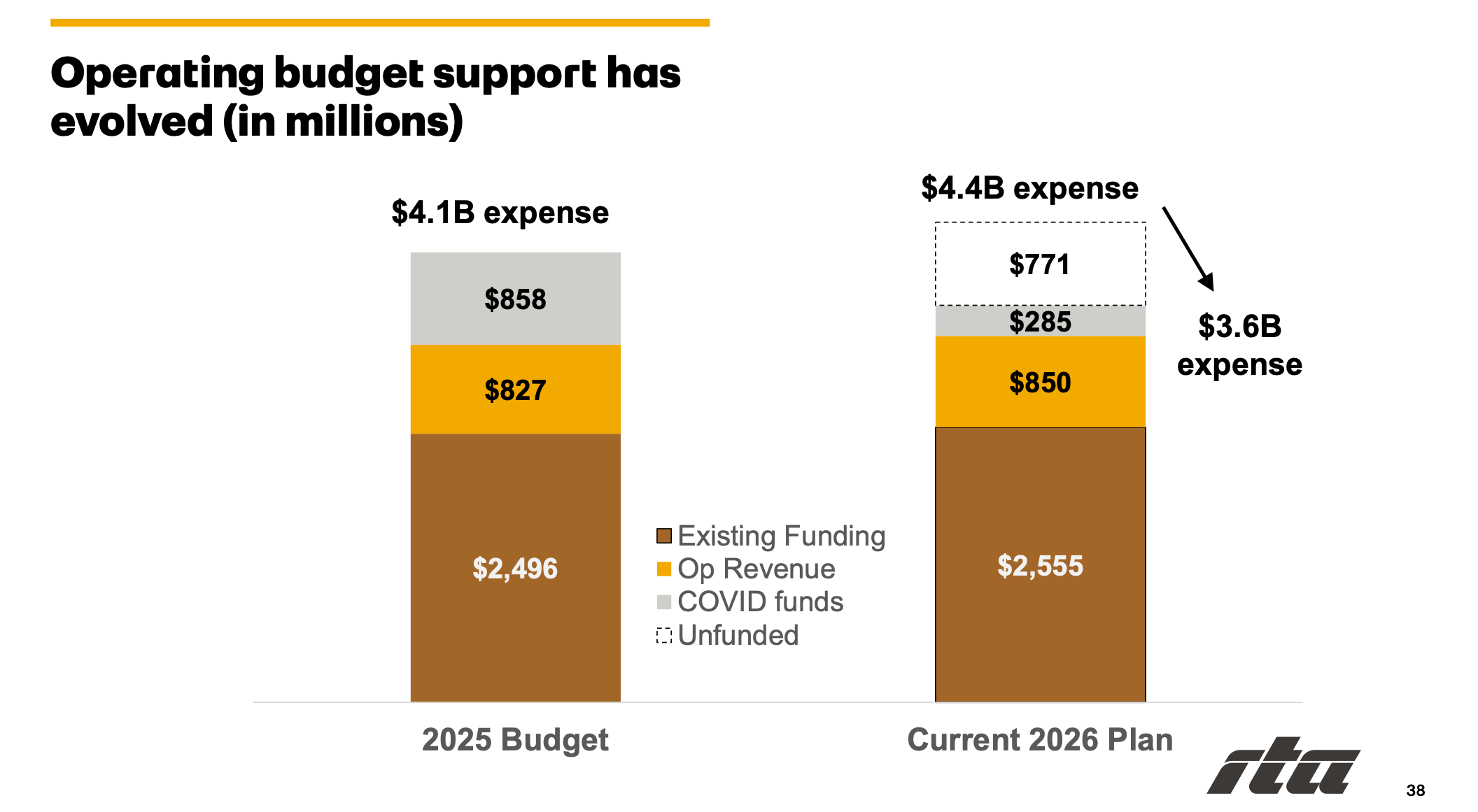
Unlike SEPTA, which uses a July 1 to June 30 fiscal year, the Chicago-area transit providers operate on a January 1 – December 31 fiscal year, giving that area more time to deal with this year’s impending budget shortfall. But the shortfall is much bigger there. The Regional Transit Association (RTA), an umbrella organization that supports the three Chicagoland transit providers, has to start working with providers in July on drafting their budgets for the upcoming year based on how much money the RTA estimates will be avaialble, and right now, the slides shown to the RTA Board two weeks ago indicate a $771 million collective operating shortfall throughout the region next year:
The state Senate has passed a large package of mass transit governance reforms and additional funding, but the House did not take action before the end of the session. The issue of whether or not the governor will call for a special session to deal with mass transit in the coming weeks is still unsettled.