Searching for Accountability at Denver’s Transit Agency
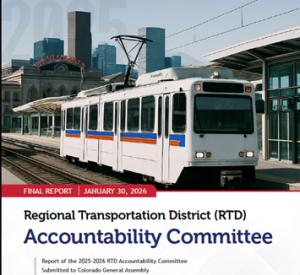
In recent years, Colorado state officials have expressed concerns about the bus, rail, and paratransit services provided by the Denver metropolitan region’s Regional Transportation District (RTD). Last week, an Accountability Committee established by the state legislature released a report with an extensive list of recommendations to improve the transit agency.
The Committee found that without meaningful governance reform, RTD risks continued erosion of service quality, public trust, and regional credibility amid mounting fiscal, operational, and workforce pressures. The key to that reform relates to changing the way members are selected to serve on the RTD’s Board of Directors.
At most U.S. transit agencies, members are appointed to their boards by mayors, governors, or county executives. In the Denver region, however, the area is broken into population-based districts with approximately 200,000 residents each, and the residents themselves vote for board members to represent their district. After much discussion, the RTD Accountability Committee concluded that this current structure is impeding effective leadership, accountability, and oversight.
Excerpt of Sample Ballot for 2024 General Election in Denver (RTD candidates are on bottom right)

The Committee also found that workforce capacity, especially among operators and frontline maintenance staff, is a key constraint to improving and expanding RTD’s services. Building upon its prior research, the Eno Center for Transportation helped the Accountability Committee develop a set of recommendations that would help RTD in its recruitment, retention, and training efforts.
Kelly Blynn, a senior official in Colorado’s energy office and the governor’s liaison to the Committee, said, “The Committee went through a robust, fair, and impartial process as dictated by the legislation, holding 12 public meetings from August through January, with over 40 hours of meeting time.” She added, “Over the course of the process, Committee members started with each topic by learning and discussing, including doing significant pre-reading, hearing presentations from experts like Eno Center, and reviewing stakeholder input.”
Background
Initially created by the state in 1969, RTD has overseen the expansion of bus, light rail, commuter rail, and paratransit services across one of the largest and most geographically diverse service areas of any transit agency in the country. It serves a 2,345 square mile area (about the same size as the entire state of Delaware) with more than 3 million people. The district includes 40 municipalities with 10 rail lines and over 100 bus routes.
The process for directly electing board members was launched by a petition drive and approved by voters in 1980. Ever since, there has been tension between supporters of having democratically elected board members sensitive to local issues, and those who favor appointed board members. In theory, appointed members would have greater transit and finance expertise, and take a more regional perspective on issues.
Since the COVID-19 pandemic, RTD’s governance and operating model has been strained by regional growth patterns, fiscal constraints, workforce challenges, changing travel patterns, and unresolved legacy commitments.
In 2024, the Colorado legislature passed bills that raised funds for public transit through new fees on oil and gas production and rental cars. It tried, but failed to fundamentally restructure the agency, though. One 2024 bill supported by influential legislators would have eliminated 10 elected positions from RTD’s 15-member board of directors in favor of newly appointed seats and elected seats that would represent the entire district.
In May 2025, the legislature passed (and the governor signed) a “Transit Reform” act that required RTD to undertake a number of initiatives including aligning with the state’s greenhouse gas reduction targets, developing a 10-year strategic plan and posting more detailed information on its website about capital projects, ridership, planned service changes, and workforce statistics.
The sponsors said they wanted to unlock RTD’s potential to deliver fast, frequent, dependable public transportation. State Senator Iman Jodeh explained, “This law is about restoring trust in our transit system.” The Transit Reform act also created the RTD Accountability Committee to provide the legislature with recommendations regarding governance, workforce issues, and paratransit.
Committee’s Recommendations
The Committee brought together Colorado residents appointed by the legislature, governor, and RTD who represented local government leaders, labor representatives, the RTD Board, key rider constituencies, and subject-matter experts.
Kelly Blynn said, “The Committee included really thoughtful, public-spirited, and passionate members who had very diverse backgrounds and perspectives, but ultimately all came together aligned around the goal of significantly improved transit for the Denver region, and who feel the urgency of addressing key challenges to ensure RTD is successful.”
Blynn said, “Having the national perspective and expertise on workforce retention from Eno Center was invaluable for helping understand how RTD’s peers are tackling very similar challenges, how RTD has been making strides in addressing the issue locally, and identifying additional best practices from their peers they could try out.”
While the Committee’s recommendations received support from a majority of its members, they were not adopted unanimously. For example, regarding restructuring the board, one member noted, “I urge prudent and incremental changes that address specific real weaknesses in the board’s current arrangement, rather than a radical reconfiguration that voters did not ask for and that increases the risk of disenfranchising large portions of RTD’s riders, potential riders, and taxpayers.”
The Accountability Committee’s governance reform recommendations included reducing the board to nine members, with five elected members and four others appointed by the Governor and confirmed by the Senate. The appointed members would be required to collectively bring key areas of expertise to the board—such as finance, land use, and transportation planning. The elected members would serve in population-based districts, and serve staggered four-year terms.
In addition, the Committee recommended creating an educational program, led by an outside entity, to train and inform prospective RTD Board candidates. Furthermore, it proposed increasing and indexing board compensation to inflation and making the board chair a full-time position.
Workforce Recommendations
Eno analyzed recent RTD data and initiatives relating to workforce recruitment and retention and conducted interviews with representatives of RTD and the Amalgamated Transit Union to gain an understanding of RTD’s current challenges and opportunities. RTD is not immune from the fundamental changes shaping the U.S. labor market and the U.S. transit industry in particular.
Eno noted that public transit is generally a highly routinized, regulated, and unionized industry that by its nature is structured by schedules, rules, and hierarchy, including procedures that reward seniority. These characteristics were established for good reasons, particularly the priority of maximizing safety and putting a reliable service out on the street with skilled, reliable employees. However, these features of the industry can be less attractive to younger generations of workers accustomed to the “gig” economy, flexible hours, and “work-life” balance.
Despite this challenge, Eno identified numerous initiatives for the Committee to consider relating to recruitment, retention, compensation, hiring processes, and training. The Committee’s recommendations included partnering with more organizations to recruit potential employees, exploring more flexible and part-time positions, expanding apprenticeship programs, and improving employee surveys.
David Bragdon, head of the Hudson Skykomish consulting firm, provided ongoing support to the Committee. He said, “The Eno Center’s unbiased research approach was crucial to dispelling speculative narratives about transit in Denver, and establishing a factual understanding about what’s going right and what can be improved.”
For more information
- Report of the 2025-2026 RTD Accountability Committee
- Report’s Appendix (Eno’s report to the Committee is on page 750 and its presentations to the Committee begin on pages 712 and 807)
- Eno article about addressing governance issues in Chicago, Baltimore, Tampa, and Washington, D.C.
- Eno workforce report regarding strategies to hire, train, and retain bus operators