
Round Up the Usual Suspects: Politicians Make Familiar Proposals to Counter High Fuel Prices
As gasoline and diesel fuel prices continue to rise following the U.S. and Israeli militaries bombing Iran for several weeks, and Iran retaliating by attacking shipping in the Persian Gulf, political leaders are reacting to rising oil prices with their usual toolbox of solutions.
This crisis may turn out to be the worst supply shock of all time – worse than the 1979 Iran revolution. 20 percent of the world’s seaborne oil flows through the narrow Straits of Hormuz between Iran and the Arabian peninsula, which is currently shut down due to continued Iranian military activity against shipping. And an additional 12 percent of that shipping goes through the even narrower straits on the other side of the Arabian peninsula, between Yemen and Djibouti, that provides access to the Red Sea and the Suez Canal. Iranian-allied Houthi militias control the part of Yemen overlooking those straits, and the Iranians are trying to get them to join in to attacking all ocean shipping.
The price of crude oil skyrocketed quickly, then dropped drastically as the White House said something about the bombing over quickly that was refuted by the Pentagon just after financial markets closed, then has crept back up to the $95 per barrel range. As shown in the following chart, gasoline prices don’t rise as fast in times of crisis as do crude prices themselves (crude has to be bought, shipped to a refinery, refined, and then the gasoline put into a pipeline and sent out to a tank farm and thence by truck to a service station before all of the financial effects are felt by motorists).
The national average for regular unleaded gasoline was $3.63 per gallon per AAA, up almost 70 cents per gallon in one month (+23 percent). But if oil prices stay at the $95 per barrel range, or go above that, gasoline will continue inching upwards until it hits the point we got to in mid-2022. Then, oil traded north of $100 (up $115 per barrel) for long enough that gasoline, per AAA, hit its highest average price ever, $5.02 per gallon.
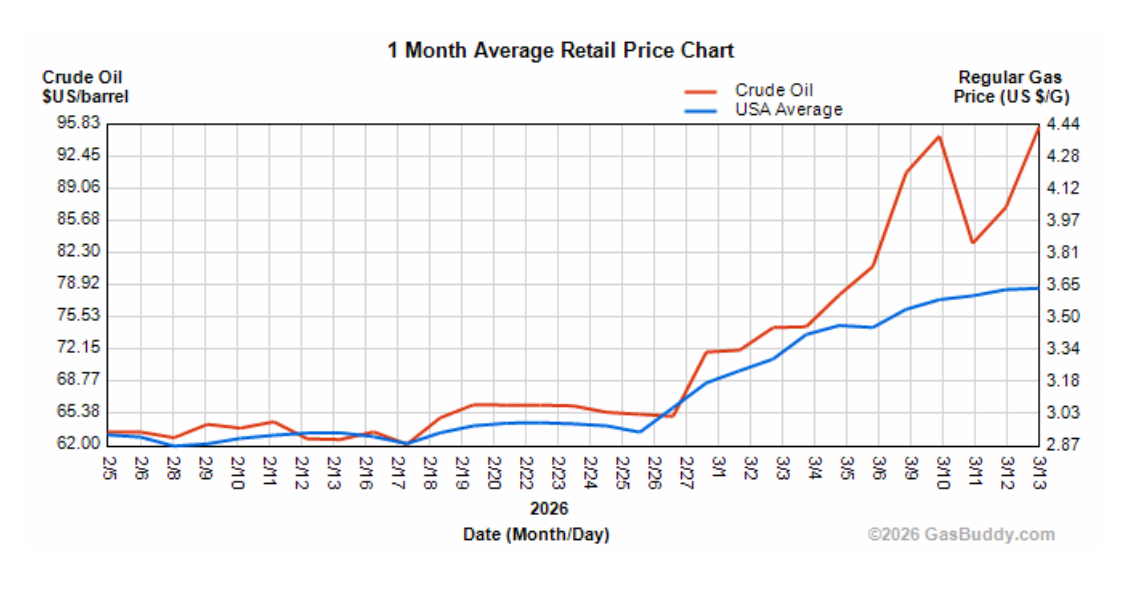
Meanwhile, diesel fuel is not shown on the chart but is in worse shape because more of the diesel precursor feedstock comes out of the Gulf. While gasoline is up 23 percent from one month ago, diesel is up 33 percent, to a U.S. average of $4.89 per gallon. The spread between the average price of regular unleaded vs the average price of diesel has increased from 25 percent to 35 percent in one month (it was diesel +73¢/gal., now it’s diesel +$1.26/gal.).
The days in which U.S. motorists were asked to share the sacrifice of higher prices for a worthy national cause, such as building an Interstate system or fighting a prolonged war, appear to be gone, so the usual rush is on to find ways to make fuel prices more bearable to the motoring public.
Strategic Petroleum Reserve sales
This week, the International Energy Agency announced a coordinated drawdown of 400 million barrels from the petroleum stockpiles of member countries, including what the Trump Administration confirmed would be a 172 million barrel drawdown from the U.S. Strategic Petroleum Reserve (SPR). This would be the biggest single drawdown in the history of the IEA, though the two drawdowns in 2022 in response to supply and pipeline disruptions related to Russia’s invasion of Ukraine totaled slightly more.
(The SPR was established by the same 1975 law that created NHTSA fuel efficiency standards, which are also discussed in this issue of ETW.)
This will be only the fifth time since its inception that the SPR has sold its oil as originally intended – to ease price strains in a time of unforeseen market-disrupting crisis. (During smaller crises like supply outages due to natural disasters, oil companies can borrow oil from the SPR to maintain normal operations so long as they replace it promptly, and this happens often enough that we aren’t going to list all of those transactions.)
But the SPR has also sold 169 million barrels of oil over the years for other reasons. The first time, in the mid-1990s, there was no choice – the Weeks Island facility in which some SPR oil was stored was determined to be geologically unstable and had to be shut down, and that oil had to go somewhere. Congress used some of the sale money to pay for closure of the facility itself and used the rest to pay for appropriations or to reduce the deficit.
Starting in 2017, SPR sales became popular in Congress as a “pay-for” to offset the cost of various schemes. Most often it was as an offset for increasing the discretionary spending caps through the Bipartisan Budget Acts of 2015 and 2018. It was also used to pay for modernization of the SPR itself, and as the pay-for for the 21st Century CURES Act, the Stephen Sepp Wildfire Suppression Funding and Forest Management Activities Act, and (how could we forget) – the FAST Act of 2015.
| Emergency sales | Million bbl | |
| 1991 Operation Desert Storm | 17.3 | |
| 2005 Hurricane Katrina | 11.0 | |
| 2011 IEA Coordinated (Libya) | 30.6 | |
| 2022 IEA Coordinated 2x (Ukraine) | 180.0 | |
| 2026 IEA Coordinated (Iran) | 172.0 | |
| Non-emergency sales | ||
| 1996 emergency Weeks Island decommissioning | 5.1 | |
| FY 1996 deficit reduction | 12.8 | |
| FY 1997 appropriations offset | 10.2 | |
| FY 2017 SPR modernization | 6.3 | |
| FY 2017 CURES Act | 9.9 | |
| FY 2018 CURES Act and BBA 2015 | 14.2 | |
| FY 2018 SPR modernization | 4.7 | |
| FY 2019 CURES Act and BBA 2015 | 11.0 | |
| FY 2019 SPR modernization | 4.2 | |
| FY 2020 wildfires and BBA 2015 | 9.9 | |
| FY 2021 BBA 2015 and BBA 2018 | 16.7 | |
| FY 2022 BBA 2015 and BBA 2018 | 38.0 | |
| FY 2023 BBA 2015 and FAST Act | 26.0 | |
However, the combined effect of the steady drip from non-emergency sales starting in 2017, coupled with the slowness of the pace of SPR refill after the 2022 emergency drawdowns, meant that the U.S. went into the Iran war with the SPR only a little over half-full: a month-end balance of around 415 million barrels at the end of last month out of a total capacity of around 750 thousand gallons.
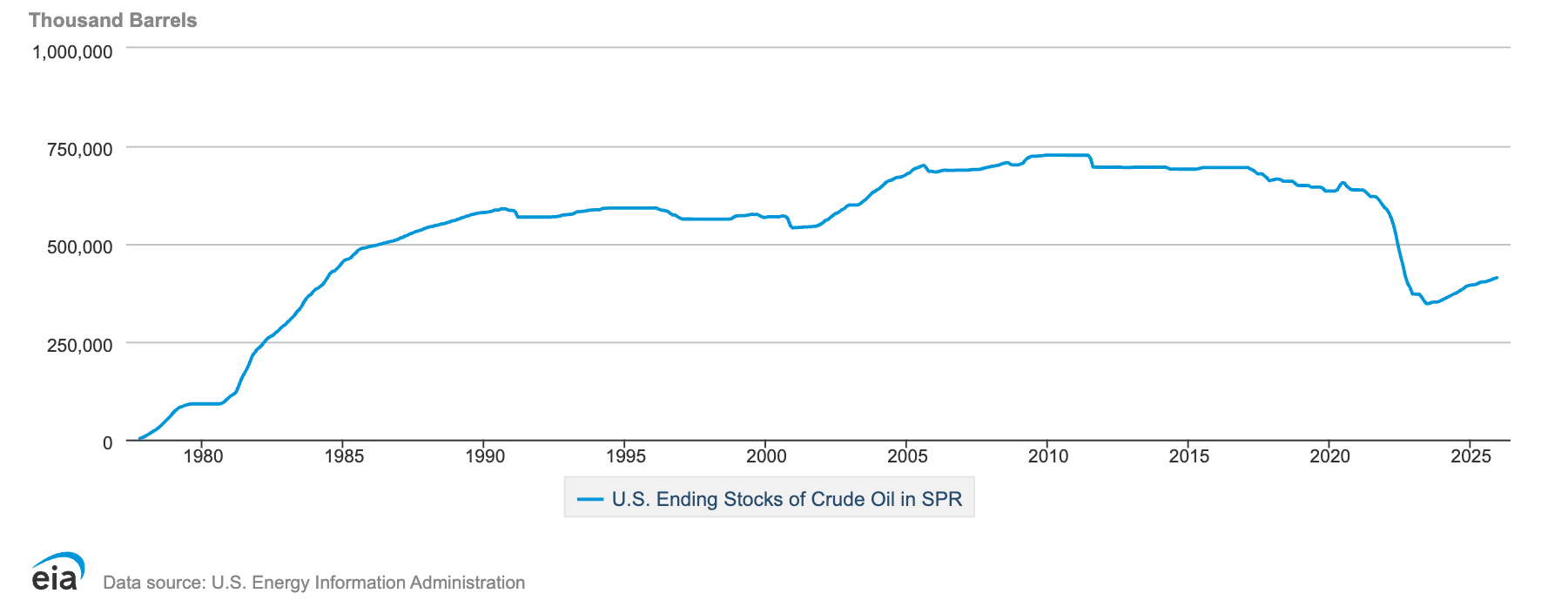
At the end of a 172 million barrel drawdown, the U.S. would only have around 245 million barrels remaining in the SPR – less than one-third of its total capacity.
Fuel tax holidays
SPR sales try to lower prices by increasing supply. Another political standby in times of high fuel prices is to get rid of the other factors that go into the retail price of fuel, other than the price of the commodity itself. And the easiest of those things to control is the one that government itself adds to the price – taxation.
On March 9, Senators Mark Kelly (D-AZ) and Richard Blumenthal (D-CT) introduced the first of what will probably become several bills temporarily lifting the federal excise tax on motor fuels. The bill (S. 4032), in section 2(a), would suspend the entirety of the 18.4 cent-per-gallon excise tax on gasoline as a motor fuel (the 18.3 cpg Highway Trust Fund portion and the 0.1 cpg Leaking Underground Storage Tank portion) from the date of enactment through October 1, 2026.
The 18.3 cpg Highway Trust Fund portion of the tax currently brings in about $26 billion per year for the Trust Fund, so to protect the Trust Fund from the costs of imposing the tax holiday, section 2(b) of the bill directs that “The Secretary of the Treasury shall transfer from the general fund to the Highway Trust Fund…amounts equal to the reduction in amounts credited (but for this subsection) to [the] Trust Fund by reason of subsection (a).” (There is similar language protecting the LUST Trust Fund as well.)
Because the federal motor fuel excise tax is levied when the fuel comes out of the refinery or pipeline tank farm and is loaded onto a truck to go to a service station, there is no guarantee that the wholesale fuel company or the retail service station won’t increase their price to eat up much, or all, of the savings provided by a fuel tax holiday. In response to this perennial problem, the bill declares it the policy of Congress that the tax savings should be passed on to consumers and then gives this vaguely worded order: “The Secretary of the Treasury shall use all applicable authorities to ensure that the benefit of the reduction in taxes resulting from the application of subsection (a) is received by consumers.”
The bill does not state what, if any, applicable authorities are available to Treasury to do anything.
In addition, the bill only gives a gasoline tax holiday, so the 24.4 cent per gallon diesel fuel tax would remain in place, even though diesel prices have increased much more, than have gasoline prices.
And the bill appears to have been drafted by persons who were not completely aware of how federal fuel taxes are levied. For a look at a fuel tax holiday bill that appears to have been drafted by the staff of the Joint Committee on Taxation, go back two decades and a bit, to September 2005 and H.R. 3683, introduced by Rep. Glenn English (R-PA) and other House Republicans. That will would have provided a 30-day tax holiday for both gasoline and diesel fuel, phrases its General Fund reimbursement mandate somewhat differently, and adds several pages of boilerplate about how “floor stocks” (defined here) are taxed, which tax experts always insist on addressing in any legislation changing fuel tax rates.
Expect more federal tax holiday bills to be introduced, and more attempts by in-cycle state governors to propose fuel tax holidays of their own, which will sunset afetr the fall elections.
Jones Act waiver
The White House told reporters yesterday that President Trump is considering a temporary waiver of the Jones Act, the century-old law that prohibits marine vessels from carrying passengers from one U.S. port to another unless the vessel was built in, and is flagged in, the United States.
There are only about 55 oil tankers in the world that meet Jones Act standards, and most of those are small (25,000 to 75,000 gross tons). They are used primarily for getting Alaksan oil to the West Coast, as well as oil and finished fuels between the mainland and Hawaii and other U.S. territories. But they also serve the function of getting products from the Gulf Coast to coastal areas that are not well-served by pipelines.
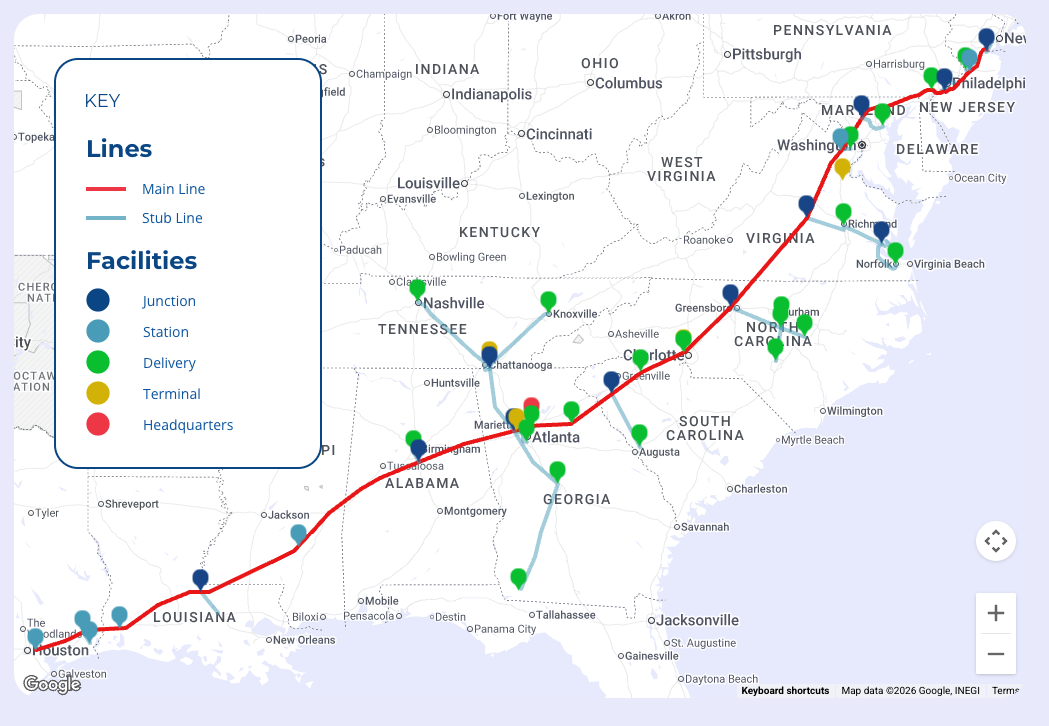
This is particularly true on the East Coast and Gulf Coast. There are two big pipelines – Plantation runs from Baton Rouge to D.C., and Colonial runs from Houston to NYC. They both run up the Tennessee and Shenandoah Valleys, and it is more convenient for a lot of coastal areas to get petroleum and its products by ship than by pipeline and then truck.
The following map of the Colonial pipeline shows which areas get left out. (Not shown: most of Florida, which is the focus of a lot of Jones Act oil tanker shipping.)
As much as the White House fears the political impact of high gas prices, the are loath to waive the Jones Act, because it is basically a tariff (which the President loves) and its purpose is to maintain U.S. shipbuilding capacity (which the President wants to reubild). At Elaine Chao’s 2017 confirmation hearing, she had to disown her previous anti-Jones-Act writings and pledge fealty to the law. (Current Secretary Sean Duffy was already a Jones Act fan.)
A group of maritime unions came together yesterday with a joint letter “to express our strong opposition to any administrative waivers granted under the Jones Act in response to rising energy price concerns…A Jones Act waiver would instead create opportunities for foreign-flag operators that avoid paying U.S. taxes, rely heavily on low-wage labor, and operate under regulatory regimes that circumvent international labor and vessel safety standards in direct conflict of America’s national security and economic interests.”
However, even if the Administration does waive the Jones Act for crude oil for the duration of hostilities, several industry analysts were quoted in the Washington Post yesterday as saying that the impact on gasoline prices would be minimal.