Reconnecting a Neighborhood in the Days After September 11
September 11, 2001, remains vivid in my memory. I woke up to a beautiful morning in my Battery Park City apartment, across the street from the World Trade Center (WTC). It was primary day for the New York mayoral election, so I went to vote at my polling place in the World Financial Center, which was connected to the WTC. Around 8:20 a.m., a voting machine problem delayed the line, and I realized I would have to wait longer. I remember telling myself to calm down: what harm could a few more minutes do? I had no idea that two planes were already heading toward the WTC—and that I would miss them by only minutes as I boarded the subway at the WTC station.

Lower Manhattan map showing Battery Park City, World Trade Center, and subway stations. Base map source: Wikimedia
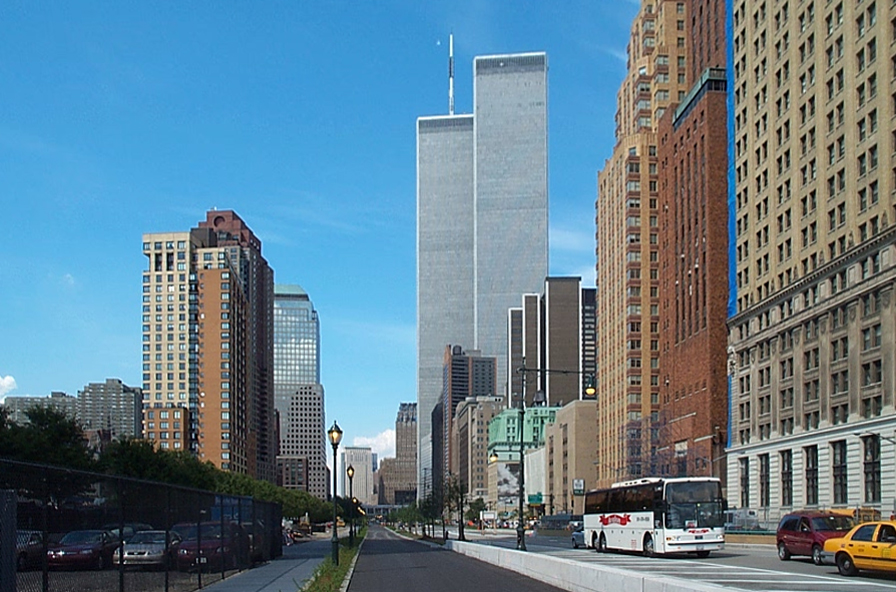
The World Trade Center towers, viewed from the West Side Highway, in July 2001. Source: Brandon McCombs per Wikipedia
At the time, my wife was home, and my son lived in the Financial District just a few blocks away. Both made their way through smoke and debris to my office, about a mile and a half north. We were displaced for weeks, but that did not stop my client, the Battery Park City Authority, from asking me to help restore transit service to the hardest-hit part- the southern neighborhood where I lived.
Three subway lines with stops adjacent to or beneath the WTC—the 1, N, and R—were out of service for an extended period. Three bus routes, the M9, M20, and M22, no longer entered Battery Park City. Two pedestrian bridges over the highway had been destroyed, and subway stations in and around the WTC were either destroyed or damaged.

World Trade Center tower debris and a pedestrian bridge over the West Side Highway after the September 11 attacks. Source: U.S. Coast Guard (Historian’s Office & Robert Schrader, USCG.)
Earlier in my career, I served as chief engineer and traffic commissioner for the New York City Department of Transportation. I remembered the Bailey bridges—rapidly built temporary bridges that became widely used during World War II. Within a week, bridge engineers from several states gathered in my office to discuss temporary bridge options for the community.
Subway restoration would take years to rebuild so we focused on bus transit for Battery Park City. Since the streets around the WTC were all covered with debris or occupied by emergency and debris removal equipment (it would take more than a year to remove debris that was being carefully removed as a simultaneous body recovery effort was underway) we had to become creative. In my consulting company we used the Tabula Rasa approach to planning. That involves not being limited to roadways for planning by erasing all but immovable objects and then designing the streets and pedestrian ways. Through that process we arrived at a difficult but necessary solution for bus ways- use the pedestrian promenades along the waterfront as roadways. As tough a decision as this was, the community, what was left of it, acceded.
Within a few months a pedestrian bridge was built across the West Side Highway connecting Battery Park City to the Financial District. A temporary roadway was built along the Hudson River waterfront to accommodate buses. And while life never returned to the way it was before 9/11, at least we had access to the rest of the city and region.
While I hope never to face anything like 9/11 again, it is inevitable that others will face similar challenges whether by terrorism, wars or natural disasters (around the world this challenge occurs almost daily). There are a few lessons that are worth repeating here when transportation systems are severely compromised:
- People usually can still walk even if road and transit systems are out. Don’t overlook walking as a transportation mode. Temporary pedestrian bridges can be built in weeks.
- If underground transit is curtailed, consider bus transit and don’t feel confined to existing roadways. The landscape may have changed dramatically.
- Government is known to be sluggish when it comes to infrastructure building but with proper leadership it can move at near-lightning speed which includes bypassing many laborious approval bottlenecks.
- Lastly don’t feel constrained by doing what was always done. Be creative and action oriented.
September 11, 2001, is now 25 years in the past. For me, it seems like yesterday.

After September 11, access from Battery Park City, on the right, was cut off from lower Manhattan on the left. A temporary bridge at Rector Street was erected in months. Shown above is the permanent replacement bridge built one-block south at West Thames Street. Photo credit: Sam Schwartz.
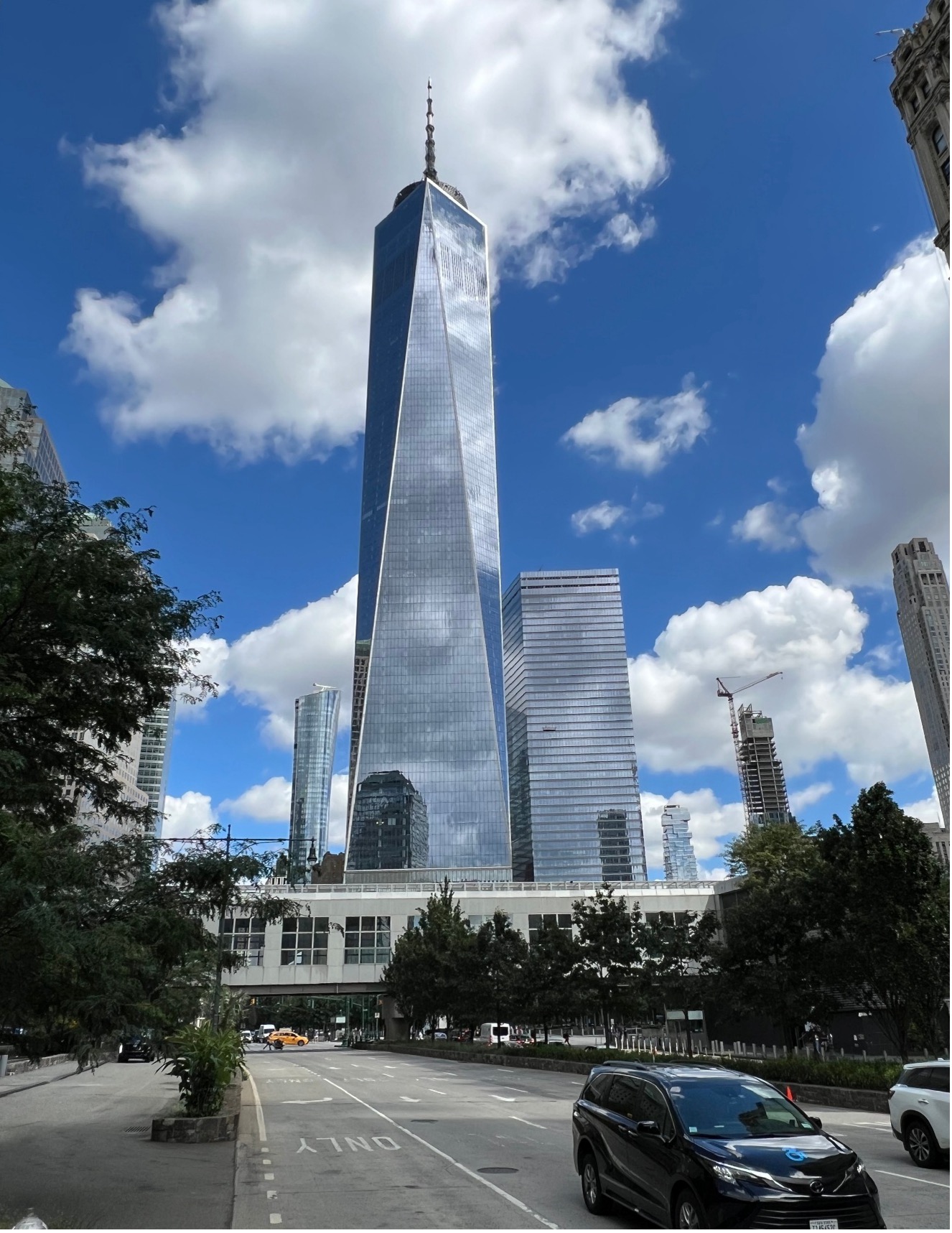
The Liberty Street Bridge connecting the World Trade Center and World Financial Center was destroyed on 9/11. Shown in the foreground, above, is the rebuilt bridge. Photo Credit: Sam Schwartz