Off to the Races: How Early Primary States Could Impact 2028 Candidates’ Transportation Agendas
While voters across the fifty states (and DC and the territories) all play a role in selecting parties’ presidential candidates, in reality, a small handful of states with early primaries often provide the momentum needed to carry candidates to the nomination. As such, campaigns dedicate a vastly disproportionate amount of time, money, and attention to early nominating states. The unique electorates and interests of these states can even alter candidates’ policy platforms and which issues campaigns elevate.
Case in point: as the longtime first in the nation contest, the Iowa caucuses have historically elevated one under-the-radar transportation issue to the forefront of presidential nominating politics. Candidates of both parties, ranging from climate advocates to proponents for limited government, have put aside ideological convictions to voice full-throated support for low carbon biofuels, specifically corn-based ethanol, under the pressure of appeasing an industry vital to the state’s economy. (Notably, however, Ted Cruz bucked the conventional wisdom in 2016, taking a rare stand against federal biofuel blend policies based on his free market convictions, yet won the state’s Republican contest.)
Earlier this month, the Democratic National Committee officially announced its slate of early nominating states. While the 2028 election is still two years away, the varied set of selected states may already provide insight on possible contours of the race and, of relevance to ETW readers, how early electorates may shape candidates’ transportation policies. In this article, we’ll profile how transportation interests of each of the selected early Democratic primary states, as well as some states likely to vote early in the yet-to-be-scheduled Republican contest, could shape policy platforms around major transportation issues.
South Carolina
On the Democratic side, the nominating race will kick off with the South Carolina primary. This southern state, key to Joe Biden securing the nomination in 2020, was elevated to this decisive first in the nation spot for a variety of reasons, foremost among them to allow a majority Black electorate to weigh in early in the contest. As a traditionally red state without the large metropolitan areas of some of its southern peers, the state’s transportation profile is far different from those with which most Democratic voters are familiar.
South Carolina is among the most car-dependent states in the union, with only 0.3% of commutes made by public transit – the fifth lowest transit mode share in the country. In this context, transit riders are unlikely to make up a significant voting bloc that candidates attempt to pursue in this initial contest. Transit riders are a relatively small subset of commuters across the country. However, in a state like Georgia, which competed with South Carolina for the chance to represent the South among the early nominating states, more voters are likely to have at least some exposure to transit usage. Georgians take transit at over four times the rate of South Carolinians, and the Atlanta-based Democratic electorate likely uses transit to a disproportionate degree compared to the state’s population at large. In South Carolina, by contrast, public transit may be too limited a mode to merit significant campaign discussion.
However, other transportation issues could come to the fore as candidates make their case to South Carolina voters. The Palmetto state sadly ranks third in the nation on fatalities per vehicle mile driven, suggesting traffic and pedestrian safety is a pressing issue that candidates could seek to address. Additionally, South Carolina is a leader in auto manufacturing, with a $27 billion auto industry, including Mercedes, BMW, and Volvo as well as major tire manufacturers. Aviation and aerospace manufacturing including Boeing are also large employers, and the state has a heavily trafficked seaport. These economic interests could impact candidates’ positions on a variety of related issues, including labor policies, tariffs, and protectionist regulations on vehicles.
Nevada
As the representative of the West, Nevada could offer candidates room to differentiate their views on electric vehicles. The state ranks third in the nation on electric vehicle adoption. With 6.7% of drivers owning either a hybrid or fully electric vehicle and, like transit ridership, likely an even higher figure among the Democratic electorate, issues like EV fees, import restrictions, and delays in charging infrastructure implementation could have personal resonance to members of a significant voting bloc.
Nevada’s population concentration around urban Las Vegas could allow transit to play more of a role in the state’s contest. The state ranks 12th in transit usage, with 2.5% of commuters depending on public transportation on a daily basis. This could prove especially relevant for the state’s influential labor unions, who serve as the backbone for Las Vegas’ tourism industry.
Meanwhile, candidates could score political points defending or attacking bold transportation projects springing up around the state. Elon Musk’s controversial Hyperloop project, a streamlined automobile tunnel of sorts which received local government subsidies, could serve as a target for Democratic animus. Federal subsidies toward the Brightline West project to connect Southern California and Las Vegas by high speed rail could serve as a punching bag for Republicans concerned about government waste, though the Trump administration has largely supported the private-run endeavor. Increasing rollout of robotaxis across Las Vegas could bring the issue of autonomous vehicles to the fore, especially in the face of labor concerns.
New Hampshire
New Hampshire falls near the middle of the pack on most surface transportation statistics. Transportation issues addressing voters across the country, including gas prices and road condition, are likely to resonate in the Granite State. While New Hampshire’s transportation profile is relatively average among the country at large, in the context of the Northeast region it represents in the early nominating contests, the state is more of an outlier. Much of the region’s population is concentrated in urban areas like Philadelphia, New York, and Boston where traffic congestion and transit access are likely to be top of mind to voters. These interests are unlikely to be represented on the rural roadways and small towns of New Hampshire, which ranks 38th in transit ridership.
New Mexico
Heading to the Southwest, New Mexico’s open roads have been plagued with problems. With 34% of miles of the state’s roads falling short of USDOT’s definition of acceptable, New Mexico ranks fourth lowest in the country on the condition of its roadways. Pedestrian safety has significantly improved in the state over recent years through implementation of vision zero policies, dropping from the most traffic deaths per capita to the number three position, but remains a major issue. With the state DOT facing a serious financial shortfall, a candidate who seizes on the issue of public roadways and credibly promises to address it could considerably impact voter opinion.
The state’s large share of public and tribal lands could also direct focus to dedicated federal funding streams for transportation upgrades in more rural and remote areas.
Michigan
As the historic hub of the American automaking industry, Michigan will likely play host to debates around industry and labor concerns around car manufacturing. The United Auto Workers (UAW) on one side and car-manufacturers General Motors (GM) and Ford on the other represent two particularly potent political forces within the state. The two sides may push candidates on the same direction on certain issues, like trade protectionism meant to bolster American auto manufacturers against foreign competitors. However, they are likely to pull candidates in opposite directions on labor concerns. Tariffs recently announced on car parts manufactured in Canada could be a particularly contentious issue if tensions are not yet resolved.
Beyond its auto industry, Michigan largely falls in the middle of the road on most transportation metrics. The choice of a Midwestern state with both the urban hub of Detroit and significant small town and rural populations lends the state some familiarity with transit (1% ridership) but not a hugely significant role. In some ways, it represents a middle ground between two other states seriously floated to host the Midwest’s early nominating contest. Iowa – which has been dislodged from its traditional opening role by the DNC but still could opt to hold an unrecognized first in the nation contest based on state law – traditionally has drawn candidates to barnstorm in a rural, low-density state. Meanwhile, if Illinois had proven successful in vying for the early position, the state could have played host to a transit-heavy campaign focused on the Chicagoland region, which dominates the state’s Democratic electorate.
Virginia
Virginia comes in highest among the early nominating states on transit usage, with 3% of commuter travelling by public transportation each day – largely due to Metrorail ties to adjacent Washington, DC, as well as the Virginia Railway Express commuter rail system and bus networks for local hubs. High-propensity Democratic voters concentrated in the densely populated Northern Virginia area could bring candidate attention to the area’s traffic conditions, its pioneering use of transit oriented development, and is utilization of public private partnership-enabled express roads. However, with 22% of roads ranked in unacceptable conditions, worse than the national average, transportation issues could also expose a divide between the DC commuter belt and rural regions across the state.
Continual concern over air safety following the January 2025 crash near DCA, as well as President Trump’s proposed changes to Dulles airport, could additionally motivate candidates to stake out positions on pressing aviation issues.
Analysis

Looking at mode share across the DNC’s selected early nominating states, all fall below the national average in terms of transit mode share. This national mean is driven significantly upwards by the outlier of New York, where nearly a quarter of residents rely on mass transit, as well as dense regions in New Jersey, Massachusetts, and Illinois. Notably, the DNC’s slate of early nominating states fails to include any of these urban-dominated, population-rich states central to the national Democratic electorate. However, early nominating states have often been picked not just to represent Democratic voters, but the kinds of swing state voters that the party will rely upon in the general election. By this metric, it may make more sense to pick states closer to the median, rather than mean, transportation profile.
Still, states with unique transportation profiles – namely transit-heavy New York and electrification leader California – will have a chance to steer candidates’ platforms if close competition drives the nominating contest out past the early states. With large delegate counts up for grabs, candidates will be forced to consider contentious issues facing these states, such as Hudson Tunnel funding and congestion pricing in New York, and high speed rail and vehicle emission regulations in California, if it turns out to be a close race.
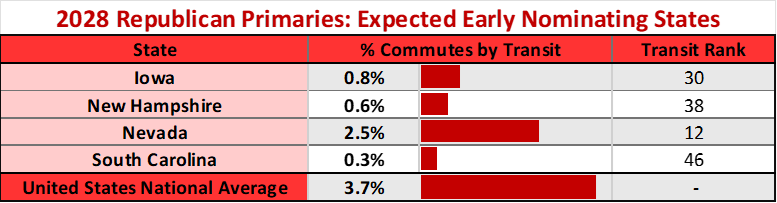
On the Republican side, while the official nominating contest is yet to be announced, most expect it will stick closely to the traditional roster of early states, most of which are also included within the Democratic slate of early states. Given the largely rural nature of three of these four states, as well as the concentration of Republican primary voters outside of urban areas, automotive-focused transportation issues are likely to drive any primary debate. Presuming Iowa retains its position on the Republican side, candidates are likely to be forced to seriously grapple with the issue of whether to support or shun ethanol for the first time since 2016, when Ted Cruz succeeded in the state despite bucking the state’s pro-biofuels norm, but ultimately failed to win over the national electorate.