
House Votes Down CR As Senate Stays Stalled
A lapse-of-appropriations government shutdown starting this weekend is increasingly likely after the House today fell 18 votes short of passing a one-month extension of (reduced) funding levels. Meanwhile, the Senate is advancing a bipartisan six-week stopgap funding bill, but procedural hurdles in that chamber mean that a vote probably won’t occur until Sunday, and even then, there no guarantee that the House will ever consider a Senate-passed bill.
After a week of stalemate, the GOP was finally showing some momentum in the House. Starting at about 10:30 p.m. last night, the House started voting on final passage of appropriations bills. First, the State Department/Foreign Operations bill (H.R. 4665 – lots of spending cuts, but to programs that no Republicans like anymore) passed by just two votes, 216 to 212. Then, the Defense bill (H.R. 4365 – spending increases, not cuts) passed by four votes, 218 to 220. Then the Homeland Security bill (H.R. 4367 – spending increases, not cuts) passed by six votes, 220 to 208.
Jammed in there in the middle was a bipartisan, 311 to 117 vote on a separate bill (H.R. 5692) providing $300 million in defense aid for Ukraine that had been stripped out of the Defense bill.
But then the House finally voted on the Agriculture bill (H.R. 4368), which had a fatal combination of massive spending cuts to farm programs popular with farm-state Republicans, and a policy proviso overriding a decision made by the FDA to allow mail-order sales of an abortion drug popular with moderate Republicans. That bill failed, falling 24 votes short of passage (191 to 237), with 27 Republicans voting “no.”
Shortly thereafter, just after midnight, leaders released the text of modifications they intended to make to their continuing resolution (H.R. 5525). As introduced, that legislation extended fiscal 2023 appropriations for one month, but took an 8.13 percent across-the-board cut out of them (except for national defense programs and the Department of Veterans Affairs), and added the GOP’s immigration reform and border enforcement bill. The new amendments unveiled at midnight did two things: changed the across-the-board cut from 8.13 percent to 29.89 percent, and created another bipartisan commission with fast-track authority to solve the financial problems too difficult for Congress to address themselves.
For comparison, the 29.89 percent across-the-board cut would cost the Federal Aviation Administration Operations account $297 million during the one month of the duration of the CR, compared with the level in the Senate CR or any other “clean” CR.
The House actually voted to add these new provisions to H.R. 5525 by a party-line vote, despite a new White House veto threat. But then the House voted down the underlying amended bill, 198 to 232:
| Yea | Nay | NV | |
| GOP | 198 | 21 | 2 |
| Dem | 211 | 1 | |
| Total | 198 | 232 | 3 |
(The GOP “no” votes were Reps. Biggs (AZ), Bishop (NC), Boebert (CO), Buck (CO), Burchett (TN), Burlison (MO), Cloud (TX), Crane (AZ), Gaetz (FL), Gosar (AZ), Greene (GA), Hunt (TX), Mace (SC), Miller (IL), Mills (FL), Mooney (WV), Moore (AL), Nehls (TX), Ogles (TN), Rosendale (MT), and Self (TX).)
The House then started killing time until a 4 p.m. closed-door GOP member meeting to figure out what to do next.
Meanwhile, the Senate is killing time waiting for “cloture” petitions to “ripen.” Yesterday afternoon, the Senate brought up the House-passed FAA bill, and Majority Leader Schumer then offered a completely new bill as a replacement. The new bill is a six-week CR that also includes $6 billion for Ukraine and $6 billion for disaster relief and the FAA extension and a host of health care extensions and the flood insurance extension. Schumer then filed cloture on that amendment, and on the bill itself.
By rule, the next cloture vote is one hour after the Senate convenes on Saturday. If leaders were in a real hurry, they could adjourn at 11:59 pm tonight and then bring the Senate back in at 12:01 a.m. tomorrow morning and hold the vote then, but they appear to be holding the next vote at a normal 11 a.m. Saturday timeframe, perhaps acknowledging that the 30 hours of postcloture debate, then the next cloture vote on the bill itself, then the 30 hours, will not get yielded back, shutdown or no shutdown, so there is no sense of urgency.
Sen. Ron Johnson (R-WI) this afternoon sent around the text of a “clean” two-week CR to see if anybody objected, but they probably will. The amendment situation, and the timing of the Senate vote on the CR sometime Sunday or early next week, is still unclear.
Meanwhile, the House had been scheduled to be in recess for the first two weeks of October, but the optics of being on vacation while the government is closed are just terrible, so the House Majority Leader has announced that the House will be in session. During the ongoing closed-door GOP meeting, leaders just proposed a schedule to continue debating appropriations bills during this period, and that proposed schedule calls for the House to debate the Transportation-HUD funding bill on October 11-13.
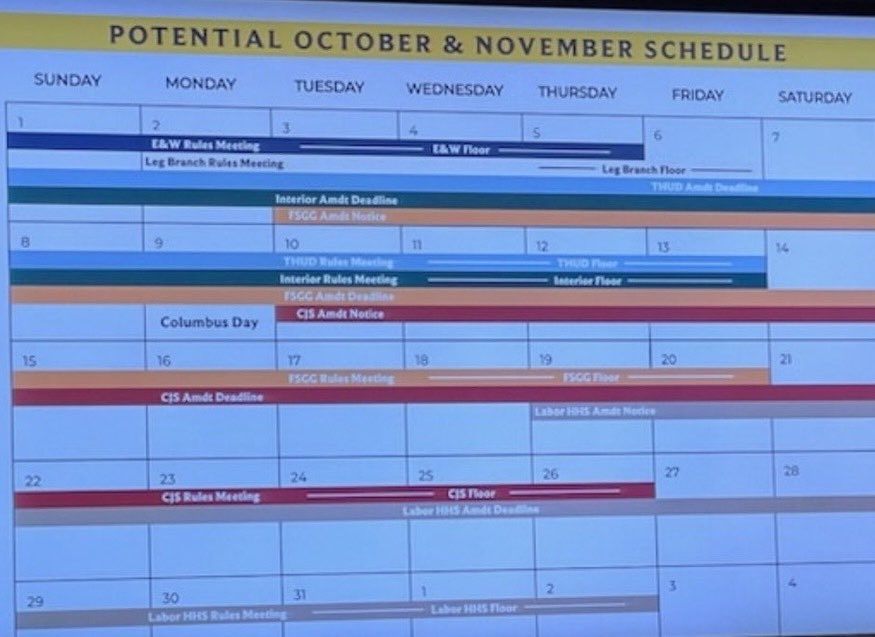
As things stand now, a lapse-of-appropriations shutdown will start at 12:01 a.m. on Sunday morning, but employees who normally don’t work Sunday won’t be affected until first thing Monday morning, when they will be advised of their furlough and pay status.
Search Eno Transportation Weekly
Happening on the Hill
Tags
Related Articles
 https://enotrans.org/wp-content/uploads/2025/12/Coast-Guard.jpg
1414
2121
kferrell
https://enotrans.org/wp-content/uploads/2022/12/Eno-Logo-2.png
kferrell2025-12-19 14:59:172025-12-19 15:48:29The Coast Guard’s Ongoing Experience with New Technology
https://enotrans.org/wp-content/uploads/2025/12/Coast-Guard.jpg
1414
2121
kferrell
https://enotrans.org/wp-content/uploads/2022/12/Eno-Logo-2.png
kferrell2025-12-19 14:59:172025-12-19 15:48:29The Coast Guard’s Ongoing Experience with New Technology https://enotrans.org/wp-content/uploads/2025/10/maritime.jpg
1498
2000
kferrell
https://enotrans.org/wp-content/uploads/2022/12/Eno-Logo-2.png
kferrell2025-10-24 15:18:312025-10-24 16:18:01Senate Commerce Committee Holds Hearing on Maritime-Related nominations
https://enotrans.org/wp-content/uploads/2025/10/maritime.jpg
1498
2000
kferrell
https://enotrans.org/wp-content/uploads/2022/12/Eno-Logo-2.png
kferrell2025-10-24 15:18:312025-10-24 16:18:01Senate Commerce Committee Holds Hearing on Maritime-Related nominations https://enotrans.org/wp-content/uploads/2025/09/Maritime-Fuel-scaled.jpg
1440
2560
kferrell
https://enotrans.org/wp-content/uploads/2022/12/Eno-Logo-2.png
kferrell2025-09-12 16:10:312025-09-12 16:10:31Maritime Decarbonization – US Moves Pale Next to IMO’s
https://enotrans.org/wp-content/uploads/2025/09/Maritime-Fuel-scaled.jpg
1440
2560
kferrell
https://enotrans.org/wp-content/uploads/2022/12/Eno-Logo-2.png
kferrell2025-09-12 16:10:312025-09-12 16:10:31Maritime Decarbonization – US Moves Pale Next to IMO’s https://enotrans.org/wp-content/uploads/2025/05/cargo-theft-scaled.jpg
1707
2560
kferrell
https://enotrans.org/wp-content/uploads/2022/12/Eno-Logo-2.png
kferrell2025-05-02 14:42:202025-05-02 16:00:17Roundtable: Combatting Cargo Theft: Stakeholder Perspectives
https://enotrans.org/wp-content/uploads/2025/05/cargo-theft-scaled.jpg
1707
2560
kferrell
https://enotrans.org/wp-content/uploads/2022/12/Eno-Logo-2.png
kferrell2025-05-02 14:42:202025-05-02 16:00:17Roundtable: Combatting Cargo Theft: Stakeholder Perspectives  https://enotrans.org/wp-content/uploads/2025/04/Shipbuilding.jpg
1500
2000
Jeff Davis
https://enotrans.org/wp-content/uploads/2022/12/Eno-Logo-2.png
Jeff Davis2025-04-11 15:28:302025-05-01 11:38:19Trump Signs Shipbuilding Executive Order
https://enotrans.org/wp-content/uploads/2025/04/Shipbuilding.jpg
1500
2000
Jeff Davis
https://enotrans.org/wp-content/uploads/2022/12/Eno-Logo-2.png
Jeff Davis2025-04-11 15:28:302025-05-01 11:38:19Trump Signs Shipbuilding Executive Order https://enotrans.org/wp-content/uploads/2023/02/port-authority-of-new-york-and-new-jersey-freight-maritime-sea-scaled-2.jpg
1707
2560
Jeff Davis
https://enotrans.org/wp-content/uploads/2022/12/Eno-Logo-2.png
Jeff Davis2025-02-07 14:14:262025-02-07 14:14:26House Maritime Subcommittee Sets Sail into 119th
https://enotrans.org/wp-content/uploads/2023/02/port-authority-of-new-york-and-new-jersey-freight-maritime-sea-scaled-2.jpg
1707
2560
Jeff Davis
https://enotrans.org/wp-content/uploads/2022/12/Eno-Logo-2.png
Jeff Davis2025-02-07 14:14:262025-02-07 14:14:26House Maritime Subcommittee Sets Sail into 119th https://enotrans.org/wp-content/uploads/2023/01/cargo-supply-chain-freight-port-maritime-boat-shipping.jpg
1396
2146
Jeff Davis
https://enotrans.org/wp-content/uploads/2022/12/Eno-Logo-2.png
Jeff Davis2024-12-13 14:24:142024-12-13 14:24:14Water, Defense/Maritime Bills Advance in House
https://enotrans.org/wp-content/uploads/2023/01/cargo-supply-chain-freight-port-maritime-boat-shipping.jpg
1396
2146
Jeff Davis
https://enotrans.org/wp-content/uploads/2022/12/Eno-Logo-2.png
Jeff Davis2024-12-13 14:24:142024-12-13 14:24:14Water, Defense/Maritime Bills Advance in House https://enotrans.org/wp-content/uploads/2023/02/inland-waterways-water-ohio-river-dam.jpg
1413
2121
Jeff Davis
https://enotrans.org/wp-content/uploads/2022/12/Eno-Logo-2.png
Jeff Davis2024-12-06 13:45:112024-12-06 13:45:11Biennial WRDA Bill Transfers $2B in Unused Highway TIFIA Funding to States
https://enotrans.org/wp-content/uploads/2023/02/inland-waterways-water-ohio-river-dam.jpg
1413
2121
Jeff Davis
https://enotrans.org/wp-content/uploads/2022/12/Eno-Logo-2.png
Jeff Davis2024-12-06 13:45:112024-12-06 13:45:11Biennial WRDA Bill Transfers $2B in Unused Highway TIFIA Funding to States https://enotrans.org/wp-content/uploads/2023/07/iStock-1415497169-scaled.jpg
1707
2560
Jeff Davis
https://enotrans.org/wp-content/uploads/2022/12/Eno-Logo-2.png
Jeff Davis2024-10-04 11:56:412024-10-04 11:56:41East Coast Port Strike Suspended Until January
https://enotrans.org/wp-content/uploads/2023/07/iStock-1415497169-scaled.jpg
1707
2560
Jeff Davis
https://enotrans.org/wp-content/uploads/2022/12/Eno-Logo-2.png
Jeff Davis2024-10-04 11:56:412024-10-04 11:56:41East Coast Port Strike Suspended Until January https://enotrans.org/wp-content/uploads/2023/04/capitol-capital-congress-senate-house-scaled-2.jpg
1707
2560
Jeff Davis
https://enotrans.org/wp-content/uploads/2022/12/Eno-Logo-2.png
Jeff Davis2024-09-27 15:07:502024-09-27 15:07:50Senate Commerce Holds Final Nominations Hearing of 2024
https://enotrans.org/wp-content/uploads/2023/04/capitol-capital-congress-senate-house-scaled-2.jpg
1707
2560
Jeff Davis
https://enotrans.org/wp-content/uploads/2022/12/Eno-Logo-2.png
Jeff Davis2024-09-27 15:07:502024-09-27 15:07:50Senate Commerce Holds Final Nominations Hearing of 2024 https://enotrans.org/wp-content/uploads/2023/04/iStock-1134061703-scaled-2.jpg
1707
2560
Jeff Davis
https://enotrans.org/wp-content/uploads/2022/12/Eno-Logo-2.png
Jeff Davis2024-09-20 13:31:492024-09-20 13:32:46US Sues Owners of DALI for Key Bridge Response Costs
https://enotrans.org/wp-content/uploads/2023/04/iStock-1134061703-scaled-2.jpg
1707
2560
Jeff Davis
https://enotrans.org/wp-content/uploads/2022/12/Eno-Logo-2.png
Jeff Davis2024-09-20 13:31:492024-09-20 13:32:46US Sues Owners of DALI for Key Bridge Response Costs https://enotrans.org/wp-content/uploads/2023/07/iStock-1168247335-scaled.jpg
1707
2560
Jonathan Hammond
https://enotrans.org/wp-content/uploads/2022/12/Eno-Logo-2.png
Jonathan Hammond2024-07-12 15:14:182024-07-12 15:14:18Senate Assesses Aftermath of Francis Scott Key Bridge Collapse
https://enotrans.org/wp-content/uploads/2023/07/iStock-1168247335-scaled.jpg
1707
2560
Jonathan Hammond
https://enotrans.org/wp-content/uploads/2022/12/Eno-Logo-2.png
Jonathan Hammond2024-07-12 15:14:182024-07-12 15:14:18Senate Assesses Aftermath of Francis Scott Key Bridge Collapse
