Hearing: Air Traffic Control Still Needs Significant Improvement
On Thursday, December 12, the U.S. Senate Science, Commerce, and Transportation Subcommittee on Aviation Safety, Operations, and Innovation held a hearing titled “U.S. Air Traffic Control Systems, Personnel and Safety.” The Subcommittee called on several witnesses to provide insights into safety issues facing U.S. airspace, particularly the Federal Aviation Administration (FAA) and its air traffic control operations.
Witness List
- Kevin Walsh, Director, Information Technology and Cybersecurity, Government Accountability Office (GAO)
- Dean Iacopelli, Chief of Staff, National Air Traffic Controller Association (NATCA)
- Capt. Jason Ambrosi, President, Air Line Pilots Association (ALPA)
- Dave Spero, National President, Professional Aviation Safety Specialists, AFL-CIO (PASS)
- Marc Scribner, Senior Transportation Policy Analyst, Reason Foundation
Context
Thursday marked this Senate Commerce Committee’s 12th hearing related to aviation technology and safety. There have been growing calls among members of Congress and within the aviation industry for increased action on issues related to air traffic control, aviation technology, oversight, and safety. The GAO released a report highlighting critical infrastructure issues with FAA air traffic control operations. Among its findings, the report found that around one third of FAA air traffic control systems are “unsustainable.” Subcommittee chair Sen. Tammy Duckworth (D-IL) and full Committee ranking member Sen. Ted Cruz (R-TX) highlighted the urgent need to modernize ATC operations and that working within an outdated ATC system is cause for great concern.
Members referenced a January 2023 incident when the Notice to Air Missions (NOTAM) applications became unreliable. The FAA ordered a ground stop, pausing all flight departures in the United States during the morning of January 11, 2023, giving time to resolve the issue with NOTAM. The NOTAM is a critical system that provides real time status and any abnormal information regarding the National Airspace System (NAS). NOTAM relies on both legacy and newer systems, with the legacy system operating on 30-year-old software. Members pointed to this incident as an example of the urgent need for increased ATC modernization efforts.
Full committee chair Sen. Maria Cantwell (D-WA) referenced several safety incidents, including the Alaska Airlines incident of a door blowing off the aircraft during a scheduled flight. The senator referred to this and several notable and recent airline crashes as examples of the urgent need for increased aviation safety. Members and witnesses agreed that the United States has an incredibly safe airspace. Yet, everyone was in agreement that improvements in ATC operations were crucial in ensuring and maintaining the safety of the national airspace for the flying public and the thousands of personnel working in aviation. As such, the discussion focused on several elements of air traffic control: infrastructure needs, staffing/personnel needs, and some discussions on the fundamental questions of air traffic control and governance.
Infrastructure Needs
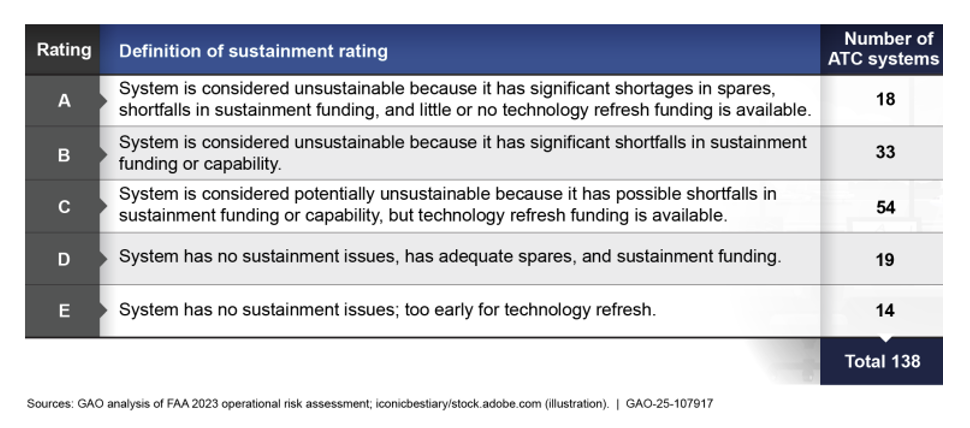
Walsh, in his opening remarks, discussed some of the findings of the December 2024 GAO report on ATC systems and operations. According to Walsh, the 138 ATC systems monitor weather, conduct surveillance, facilitate communications, and manage flight operations. These functions maintain NAS safety and operation. The GAO report noted that 18 systems are especially concerning, and the FAA did not have investment plans for four of these systems. Figure 1 shows the FAA’s sustainment ratings, from E representing no issues to A representing systems that are unsustainable. Walsh expressed concern that outdated ATC systems paired with FAA investment plans that take many years to implement are concerning given the growing demand for air travel.
Figure 1. Federal Aviation Administration (FAA) Air Traffic Control (ATC) System Sustainment Ratings
Iacopelli noted that the average FAA control tower is around 30 years old. Some towers are 50 to 60 years old, operating with equipment that is not manufactured anymore. The issue of old infrastructure exists at large, urban airports and in smaller, rural areas. Sen. Peter Welch (D-VT) noted that upgrades at smaller and rural airports are necessary. Smaller and rural airports can be a connection for rural residents to larger metropolitan areas, underlining the value in upgrading ATC infrastructure at both large metropolitan airports and smaller airports.
Responding to Sen. Duckworth, Iacopelli reiterated that the airspace is safe, but there is cause for concern about the aging infrastructure. Specifically, he noted that the FAA Telecommunications Infrastructure (FTI) is not sustainable. The FTI network uses copper wiring for its connections, which Iacopelli argued is not sustainable and should be replaced with fiber optic connections.
In his opening remarks, Captain Ambrosi discussed the importance of the Next Generation Air Transportation System, or NextGen. NextGen is a large-scale FAA effort to modernize the NAS, including programs to improve communications, navigation, automation, information management, weather, safety management, and research and development. NextGen represents a comprehensive strategy to prepare the NAS for the future, and Ambrosi noted that there are NextGen capabilities that increase situational awareness and provide pilots with necessary tools. However, Ambrosi added that the system potential has not been fully realized.
Staffing and Personnel Needs
A common theme throughout this hearing and past hearings is that flying in the U.S. remains safe, but the aviation infrastructure in place is aging and in urgent need of improvement. In thinking about how the U.S. airspace remains safe despite aging infrastructure, there is one important component that could explain such a premise: the people on the ground and in the air.
Thousands of pilots, technicians, managers, air traffic controllers, airport/airline staff, in-flight attendants, and other aviation specialists are constantly at work, keeping things running. In the quest for ensuring aviation safety, the human element is invaluable (dare I say, irreplaceable). Responding to Sen. Duckworth, Spero noted that people like pilots and technicians find creative workarounds to operate with aging infrastructure and technology. But Spero highlighted that it will get harder for people in aviation to maintain systems that are only getting older.
At numerous points in the hearing, Iacopelli echoed the sentiment of staffing needs, pointing to the FAA Reauthorization Act of 2024’s maximum hiring requirement for five years. He noted that NATCA is working with the FAA to promote hiring, college training initiatives, and improve the success rate of training. To achieve all the personnel-related goals, Iacopelli emphasized the need for more funding.
Ambrosi discussed another staffing element: having multiple personnel working together. Whether on the ground or in the air, having two heads can prevent a near miss or something catastrophic. For example, one person is looking down at a system display, showing important information and one person is looking up, to see the real-time ground conditions. That requires two people, working together to ensure safety and smooth operations.
Fundamental Questions
Ambrosi’s line at the end of his opening testimony underlined a distinction between sustainment and modernization. Sen. Cantwell began her questioning with an emphasis on that distinction, suggesting that it was an important dilemma. ATC infrastructure is aging, and it is important to maintain operations and modernize operations with newer technologies. Members and witnesses discussed the idea that it is best to avoid a trade-off between maintenance and modernization. The discussion suggested that to ensure the safety of the flying public, the FAA ought to properly maintain and modernize air traffic control to reflect new innovations in technology.
In his opening testimony, Scribner argued the need for institutional change within the governance structure of aviation. He referenced a previous Reason Foundation study which suggested five issues within the current structure of the FAA and ATC. As a method to resolve issues in management, technical expertise, and bureaucracy, Scribner pointed to various other countries which have separated air traffic control operations from the civil aviation regulatory structure. Funding a separate ATC system would come from a “public utility model.” In this model, the air traffic control provider is paid directly by customer, using user-based fees. Towards the end of the hearing, Sen. Dan Sullivan (R-AK) voiced his concern with the idea of privatization of air traffic control operations. The senator noted that smaller and rural airports would lose out under any privatization of air traffic control, suggesting that government is best equipped to ensure the success of smaller and rural airports. (Ed. Note: The Eno Center has done some work on this issue in the past.)
Key Takeaways
Ranking member Cruz began his questioning by asking Walsh to summarize the current ATC system. Walsh responded by saying the current system is best characterized by the phrase, “if it ain’t broke, don’t fix it over many years.” Walsh added that beyond funding, there is a need for oversight, training, and hiring. Improving the ATC system is not a quick fix, and as Walsh noted, will take years, billions of dollars, and the efforts of many people. Responding to Sen. Jacky Rosen (D-NV), Iacopelli emphasized the importance of the FAA being adequately funded to deploy various programs quickly and effectively. Responding to Sen. Amy Klobuchar (D-MN), Ambrosi encapsulated a key takeaway in a single phrase: “it’s an all of the above strategy.”