Governing, Aligning and Adapting in Transportation’s AI Era
Transportation agencies are navigating a period of profound change. Artificial intelligence, automation, digital delivery and connected infrastructure are no longer distant concepts; they are practical tools reshaping how agencies plan, build, operate and maintain the systems that connect people to opportunity. In Texas, rapid growth is adding people, freight, economic activity, and higher expectations for the Texas Department of Transportation (TxDOT). Across the country, agencies face added pressure from aging infrastructure, workforce constraints, severe weather, rising costs, and limited revenue sources.
Drawing from TxDOT’s experience, three themes stand out for transportation agencies seeking to leverage AI and emerging technologies to help meet these challenges: responsible governance, enterprise alignment, and strategic adaptation. Responsible governance ensures powerful tools are used transparently, securely, and accountably. Enterprise alignment moves promising innovations from pilots to scalable agency capabilities. Strategic adaptation helps agencies continuously align with changing technology, public expectations, and operational demands.
AI offers both opportunity and responsibility in this moment. It can accelerate analysis, automate repetitive processes, and give professionals better information sooner. But the question is not whether these technologies will influence transportation; they already are doing so. The question is how state and local agencies are prepared to use them effectively to strengthen public trust, improve performance, and preserve human judgment. Transportation must remain human-led and technology-supported, with people accountable for decisions, outputs and safety-critical judgments.
Responsible Governance
Responsible governance is the foundation for public-sector innovation. Every transportation agency considering AI should have a clear roadmap for integrating it responsibly into operations. At TxDOT, that work is guided by an agency-wide Artificial Intelligence Strategic Plan focused on five connected priorities: optimizing infrastructure, improving data-driven decision-making, enhancing the stakeholder experience, unlocking workforce potential, and incorporating security and data privacy safeguards. For any agency, the broader objective is the same: use emerging technologies to improve safety, reliability, efficiency, and service delivery while ensuring transparency, accountability, and public value.
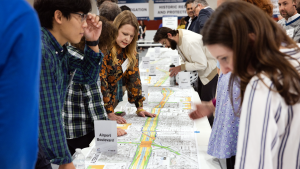
Photo credit: Texas Department of Transportation
This kind of governance is not intended to slow innovation. It allows innovation to scale with confidence. AI systems are only as reliable as the data, models, and assumptions behind them, so strong data standards, validation and monitoring must be part of every deployment. Cybersecurity and privacy must also remain priorities. The same principles that guide responsible AI adoption at TxDOT—transparent data use, accurate outputs, accountable human oversight, and trustworthy systems monitored for performance, bias, and fairness—are relevant for agencies of every size. Transportation agencies also need clear policies, risk reviews, vendor accountability, and continuous oversight after deployment.
Enterprise Alignment
Enterprise alignment effectively turns promising tools into agency capabilities. At TxDOT, the focus has been on empowering our teams to not only use AI, but to increasingly build the technology solutions the agency relies on. For transportation agencies, the question is not simply what can we do with AI, but what can we build with AI. For TxDOT, this means an enterprise AI capability model that aligns with three groups: everyday users, power users, and solution builders. Everyday users apply AI to draft, summarize, search and organize information more efficiently. Power users apply AI to more complex workflows, recurring business processes, and operational needs. Solution builders use secure enterprise platforms and frontier AI models to integrate organizational data, apply domain-specific logic, and develop custom business applications. The goal is to make appropriate AI tools and technical capabilities available in secure, cost effective and structurally aligned ways so teams across the organization have the right resources to serve business needs at scale.

Photo credit: Texas Department of Transportation
That alignment also depends on developing our people. At TxDOT, training resources and AI champions help employees build proficiency, share user experiences, and encourage growth in AI use and development. Together, those resources give employees opportunities to hear from peers, see practical examples, and apply new tools in ways that translate enterprise capability into solutions shaped by those closest to the work. The goal is not to replace judgment and experience; it is to give employees better information, stronger capabilities and more time for the critical thinking and public service that only people can provide.
Strategic Adaptation
Strategic adaptation is how transportation agencies continuously align their work with changing technology, public expectations and operational demands while staying focused on their missions. The pace of AI development makes that need especially clear. Over the past two years, TxDOT developed its first AI Strategic Plan, revised it, and now finds that even a version only months old does not fully reflect the current state of practice. That is not a sign of failure; it is a reminder that AI requires agencies to continuously adjust and update their approach.
This shift is also about more than AI tools. Transportation agencies are increasingly investing in digital infrastructure alongside physical assets. In other words, agencies are designing, building, operating and maintaining roads and bridges in both physical and digital environments. Digital infrastructure is taking shape through 3D design and digital delivery, digital twins that provide virtual representations of infrastructure assets, and connected real-time management that leverages field sensors, cameras and V2X communications. These tools improve design visualization, constructability review, incident response and lifecycle decisions that enable agencies to turn evolving AI capabilities into more proactive, data-informed designs and operations.
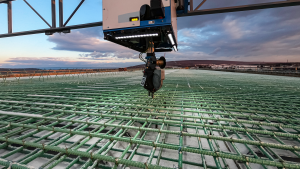
Photo credit: Texas Department of Transportation
Looking ahead, we should expect the pace of AI and technology change to accelerate. The systems we rely on today will continue to evolve into more advanced platforms that combine digital agents, multimodal interfaces, robotics, and physical AI capable of perceiving, reasoning, and acting in real-world environments. Meeting that moment will require transportation agencies to become more adaptive enterprises while maintaining trust through disciplined oversight, connecting people and data, and adjusting as technology and public needs change. While our future is increasingly digital, connected and intelligent, our responsibility remains deeply human: to serve the public, protect lives, steward investments and build systems that expand opportunity.
Marc D. Williams, P.E., is Executive Director of the Texas Department of Transportation and Vice President of AASHTO
Last year, TXDOT’s AI Strategic Plan was featured in an Eno webinar. Learn More