Gerald R. Ford (1974-1977): A Ford, Not a Lincoln
This article is a part of our series From Lighthouses to Electric Chargers: A Presidential Series on Transportation Innovations

The only U.S. president never to have been elected president or vice president, Gerald Ford famously declared, “I am Ford, not a Lincoln.” Yet, as Henry Ford and Ford Motor Company were transformative in the history of US transportation, so was Gerald Ford a transformative president in US transportation policy.
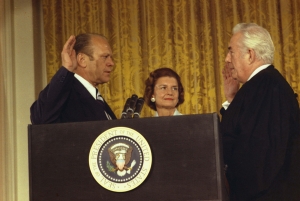
Gerald Ford taking the oath of office, minutes after Richard Nixon resigned in August 1974.
The Ford Administration initiated the economic deregulation of the transportation industry, a bipartisan revolution carried forward by the Carter and Reagan Administrations, that opened the skies for all Americans to fly and greatly enhanced the efficiency and delivery of transportation services.
Former Federal Reserve Chair Alan Greenspan called this Ford’s “great unsung achievement,” for which credit has largely been given to Carter and Reagan. In his biography, An Ordinary Man, Richard Norton Smith writes: “In fact all three men, each in his own way, were committed to loosening the regulatory straitjacket that frustrated innovation, stymied competition, and robbed consumers and taxpayers alike. Ford, however, was first out of the gate, when resistance to change was most entrenched.”
After 1887, when Grover Cleveland signed the Interstate Commerce Act to reign in the monopolistic railroads, federal agencies began to proliferate and bureaucracies expanded to micromanage the delivery of all kinds of products and services. In transportation, this meant approving routes, rates, and services, barring innovative new entrants, and entrenching inefficiencies such as requiring trucks to take circuitous routes to carry specified products and then return to their point of origin without any cargo. These inefficiencies, outmoded work rules and escalating labor costs were simply passed through to the consumer in fare and rate increases. Regulated companies and unions supported the status quo which protected them from new low cost competitors.
Faced with a crisis of spiraling inflation, Ford sought to address the root causes, including the embedded costs and inefficiencies of economic overregulation, costing families up to $2,000 a year. He checked in with former colleagues on Capitol Hill and identified some unanticipated bedfellows. Senator Ted Kennedy and his bright counselor Steven Breyer (later Justice Breyer), a Harvard Law administrative law professor, were intensely interested in airline deregulation. With Ford’s encouragement a bipartisan caucus of two dozen senators and representatives coalesced around the issue and attended a White House strategy session with the president.
Bipartisan support also came from the private and civic sectors. Consumer advocate Ralph Nader’s 1970 study of the Interstate Commerce Commission had depicted a stultified bureaucracy captured by the industry it was created to regulate. At a strategy meeting at the White House with reluctant independent agency heads, the president mused, according to Richard Norton Smith, “I don’t understand why we have an Interstate Commerce Commission.” The conservative leaning American Enterprise Institute published the studies of several scholars, including James Miller and George Eads, whose research demonstrated the inefficiencies of overregulation, citing the low fares, customer service, and route flexibilities of Southwest Airlines and Pacific Southwest Airlines which were state-chartered carriers not regulated by the federal Civil Aeronautics Board (CAB).
Ford established the Domestic Council Review Group on Regulatory Reform and assigned some of his most capable staffers, White House Counsel Rod Hills (husband of HUD Secretary Carla Hills and later Chair of the Securities and Exchange Commission), Deputy Counsel Ed Schmults, and Yale economist Paul McAvoy of the Council of Economic Advisors to work with Congress and Transportation Secretary Bill Coleman to develop legislation. Deputy Undersecretary of Transportation John Snow (later Secretary of the Treasury) chaired a taskforce of department policy advisors and lawyers to draft legislation deregulating the airlines, railroads and trucking industry.
In October 1975, the Ford administration proposed to Congress the first airline deregulation bill, which encouraged new low cost competitors, liberalized charter rules, phased in pricing flexibility and phased out “the inequitable, inefficient and uneconomical” CAB. Ford also appointed John Robson as Chairman of the CAB, who supported the president’s deregulation initiatives and introduced greater pricing and service flexibility within the confines of the existing statute.
In 1978, a modified bill phasing out the CAB and phasing in deregulation, the Airline Deregulation Act, was signed by into law by President Carter. In subsequent decades the airline industry has traveled a roller coaster ride though bankruptcies, new entrants, consolidation, low fare options, and national crises from 9/11 to Covid-19. Yet, the inflation-adjusted real price of flying fell 44.9% from 1978 to 2011, and there has been a more than a tripling of passenger miles flown since 1978. Air travel is no longer a luxury for the wealthy few but available to all Americans.
Although the Ford administration proposed airline, railroad and trucking deregulation, only one partial success was enacted during his term, the Railroad Revitalization and Regulatory Reform Act of 1976 (the 4R Act), based on a bill submitted by President Ford in May 1975. Addressing the railroad bankruptcy crisis, the act gave the railroads pricing flexibility and the ability to abandon unprofitable routes.
Drawing upon the intellectual support of academic and think tank studies, working in a bipartisan basis with Congress, and reaching out to the reluctant affected industries and unions, the Ford Administration built a solid foundation for regulatory reform which reached beyond transportation into telephones, banking and energy. The momentum for regulatory reform was firmly established, in a stark policy departure from Ford’s predecessor, Richard Nixon. Instead of expanding government economic regulation which too often served to protect the incumbent carriers, the focus shifted to incentivizing the private sector to innovate and compete in providing efficient less costly service to the consumer. Regulatory reform was warmly embraced by the Carter, Reagan and Clinton Administrations. Rare in U.S. history, outmoded government programs and agencies were phased out and terminated.
In November 1977, President Carter signed legislation deregulating the air freight industry, launching FedEx and overnight delivery services, and the following year, the entire domestic aviation industry. The CAB was abolished in 1984 and the ICC a decade later. Both the trucking industry and the Teamsters union fought Ford’s Motor Carrier Reform Act viciously, but in 1980, President Carter signed the Motor Carrier Act, removing constraints on trucking and the Staggers Rail Act, completing the work of Ford’s 4R Act.
Deregulating international aviation took longer, starting in 2009, but today the US has over 100 Open Skies agreements permitting route and pricing flexibility in international air service.
The consumer and cost saving benefits of Ford’s deregulation initiatives may be one of the most under told stories in the history of transportation. But there are other initiatives in Ford’s transportation policies that also laid a foundation for future administrations.
Faced with the 1973 oil crisis, Ford emphasized energy conservation in transportation. He advocated for more fuel-efficient vehicles and encouraged the development of alternative energy sources, setting the stage for the response of subsequent administrations to the impact of climate change.
Central to energy efficiency was Ford’s support for alternatives to the automobile. He signed the National Mass Transportation Assistance Act of 1974, authorizing $11.8 billion in funding for mass transit and covering operating costs as well as construction costs, while emphasizing cost-efficiency.
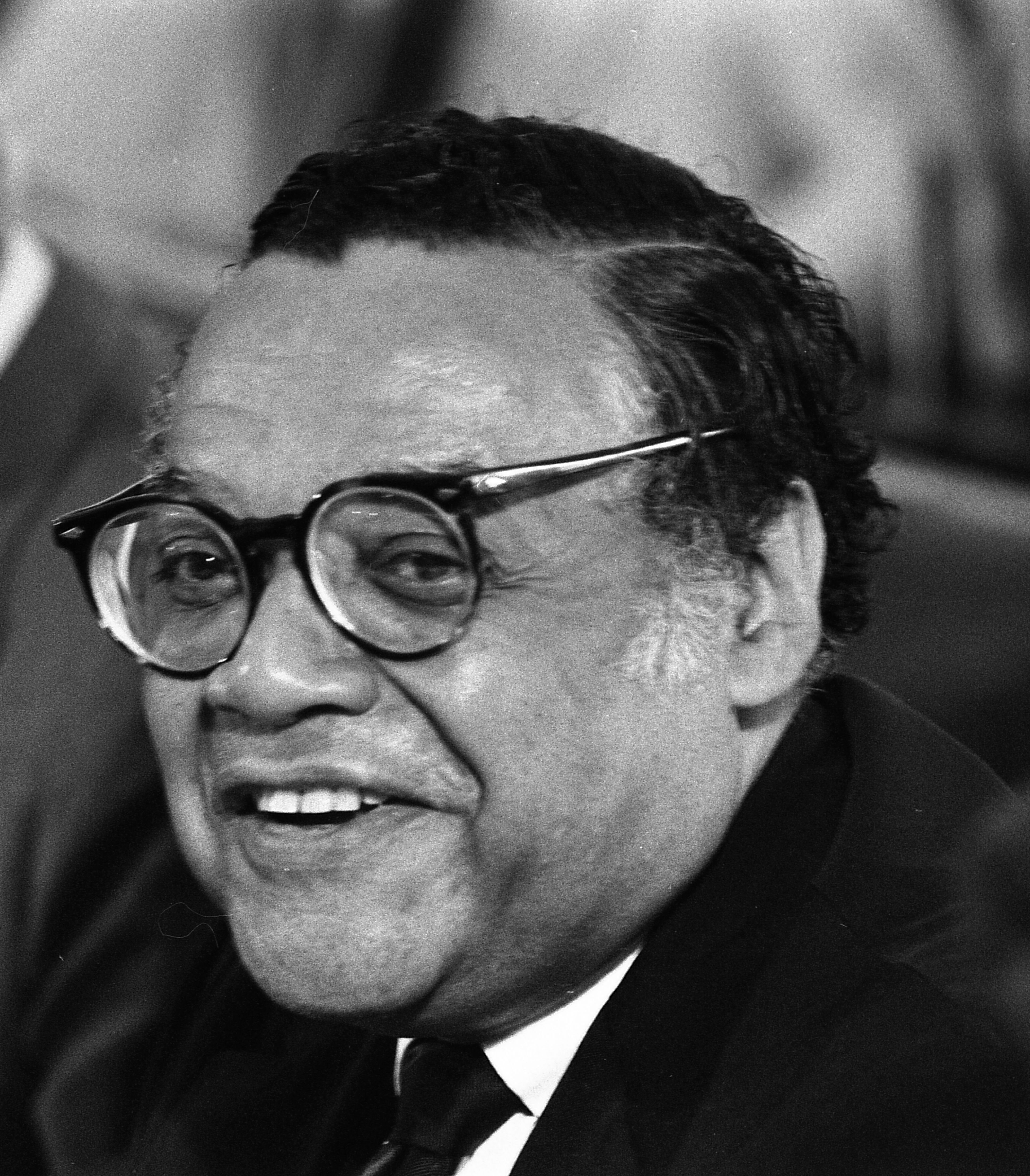
Ford is remembered for his strong cabinet to whom he delegated much and frequently sought advice. His secretary of transportation, William T. Coleman, Jr., the first African American in a Republican cabinet, was first in his class at the Harvard Law School and worked closely with Ford as a counsel to the Warren Commission (in 1963 and 1964) investigating the assassination of President Kennedy. Coleman is generally considered one of the best to ever hold the job. The department headquarters was named the William T. Coleman, Jr, Norman Y. Mineta Federal Building in 2023. Mineta, Transportation Secretary in the George W. Bush administration, was a friend, colleague and client of Bill Coleman’s.
1975, August 27 – The White House – Cabinet Room – William Coleman – head and shoulder portraits – Cabinet Meeting, Secretary of Transportation
Photo of William Coleman. Source: Gerald R. Ford Library & Museum
With the president’s full support, Coleman is remembered, among other achievements, for the department’s first ever national transportation plan; the conditional decision to allow the SST Concorde to fly to the U.S.; the introduction of airbags and other auto safety measures; the reorganization of the bankrupt northeast railroads; the creation of the Materials Transportation Bureau, known today as the Pipeline and Hazardous Materials Safety Administration; and, of course, the introduction of legislation deregulating the airlines, railroads and trucking.
President Ford was strongly committed to investment in transportation infrastructure, especially the preservation and completion of Eisenhower’s Interstate Highway System. He urged the cutting of red tape and bureaucratic hurdles that resulted in delays and cost overruns for projects like I-40 in Memphis. He fully supported measures to increase transportation safety, cost efficiency, and energy conservation.
In closing, I was witness to a meeting that illustrates how President Ford made transportation policy decisions. Secretary Coleman hired me as his special assistant in June 1975, and on my first day of work he told me we were going for a ride. We were driven to the White House and I was ushered into the Oval Office, sitting behind Secretary Coleman as he made the case for an additional $1.26 billion in federal funding to complete the planned 98-mile Washington Metropolitan Area Transit system. Also at the table was Office of Management and Budget Director James Lynn, who strongly opposed Coleman’s recommendation. Lynn proposed instead scaling back Metro to a truncated 41 or 68-mile system, arguing that the most expensive project since the Interstate Highway System for the District of Columbia was a white elephant that could not be justified to the American taxpayer.
Coleman argued that DC, Maryland and Virginia had come together with a plan that benefitted all three jurisdictions. Most importantly, at a time when our cities were in crisis, becoming isolated urban ghettos as the middle class fled to the suburbs, Metro’s hub and spoke rail system would bring people into the city center, knitting the region together and revitalizing the nation’s capital as a sports, entertainment and cultural center.
Ford was very concerned with government cost overruns and had directed Lynn to find ways to cut the federal budget, but he also was well aware of the deterioration of many parts of the District of Columbia, including the Pennsylvania Avenue dead zone between the Capitol and the White House. He listened intently to the arguments of both parties for about an hour, asking probing questions from each of them. He then turned to his OMB director and said something along the following lines: “Bill is correct. We have to build the 98-mile system, but I want some stringent cost controls on how the federal funds are spent.”
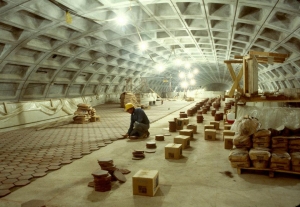 Installation of tiles at D.C.’s Ballston Station in 1978. Source: Washington Metropolitan Area Transportation Authority.
Today, Metro’s 118- mile system serves both Washington airports and has contributed greatly to the revitalization of the nation’s capital. The failure of the local jurisdictions to provide for sustained operational and maintenance costs continues to be a challenge.
Resources
Richard Norton Smith, An Ordinary Man, The Surprising Life and Historic Presidency of Gerald R. Ford, New York: Harper Collins, (2023).
William T. Coleman, Jr. and Donald T. Bliss, Counsel for the Situation, Shaping the Law to Realize America’s Promise, Washington D.C.: Brookings Institution Press (2010).
About the Author
Ambassador Donald T. Bliss (Ret.) was Acting General Counsel of the Transportation Department during the Ford Administration, Deputy General Counsel during the Carter Administration, and Ambassador to the International Civil Aviation Organization in Montreal, a Specialized Agency of the United Nations regulating international aviation, during President George W. Bush’s Administration.