Eno Center Hosts Rising Construction Costs: Implications for Reauthorization
On Thursday November 6th, the Eno Center hosted a webinar, “Rising Construction Costs: Implications for Reauthorization.” The webinar built upon Eno’s August 2025 whitepaper, “Rising Construction Costs: Analyzing the Contributors to Cost Escalations and the Impact on Federal Transportation Infrastructure Investments.” The webinar featured panelists Dr. Alison Premo Black, Senior Vice President and Chief Economist at the American Road & Transportation Builders Association (ARTBA), and Susan Howard, Director of Policy and Government Relations at the American Association of State Highway and Transportation Officials (AASHTO). The webinar participants discussed the impact of inflation in the construction industry during the implementation on the Investment Infrastructure and Jobs Act (IIJA) and how state transportation agencies and industry professionals are navigating a higher cost environment heading into surface transportation reauthorization.
In her introductory remarks, Dr. Black discussed how the National Highway Construction Cost Index, NHCCI, reflecting bid prices, traditionally ran parallel to the highway Producer Price Index (PPI), tracking a basket of construction goods. In 2021, both indices started to increase significantly as costs increased for contractors getting supplies but were not yet being translated into bid prices. However, during the implementation of the IIJA, these cost pressures for a confluence of reasons were not temporary, and the NHCCI began to outpace the PPI, reflecting both increased costs and increased project complexity. With the passage of the IIJA, states have been able to pursue more bridge restoration and repair projects, new construction, and capacity expansion in proportion to reconstruction and repair. According to Dr. Black, this more complex project profile has increased costs seen in the NHCCI.
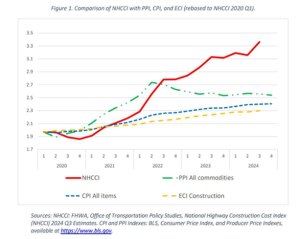
Federal Highway Administration. (2025, May 14). National Highway Construction Cost Index 2024 Q3. U.S. Department of Transportation. https://www.fhwa.dot.gov/policy/otps/nhcci/NHCCI_Narrative_Article_2024_Q3.pdf
To assess the real investment of IIJA, ARTBA looks at a variety of measures. Dr. Black highlighted that there has been a significant increase over the last few years in the number of state and local government contract awards as federal funding has increased. She also emphasized that compared to 2021, 35,600 new jobs for highway and bridge contractors have been added. Dr. Black concluded that while prices are increasing, progress is being made on major projects.
In her introductory remarks, Howard discussed how states are experiencing lower numbers of bidders, limiting pricing options for states in addition to the higher material costs seen across the country and labor market limitations. States are in an uncertain environment around federal funding with one year left of the IIJA, concerns about high costs due to Build America, Buy America requirements for manufactured products, and how tariffs will trickle down to construction costs. States typically forecast that the last year of the previous highway bill, without inflation adjustments, will be the baseline for the new funding bill to avoid overestimation in forecasting. However, Howard is not certain that the levels of the IIJA’s last year will be the new baseline, which will have an impact on states’ funding even if traditional apportionments continue. (The IIJA also provided advanced appropriations that will likely not be in the next reauthorization). IIJA dollars were essential for states to successfully navigate an inflationary environment and continue to deliver on large projects. Howard emphasized the importance of communicating with the public about states and local agencies’ ability to deliver on major projects despite cost challenges.
The panelists discussed how their organizations are communicating with members of the public and with those on the Hill about the impact of the IIJA and about remaining needs for reauthorization. Dr. Black emphasized the importance of discussing both the dollar amount of investments and the physical impact of both large and small projects. Howard agreed with the importance of focusing on localized community impacts of projects and showing both the public and legislators that states have been good stewards of IIJA funding. Both Howard and Dr. Black advocated for reauthorization to at least meet an inflation adjusted baseline from the final year of IIJA.
In terms of legislative changes to enhance project delivery and enhance capacity in reauthorization, Howard mentioned the need to make process improvements to Buy America to reduce project delays. Howard emphasized the importance of federal capacity in supporting states to navigate new program requirements. She also said there is room for the federal government to help states harness technological innovations such as digital construction to support capacity improvements. Dr. Black said the requirements attached to federal funding can add to costs and advocated for greater streamlining of regulatory requirements. Howard emphasized the need for flexibility within federal programs to enable states to best deliver projects. Dr. Black said that while the industry always delivers and cannot do more with less, there are opportunities for productivity enhancements in the future through technological innovation. This will be particularly important as it appears that while escalations have moderated, elevated costs are here to stay.
However, Dr. Black emphasized the continued importance of greater access to labor to deliver projects even as technology is increasing capacity. Dr. Black’s work has shown that while nationally wages are up five percent in the construction industry, in rural areas where large projects have created increased demand for labor than the area typically supports, wages have had double digit increases to attract workers. Increased demand for labor in manufacturing has also enhanced labor supply needs as the construction and manufacturing industries share a labor field. Howard raised concerns about trends in losses in labor capacity for state DOTs and contractors.
In terms of lessons learned in navigation of uncertainty, Howard highlighted the importance of states’ nimbleness in determinations about project scope, timing, and funding. Dr. Black emphasized states and contractors working together to adapt the flow of projects, and she emphasized that contractors are very strategic about risk and will not over-extend their capacity. Both panelists highlighted creativity and adaptability by Georgia and Utah. Dr. Howard also highlighted a trend of states continuing to raise their own transportation funds, negating concerns about a federal funding substitution effect. In addition to the high-cost environment experienced during the implementation of the IIJA thus far, states and contractors continue to experience an environment of unknowns. Howard said the biggest risk faced by states is uncertainty, and states will be very conservative as they move forward on projects when funding is uncertain. Dr. Black emphasized the added uncertainty of tariffs, with contractors needing more funds and time to acquire materials.
The panelists made clear throughout the webinar that while construction costs escalated during the implementation of the IIJA, reducing the initial purchasing power of IIJA dollars, the investments still created tangible impacts on the transportation landscape, including through increased employment in the construction sector and increased implementation of both major and smaller projects. States and contractors have remained adaptable in the face of uncertainties, and IIJA dollars helped weather the inflationary environment. However, heading into surface transportation reauthorization, states continue to face uncertainties, including tariff cost increases, regulatory changes, federal funding uncertainty, and the continued need for greater labor supply and capacity. Advocates are working to communicate with both those on the Hill and the public about how changes in the cost environment have affected the IIJA implementation, how states and contractors have continued to deliver on IIJA funding, and on the need for continued federal funding support to continue to connect the economy through effective road and infrastructure systems.