Donald Trump (2017-2021): Unlocking Innovation and Preserving Safety
This article is a part of our series From Lighthouses to Electric Chargers: A Presidential Series on Transportation Innovations.
Donald J. Trump, a New York real estate developer and TV celebrity, announced his candidacy for president in June 2015. Although he had never run for office, he defeated senators, governors, and other seasoned politicians in one Republican primary after another. In the November 2016 general election, he defeated former First Lady and Secretary of State Hillary Clinton, running on a platform focused on immigration, trade, jobs, and national security. On November 29, 2016, the President-Elect announced his nominee for Transportation Secretary would be Elaine L. Chao who had served as the 24th U. S. Secretary of Labor. Below, Secretary Chao recounts her service in that role.
————-
When I was sworn in as the 18th U.S. Secretary of Transportation in January 2017, I returned to a department I had served twice before as Deputy Secretary and Deputy Maritime Administrator. The landscape had changed dramatically — autonomous vehicles were being tested, drones were delivering medical supplies, and 5G connectivity was reshaping ports to rural highways.
I positioned the Department as a steward of safety; stepped up infrastructure investments; prepared the foundation for the transportation system of the future, by engaging with emerging technologies to address legitimate public concerns of safety, security and privacy without hampering innovation. Against this backdrop, efforts were made to reform and decrease unnecessary regulations that do not promote safety, infrastructure growth, or discouraged innovation.
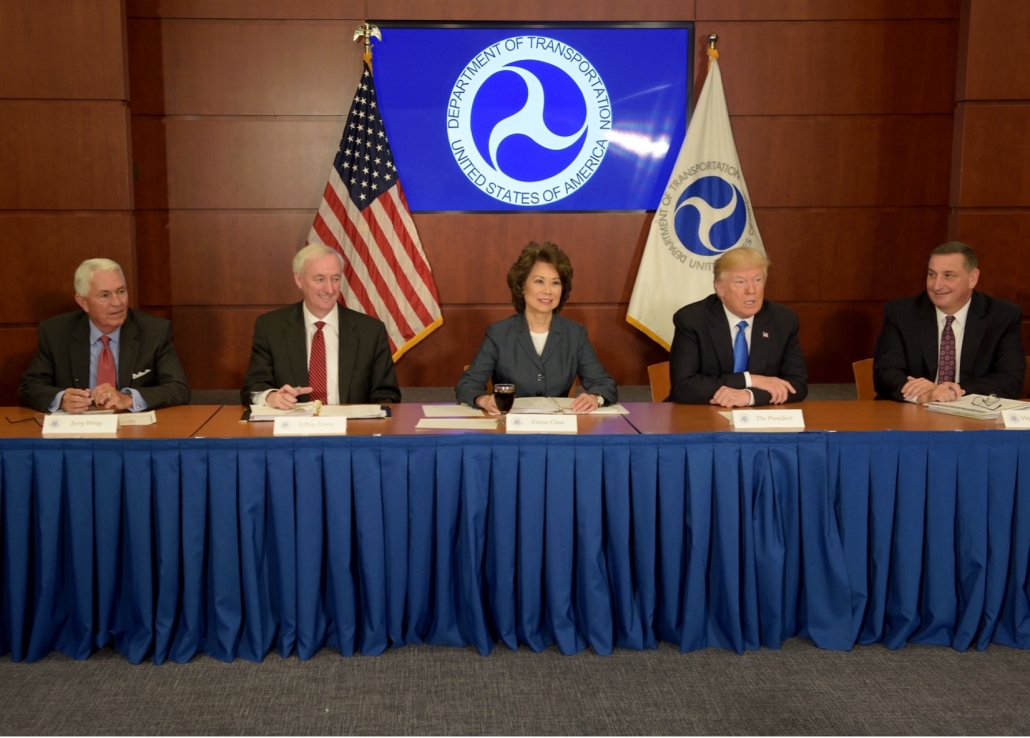
Photo: Discussing the Administration’s infrastructure initiative at the U.S. Department of Transportation on June 9, 2017. Source: McConnell/Chao Archives at University of Louisville.
But, soon after the start of our tenure, while in Canada leading a delegation of Congressional members to tour NAV Canada, the non-governmental, independent Air Traffic Control System, our new team faced our first public crisis. A massive fire resulted in the collapse of the Interstate 85 (I-85) bridge in Atlanta, Georgia, on the evening of March 30, 2017. Two miles of I-85 were closed to traffic, ensnarling a vital thoroughfare and inconveniencing an entire region. By the next morning, I had signed off on a $10 million emergency request for assistance. Three sections of northbound I-85 and three sections of southbound I-85 were replaced at a cost of $16.6 million; re-opening of the interstate occurred in only 43 days, on May 12, 2017 under budget and ahead of schedule. It was an indication of how we were going to do things.
Clearing Runways for Innovation
Overly burdensome rules and regulations do nothing to increase safety or promote productivity. A Regulatory Reform Task Force was established to identify obsolete, duplicative, or overly burdensome rules and regulations. We implemented permitting reforms that expedited National Environmental Policy Act (NEPA) reviews and coordinated infrastructure approvals between federal agencies, entitled: One Federal Decision which was later codified in the Bipartisan Infrastructure Law (BIL). Instead of taking years or sometimes decades, this initiative streamlined environmental reviews for major infrastructure projects by setting deadlines (average of 2 years for review; 90 days for final permits) and requiring a single lead agency to coordinate decisions, for faster and more efficient project delivery, without sacrificing environmental or safety standards.
Under my tenure, the Department delivered over 80 regulatory reforms, generating more than $98 billion in savings to the economy while raising safety standards and making better use of taxpayer funds, including:
- The Safer Affordable Fuel-Efficient (SAFE) Vehicles Rule, which set fuel standards for vehicles for model years 2021 to 2026, and was expected to boost new vehicle sales by 2.7 million by 2029 before its modification in 2024.
- The 2018 repeal of a January 18, 2017 Greenhouse Gas (GHG) measureby the Federal Highway Administration (FHWA) which would have burdened state departments of transportation with costly and statutorily-unauthorized GHG reporting requirements with no real results.
- The 2019 repeal of the century-old Proprietary Products Rule by the Federal Highway Administration, which now allows states to use patented or proprietary materials in highway projects when advantageous to do so.
- The 2017 repeal of the ineffective 2015 electronically controlled pneumatic brake rule, which saves rail users hundreds of millions of dollars.
- The full implementation of Positive Train Control (PTC) on all of 41 railroads required to be adopted by statute by 2015. When I was sworn in, only one railroad had implemented PTC and many industry observers were skeptical any progress would be made. Oddsmakers believed Congress would have to grant another extension. Instead, I made it a priority and presided over a fully compliant implementation nationwide, bringing technology and greater safety to America’s railroads.
- The full funding of the Portal North Bridge Project (New Jersey) was a twofold milestone. First, it marked a major investment in Amtrak’s Northeast Corridor, funding the replacement of an infamous 110-year-old swing bridge prone to chronic malfunction. Second, Portal North marked the first time that the Federal Railroad Administration and the Federal Transit Administration coordinated grantmaking on a large scale, a key precedent that is now being replicated on many projects.
Preparing for the Transportation System of the Future
The Department of Transportation, under my tenure, prepared for a future that included automated vehicles, drones, and commercial space. The mantra was that the Department needed to engage with emerging technologies to address legitimate public concerns about safety, security, and privacy without hampering innovation.
With input from the public, we granted temporary authorization for 87 automated driving system-equipped vehicles across 89 projects in 20 states, issued the first-ever exemption for an automated vehicle, and published a series of key policy frameworks that outline roles, responsibilities, and voluntary best practices for companies developing vehicular transformative technology. We extended this guidance beyond passenger cars to include automation in trucking, transit, and maritime shipping, clarifying my safety-first approach. The AV TEST Initiative, a voluntary platform for sharing testing data, added new public transparency and engagement.
The Department’s engineers and research specialists also focused on internal safety testing and development of cooperative driving automation through the Federal Highway Administration’s Cooperative Automation Research Mobility Application (CARMA) Platform. This work focused on integrating vehicle automation with highway infrastructure to improve future vehicle automated system efficiency and safety in real-world scenarios.
Rather than innovation-stifling regulations, we focused on a sensible policy environment to encourage progress. Since new technologies require updated regulatory approval models, I established the Non-Traditional and Emerging Transportation Technology Council to help entrepreneurs navigate the confusing and sometimes conflicting federal government approval processes. The Council’s guidance unlocked hundreds of millions of dollars in private investment for advanced transportation systems to ensure America’s leadership in transportation. The Bipartisan Infrastructure Law in 2021 later codified this Council into permanent law so that it continues to this day.
Reclaiming the Skies—and Beyond
We overhauled the Federal Aviation Administration’s launch and reentry regulations, reasserting American leadership in commercial spaceflight. After the U.S. had lost the lead in orbital launches to China and Russia beginning in 2012, we reclaimed the lead during my term. The FAA licensed 354 launches, permitted 46 experimental launches, and granted 12 spaceport operator licenses. We created a dedicated Office for Spaceport Policy and a Center of Excellence for Commercial Space Transportation, laying the groundwork for a new era of American space innovation.

Photo: Announcement of initiatives for a major FAA reform bill, focusing on modernizing air traffic control, at the White House East Room on June 5, 2017. Source: McConnell/Chao Archives at University of Louisville.
Closer to Earth, we established the DOT’s Unmanned Aircraft Systems Integration Pilot Program and approved over 465,000 drone authorizations, exemptions, and waivers. These facilitated a wide range of uses, including, for example, remote safety inspections of rail and pipelines, or delivery of medical supplies to remote locations. Under my leadership, the Department proposed final rules on Remote ID and Operations Over People, which were finalized in 2022. These rules enabled safer, more widespread drone use, allowing drones to fly at night, over people and vehicles and placing America once again as a leader in advanced aviation. Subsequently, there were periodic news reports of mysterious drone sightings at night. These are likely sightings that are now allowed by our regulations and tracked by Remote ID registration of drones.
When I was Deputy Secretary of Transportation, I was concerned with upgrading and modernizing the Air Traffic Control (ATC) system. When I was Secretary, the ATC system was still struggling to modernize. Equipment upgrades and purchases were stalled in lengthy procurement processes, making state-of-the-art equipment nearly obsolete when delivered. The budgetary process was still mired in politics making long term planning so essential in a major capital expenditures exercise like this so challenging.
In 2017, we proposed legislation that would have liberated the ATC from the federal bureaucracy, allowing it to operate with greater independence and to expand technology and performance. Unfortunately, certain private aviation groups stymied the bill. Today, as America faces worse delays, system outages, and modernization backlogs in air traffic management, I wish our proposal had succeeded in order to benefit the traveling public and the aviation sector.
Rural America and Freight Mobility
For too long, the importance of freight travel to our economy has been overlooked and underappreciated. And much of that travel is through rural areas. Although rural areas are home to 20% of Americans, they contain 70% of America’s road miles and carry almost half the nation’s truck traffic. Plus, 44% of rural car travel is by urban drivers, and rural traffic fatalities are twice those of urban areas. Further, 90% of the nation’s bridges with weight limits are in rural areas. Anyone attuned to the cost of living, especially as to goods, has to pay heed to this. Fairness to rural Americans who have to travel to work, school, health care, and elsewhere requires that as well.
Nonetheless, under the previous Administration, approximately 80% of discretionary transportation grants went to urban areas, while roughly 20% was awarded to rural areas. We rebalanced the distribution of discretionary grants to give rural America its fair share (50%). As Rural America did not have the monies or armies of lobbyists and consultants to identify project funding opportunities, we also launched the ROUTES Initiative—Rural Opportunities to Use Transportation for Economic Success to provide a roadmap on federal funding. The Department also released the National Freight Strategic Plan—a first-of-its-kind blueprint to ensure America’s freight networks remained globally competitive and resilient.
Strengthening Maritime Readiness: National Security Multi-Mission Vessels
When I was Deputy Maritime Administrator many years ago, the state maritime academies were already requesting new training vessels because their old ones were ill-suited for modern maritime education. As Secretary, I prioritized allocating $330 million for the first National Security Multi-Mission Vessel (NSMV) program—the first of five special purpose-built training ships for America’s six state maritime academies in over 50 years. These modern training ships also serve national emergency response missions.
These new ships are a strategic investment in the U.S. maritime workforce, shipbuilding industrial base, and national and global emergency readiness. They have inspired a new generation to pursue maritime careers, expanding the ranks of our vital maritime workforce, and augmenting our national security.
I also safeguarded the Maritime Administration (MARAD) when OMB sought to dismantle it by shifting MSP program authority to Military Sealift Command—a move that would have ironically increased shipping costs. (The MSP is a government program that maintains a fleet of privately-owned, U.S.-flagged commercial ships. In exchange for receiving an annual stipend, the ship operators agree to make their vessels, crews, and intermodal transportation networks available to the Department of Defense during a time of war or national emergency.)
A Lifeline During the COVID-19 Pandemic
I am a veteran of Hurricane Katrina which occurred while I was Secretary of Labor, the only cabinet secretary who was praised for her fast and effective response. Prior to COVID, our team at Transportation already had experience managing emergencies in 2017 and 2018 when hurricanes Harvey, Irma, and Maria hit Texas, Florida, and Puerto Rico. These experiences enabled me to lead the response to the even-bigger emergency presented by the pandemic in 2020.
When a nationwide emergency lockdown was declared on March 13, 2020, and public health measures locked down cities and upended global supply chains, the Department immediately mobilized to keep critical infrastructure operating across all modes of transportation, from distributing millions of masks to billions of dollars and issuing numerous declarations.
- The Federal Motor Carrier Safety Administration issued the first of many emergency declarations allowing truckers to extend hours of service, ensuring the delivery of critical supplies.
- The Federal Highway Administration worked with State departments of transportation to keep rest areas open and permitted the operation of food trucks at rest areas during the emergency declaration to provide truckers a safe place to rest and eat while keeping goods moving.
- The Federal Highway Administration, in coordination with Congress, provided clarification regarding States’ authority to issue special permits for overweight vehicles during a Presidential declared emergency, which ensured continued flow of critical relief supplies and other essential goods.
- The Federal Transit Administration distributed more than $25 billion in emergency relief funding to public transit agencies nationwide.
- The Department distributed $10 billion to airports and $1 billion to Amtrak within a few weeks after signing of the CARES Act on March 27, 2020.
- The Department issued more than 200 emergency regulatory relief actions and trained technicians to safely transport COVID-19 test samples. COVID-19 guidance was issued for all transportation modes to help operators minimize health risks while maintaining service.
- Drone testing for contactless deliveries of medical supplies, COVID tests, and PPE was fast-tracked—especially in rural and tribal areas where traditional logistics were strained.
Throughout the crisis, the Department of Transportation ensured that essential travel continued, stores were stocked and people could access the essentials they needed to survive.
Also, during the COVID crisis, the Department and its nine modal agencies engaged in combatting human trafficking. We obtained over 450 pledges from transportation, labor, and non-governmental organizations across the country to commit to raising public awareness regarding human trafficking and to training more than one million employees to help fight the crime.
Human Factors and Safety
Despite advances in automation, transportation still depends heavily on human behavior. That’s why we launched initiatives to combat distracted and drunk driving, and to protect pedestrians and cyclists. We also released the first ever comprehensive Pedestrian Safety Action Plan, a multi-modal effort between the Federal Highway Administration and National Highway Traffic Safety Administration, to promote expanded use of countermeasures, technology and data-driven practices to address pedestrian safety.
During my tenure, we also confronted Boeing’s 737 MAX 8 crisis. Following two tragic fatal crashes overseas involving a Lion Air flight in Indonesia and an Ethiopian Air flight near Bishoftu, I met with the families and an independent comprehensive panel, Joint Authorities Technical Review (JATR), conducted a comprehensive safety review of FAA’s certification processes, the legacy of which continues. The FAA grounded the Boeing 737 MAX 8 on March 13, 2019 and took full control of approvals, ending Boeing’s ability to self-certify the aircraft. The plane was cleared for take off 20 months later on November 17, 2020.
Looking Ahead
As America turns to a new era of autonomous vehicles, smart infrastructure, and artificial intelligence in transportation, the framework we built—grounded in safety, flexibility, and innovation—remains a foundation for future transportation systems. The story of innovation in American transportation is ultimately about how best to provide transportation options that contributes to the vitality of our economy and enhances how we live, work and connect to one another.
The Honorable Elaine Chao has had a distinguished career in the public, private and nonprofit sector, including chair of the Federal Maritime Commission, Deputy Secretary of Transportation, director of the Peace Corps, president of the United Way, banker at Citicorp and Bank of America, 24th U.S. Secretary of Labor, 18th U.S. Secretary of Transportation, and the first Asian American woman ever appointed to a President’s cabinet.