Credit and Debit Card Integration in Transit Fares
Many transit riders know the feeling: walking to the local bus stop or rail station and trying to remember how much money is left on your transit card. You tap your card to see how much is left, and realize it’s not enough for your ride, so now you have to wait in line at the fare machine to add more money. By that time, perhaps your train or bus has passed, leaving you waiting for the next one. Most of the time, it’s a small inconvenience, but frustrating nonetheless. Visitors to the system have it worse: before riding at all, they have to work out how to pay the fare, buy another card, or download a separate app.
Some transit agencies have begun to embrace a solution: letting riders pay with contactless credit/debit cards, or using phones with Google or Apple pay—payment methods they already have in their pocket. This piece looks at what the change toward credit/debit card integration for transit fare payment does for agencies and riders, its costs, and how it has played out across the transit space.
Tap and go systems
Many transit agencies use a closed-loop system of payment, with a fare payment system that only the agency issues and accepts, such as DC metro’s SmarTrip, London’s Oyster card, or New York’s old MetroCard and newer OMNY card (these cards are examples of closed-loop systems, but the agencies do now accept credit/debit cards). Riders load money onto these cards, and that money can only be used for that system. Conversely, an open-loop system accepts the same contactless credit/debit cards that work at grocery stores and coffee shops.
Contactless payments, whether they are with a transit agency-specific card or credit card, are faster than using cash or feeding a paper ticket into a slot. In Massachusetts, cashless boardings are predicted to cut dwell times at bus stops by about 25 percent, compared to cash payments. Operators spend less time handling cash and settling fare disputes, which can add time to a bus waiting at a stop. Tap data from credit/debit cards or transit cards can also give agencies information about when and where people ride, helping to determine peak/off-peak hours or frequently used stops.
Agency cards deliver those benefits, but they come with their own overhead costs. Riders have to buy the card (or download an app for it), keep track of its balance, and carry one more card. A lost card can mean a lost balance. For some riders, unused money on a transit card is money that could have been used for something else but is now locked onto that card.
Agencies also bear costs for closed-loop systems. The agency has to produce cards, run vending machines, and maintain the software and back-end systems to collect payments—another system for the agency to manage, alongside its transit operations. For smaller agencies, that can be a difficult or even impossible system to manage, with limited staff or resources. Credit/debit cards keep what works about contactless payments and remove some of the overhead. The rider gets the same tap without a separate card or account. The agency gets the same tap without issuing or handling an entire system.
Lower Costs
London’s transit operator, Transport for London (TfL), was the first major agency to integrate credit card payment for transit, beginning in 2012. Moving to contactless payment cut the share of TfL revenue spent on fare collection from 15 percent to 8 percent. Visa estimated that agencies spend 14.5 cents for collecting one physical dollar and 4.2 cents for collecting a digital dollar. That figure comes from a major company with an interest in agencies adopting credit card payments, but it reflects the TfL experience. In New York, the MTA expects to save at least $20 million annually by retiring the MetroCard. The agency is still keeping its own system with the new OMNY card, but riders can also tap using credit/debit cards.
Beyond large transit operators, smaller agencies can gain the most from credit card integration. Studies compiled by the Massachusetts Budget and Policy Center found that fare collection costs for the Worcester Regional Transit Authority made up about 28 percent of its fixed-route fare revenue and Cape Cod’s transit operator about 77 percent. For agencies that size, which only collect a few million dollars a year in fares, a simple cash farebox and contactless reader can replace an entire agency-specific card program.
Important Considerations
Open-loop payments can be cheaper to run but are not free. One of the most important costs is card processing fees. Every time a rider pays by card, the agency pays an interchange fee to the bank that issued that card. These fees were designed around larger purchases, not a $2.25 bus fare. Most include a flat charger per transaction, which means little on a $60 grocery bill but is a large share of single bus fare. Under the Durbin Amendment, a 2010 federal law that caps debit card fees, banks with $10 billion or more in assets can charge up to 21 cents plus 0.05 percent of the purchase, plus 1 cent for fraud prevention on a debit card transaction. That comes to about 22 cents on a $2.25 bus fare, or around 10 percent. For transit agencies, this means card fees can take a noticeable share of each fare unless the agency combines a rider’s taps into a single daily charge or secures lower transit rates from credit and debit card companies. California addressed this issue through a transit program discount on interchange fees, offered through Visa and Mastercard. Even so, Cal-ITP tells agencies to expect merchant service charges of 4 to 5 percent of tap-to-pay revenue.
Agencies also face upfront hardware and software costs, because older readers cannot accept credit/debit cards. Discounts and transfers are also difficult. During a fare transaction, the credit/debit card does not recognize whether its owner is a senior, a student, a low-income rider, or whether they just stepped off another agency’s bus. Attaching a discount requires an enrollment process, and cross-agency transfers require agreements between agencies. Finally, not every rider has a card to tap. In 2025, about 18 percent of U.S. adults did not have a credit card, and 6 percent had no bank account (so no debit card either). Among adults earning less than $25,000, more than half did not have a credit card and 21 percent had no bank account. Agencies still need a way to serve those riders, by accepting cash or offering reloadable cards.
Tap and Go in Washington DC
Washington DC was an early leader in contactless payment. SmarTrip launched in 1999 as the first contactless transit smart card in the U.S. and became the common card for Metrorail, Metrobus, and several local bus systems in neighboring Virginia and Maryland.
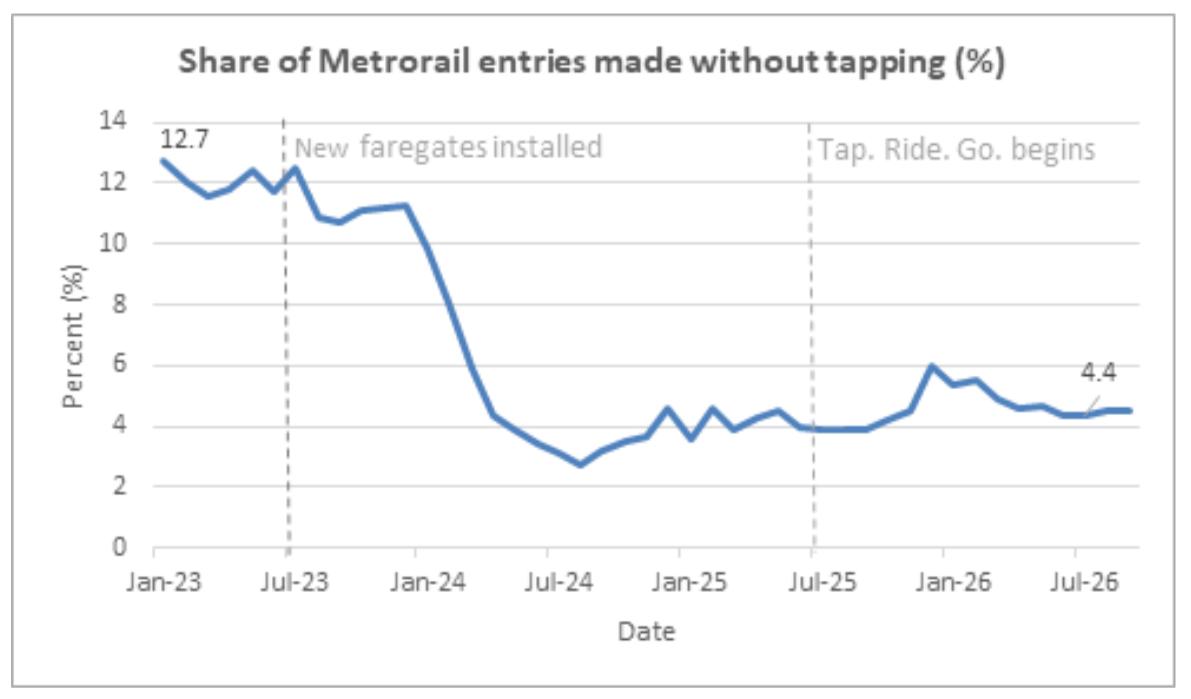
WMATA, the region’s largest transit provider, added open payments via credit/debit cards for Metrorail in May 2025 and for Metrobus in November 2025, branded as “Tap. Ride. Go.” Riders who tap the same credit/debit card on rail and bus get a $2.25 transfer discount within two hours of tapping. WMATA’s public ridership data does not show how many riders use SmarTrip versus a credit/debit card, but it does break down tapped and non-tapped entries (it has provided this breakdown since 2023). Figure 1 shows that in 2023, about 12 percent of daily Metrorail entries were untapped. That share fell below 3 percent in 2024 and is around 4.4 percent in mid-2026.
The share of untapped entries dropped after WMATA began installing new and taller faregate barriers. Most of the decline occurred between January and August 2024, well before the “Tap. Ride. Go” program launched in May 2025. Riders paying by credit/debit card are likely people who would otherwise have tapped a SmarTrip card, rather than new riders. Data that separates SmarTrip taps from credit/debit card taps would better highlight the impact of WMATA’s transition, but the agency does not publish that breakdown.
Figure 1. Share of non-tapped entries on DC Metrorail services
Source: Metrorail Ridership Summary
Credit/debit card tapping stops at WMATA and does not exist in the surrounding local transit systems. Fairfax Connector, Arlington Transit, and Loudoun County’s commuter buses take SmarTrip but not credit/debit cards. Riders with reduced fares or employer-paid SmartBenefits must stay on SmarTrip.
Other operators took a different path. Montgomery County in Maryland estimated that replacing its Ride On fareboxes would cost about $22 million, against $1.6 million a year in fares. It made Ride On fare-free in June 2025. Similarly, DASH (Alexandria, VA), CUE (Fairfax, VA), and TheBus (Prince George’s County, MD) are fare-free. That removes the payment problem entirely, but also takes those agencies out of any shared fare system. The link to Baltimore, MD is gone as well. Maryland’s MTA retired the SmarTrip-compatible CharmCard, which no MTA service has accepted since March 2026, in favor of its CharmPass mobile app.
How other regions compare
The Bay Area
In December 2025, the Bay Area’s Metropolitan Transportation Commission (MTC) launched Clipper 2.0 across two dozen agencies. Under the system, any transfer to a different agency within two hours earns up to $2.85 off, and riders can use a Clipper card or their own credit/debit card. Credit/debit card payment arrived in two steps. BART began accepting contactless cards and mobile wallets in August 2025. The region’s other agencies followed when Clipper 2.0 launched in December 2025. The impact of the Clipper 2.0 program was that certain trips became much cheaper—one AC Transit-BART-Golden Gate-Marin transit trip fell from $13.75 to $8.40. That works because one regional body settles payments and splits revenue for every operator. But discounts, passes, and employer benefits still require a Clipper card.
Other agencies’ experience in California shows how the state can lower the barrier to integrating credit cards. Caltrans and Cal-ITP set up state purchasing contracts with pre-approved hardware vendors and payment processors that must work with one another, and Cal-ITP’s Benefits tool lets riders verify eligibility through Login.gov and attach a senior or low-income discount to their own bank card. On top of the state negotiating lower transit interchange fees, California is a leader in credit-card integration for transit agencies.
New York
New York provides an example of how fast riders switch once an old card is phased out. OMNY, the MTA’s tap-to-pay system launched in 2019, lets riders pay by tapping a contactless credit or debit card, a phone or watch, or a reloadable OMNY card, which rider can buy and refill with cash. The MTA ended sales of the old MetroCard in December 2025. Of all MetroCard and OMNY entries, OMNY’s share of subway entries rose from about 24 percent in January 2022 to 50 percent in April 2024 and about 99 percent in July 2026. The OMNY share counts taps from the OMNY card, credit/debit cards, phones, and watches. Unlike WMATA, the MTA has let riders register a bank card for reduced fares since 2022.
But integration across agencies remains incomplete. PATH, which operates transit between New York and New Jersey, does not accept the OMNY card, so riders who use the OMNY card still need a separate way to pay on PATH. In contrast to DC’s situation, where some of the agencies around WMATA do not accept credit/debit cards, MTA and PATH both allow credit/debit card payments (the MTA since 2019 and PATH since 2023), so even though the MTA has a new card, it still only works within the MTA—highlighting one of the main drawbacks to contactless payments with an agency card as opposed to just using credit/debit cards.
London
London’s TfL began accepting credit/debit cards on buses in 2012 and on rail services in 2014, with automatic daily and weekly caps. A cap is a ceiling on what a rider pays. Once the fares charged in a day or in a week reach a set amount, any further trips in that period are free. Riders get the price of a daily or weekly pass without having to buy one in advance. In 2015, over 90 percent of revenue coming from Oyster and contactless payment came from Oyster card payments. By 2024, only 20 percent came from Oyster cards and almost 80 percent came from contactless payments.
Credit card integration: Valuable but not perfect
Paying for transit with a credit/debit card fixes a key problem for transit riders. No balance to remember, no extra card to buy, and no machine to find. For agencies, it frees up money on running a payment system, which can go toward running transit service instead.
But credit/debit card integration alone does not mean a completely seamless transit experience for all riders, or for riders traveling across a region with multiple systems. Riders get a seamless trip across a region only when agencies agree on fares and transfers, where discounts can attach to the cards people already carry, and when cash and prepaid options remain for riders without credit/debit cards.