Checking In on USDOT Advisory Committees
This month, USDOT has released two requests for nominations to Federal Advisory Committees. On February 13, the solicitation for the Intelligent Transportation Systems Program Advisory Committee (ITSPAC) was released. Then this week, the Department requested nominees for the Railroad Safety Advisory Committee, an advisory committee that was created in the Clinton Administration, which is not required by statute.
Federal Advisory Committees (FACs) are designed to provide advice and recommendations to the federal executive branch and have various missions. Advisory committees may be formed to expand public participation and enhance public trust in federal agency processes. They are also often used to give agencies access to expertise on complex topics to improve federal decision-making. FACs may be established by the President through an Executive Order, or by a federal agency; they can also be the result of Congressional direction to an agency and thereby required by statute.
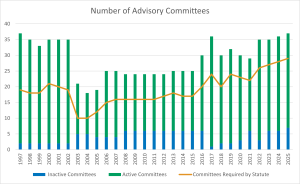
During President Trump’s first term, the U.S. Department of Transportation expanded the number of active FACs in his first year in office and in 2018 the Department more than tripled the average amount of annual spending on committee meetings for federal advisory committees, spending more than $16 million on FAC meetings that year. However in 2019 President Trump signaled an interest in pulling back on advisory committee work, issuing Executive Order 13875 on Evaluating and Improving the Utility of Federal Advisory Committees, which direct agencies to review their needs for advisory committees and terminate at least one-third of the current committees not mandated by statute. According to data on GSA’s FACA database, the number of active FACs declined following that EO, from 30 active FACs at USDOT to 27 in 2020. The number of FACs required by statute has also grown steadily at USDOT, rising from 10 in 2003 to 29 in 2025.
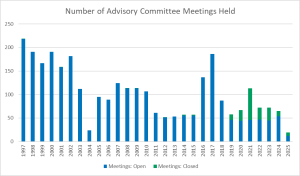
Another recent trend that began in the Trump Administration and was embraced in the Biden Administration is toward closed meetings. Prior to 2019, the number of closed meetings had never exceeded 2 in a single year; starting that year 21 percent of the FAC meetings held were closed to the public and in 2021 the majority—59 percent—of FAC meetings were closed door.
FACA Activity in the Past Year
In his second term, the Trump Administration officials at USDOT have been slower to create new FACAs and hold meetings than they were in the first year of his first term, when six new FACs were created and 186 meetings were held. In contrast in 2025 only 3 FACs were newly established and a total of 19 meetings held across all 30 “active” committees. Although the number of FACs that are still considered active at USDOT has not declined, the Department has been slow to solicit members and announce members and to host meetings. The Department also terminated seven FACs, including the Advisory Committee on Transportation Equity and the Women of Trucking Advisory Board, and allowed seven advisory board created by statute to become administratively inactive, including the Minority Business Resource Center Advisory Committee and the Women in Aviation Advisory Board.
(Ed. Note: In August 2025, the Department did not formally terminate the Federal System Funding AlternativesAdvisory Board that was supposed to be running the 50-state mileage-based user fee pilot program authorized by the IIJA, but they fired all 15 members of the Board just seven-and-a-half months into their two-year terms. No new members have been appointed, so this Advisory Board is considered “administratively inactive.” We kind of predicted this when the Board was appointed.)
One of the most publicized new FACs created last year is the United States Department of Transportation Advisory Board, which was established in May and members announced in July. The members of the advisory board are all representatives of the private sector and as BikePortland noted at the time, “US DOT Sec. Sean Duffy appointed 12 new members of the US DOT Advisory Board and every one of them is a white man.” (The Committee Chair is Gregg Reuben, who in addition to being CEO of Centerpark is also the spouse of Alina Habba, who was President Trump’s Acting U.S. Attorney for New Jersey until an appeals court deemed her appointment to be unlawful in December.)
Sec. Duffy’s Transportation Advisory Board is meeting on a quarterly basis; recordings of two public meetings are available on the Department’s website, and other non-public meetings are alluded during the December meeting. The recording of that meeting includes Secretary Duffy being informed that “it’s a public stream, so we’re gonna keep everything very high level.”
The Transportation Advisory Board FAC was established to “provide Secretary Duffy with strategic recommendations and high-level guidance on how USDOT can further modernize America’s transportation systems.” In developing draft recommendations, the FAC—per their December meeting—is “placing a very heavy emphasis on recommending public-private partnerships as a default delivery model, certainly for federal projects, but also for state and municipal projects.” In that meeting, members of the advisory committee also touched on the potential for “asset recycling of the valuable state-owned assets… that they could concession to private operators” and the potential to use federal incentives to encourage states to undertake concessions.
The Advisory Board is also focused on identifying priority projects based on criteria they have developed. One project they described to Secretary Duffy at length is their idea for a new multimodal bridge across the Hudson River with a separate tunnel below the river dedicated to commercial trucks. The Advisory Board described this as a potentially transformative “once-in-a-generation opportunity” that could be “game changing for the Northeast Corridor,” could be set up “as a P3, without requiring the largess of the federal taxpayer” and could “transcend politics.”
Although that Advisory Board moved from nominee solicitation to selection and having their first meeting within just a two month period, others have been slower to move. The Department moved a bevy of solicitations for advisory committees last Fall, including the Transit Advisory Committee for Safety at FTA, the Research, Engineering, and Development Advisory Committee, Unmanned and Autonomous Flight Advisory Committee, and the Aviation Rulemaking Advisory Committee all at FAA, the Motorcyclist Advisory Council and the National Emergency Medical Services Advisory Council, both at NTHSA, the U.S. Maritime Transportation System National Advisory Committee at MARAD, the DOT Advisory Committee on Human Trafficking, and the Air Carrier Access Act Advisory Committee all released in the month of September. However, although nominations were due for all the solicitations at least four months ago, the Department has not announced new members for any of the advisory committees.