
AI is Transforming Transportation Agencies: Starting in Texas
At an Eno webinar this week, more than 300 participants learned how artificial intelligence (AI) is poised to transform the ways agencies make decisions, manage operations, and deliver services. In previous generations, computers revolutionized transportation agencies by automating routine tasks. AI takes those changes a giant leap forward, enabling systems to learn from data, predict outcomes, and adapt in real time.
The webinar focused on the Texas Department of Transportation (TxDOT) because it is at the forefront of planning and incorporating AI into every facet of its organization. The agency’s recently completed AI Strategic Plan is helping guide the deployment of AI over the next three years. Darran Anderson, TxDOT’s Director of Strategy and Innovation, said the plan “provides direction but recognizes the pace of technological change in this area requires flexibility.”
Anh Selissen, Texas DOT’s chief information officer, said, “It’s an exciting time right now at TxDOT because the things that we’re doing are transformative.” She explained how the agency introduced a new AI tool that reduced the process to review certain invoices from weeks down to hours, if not minutes. Selissen is excited about an application that takes information from different data sources and enables TxDOT to give drivers and third-party responders warnings about potential dangers, such as drivers whose cars are disabled. She explained how a faster response to incidents can reduce the number of secondary crashes as well as keep traffic moving.
TxDOT’s AI plan is intended to serve as a guide and a reference for TxDOT’s leadership, management, and staff. TxDOT leaders are hoping that its AI planning efforts can harness the technology’s potential. The plan does not prioritize specific projects or identify the resources required to design and implement them. Rather, it sets out a vision for taking advantage of AI, and in that regard the document is a valuable resource for other transportation agencies in the early stages of exploring AI’s potential.
Challenges Facing TxDOT
Every district and division within TxDOT contributed to the development of the AI Strategic Plan. The planning process began by began with identifying the agency’s challenges, many of which are shared by other transportation agencies. These include managing diverse roadway data, responding to traffic incidents, identifying high-risk crash locations, and adapting to real-time traffic conditions.
Five of 230 Potential Uses
After canvassing the entire agency, TxDOT identified 230 potential uses for AI that are aligned with the agency’s goals and objectives. About half the ideas would improve the agency’s internal administration such as managing contracts, onboarding staff, and streamlining the review of expense reports. The other half, including the following five, are more operationally-oriented.
- Integrate utility mapping data from various sources to create a comprehensive, project-specific utility map so that TxDOT can identify potential conflicts and reduce the risk of delays and hazards.
- Leverage drones, computer vision, and machine learning to automate bridge inspections; identify structural issues, corrosion, and deterioration patterns; and predict future bridge conditions.
- Use computer vision and machine learning to automatically inventory signs and assess their condition, so that TxDOT prioritizes maintenance activities, and ensures that all signs meet safety and visibility requirements.
- Analyze data from satellite imagery, drones, and field sensors to assess the environmental impact on wildlife habitats and sensitive areas.
- Automatically track and manage inventory levels for equipment, materials, and spare parts to help predict demand and optimize stock levels.
Risks and Concerns
The strategic plan identifies steps that TxDOT needs to take to create an AI ecosystem, such as identifying data sources, expanding the agency’s data hub, and digitizing historical data. The agency will also need to improve the quality, consistency, and reliability of its data. Fully taking advantage of AI requires changes throughout the organization, including those relating to the development of new tools, processes, and training programs.
Anderson said, “We may sound all giddy and wow look at all the cool things we’re doing, but it’s not without a lot of reservation, planning, and governance put in place.”
Selissen said the agency is better prepared to implement AI tools now than it was three years ago because “we have a very strong technology governance process where no matter what technology that you bring to the table — in this instance, AI — it is layered with overall organizational safeguards that make sure that you’re not exposing the organization, needlessly.” She explained why she takes cybersecurity so seriously: “We get millions of attacks every day, not every month, but every day, into our systems…You need to safeguard the organization as a whole because if a hacker gets into the system and then basically permeates your network, it’s going to be a world of hurt for your organization.”
“AI doesn’t scare me,” Selissen said, “because we have spent so many years creating security and privacy governance around technology.” However, she said, “the privacy issue is a critical concern.” Before any new tool can access TxDOT data, she asks: “Is the data encrypted in any way, shape, or form? And is the data being exposed to people that could put our organization at risk?” She warned that everyone should understand that some chatbots like ChatGPT can take proprietary data and make them available to the public. She said, “It doesn’t matter if you purposely intended to put in sensitive information or not.”
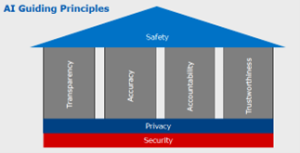
Selissen stressed the importance of conforming to industry principles and standards including those related to risk management, cybersecurity, and privacy. Given the well-known instances of AI hallucination, system designers need to consider trustworthiness, an issue which is addressed through transparency, verification, validation, and monitoring. She emphasized the importance of providing accurate data for AI tools, “Otherwise, if you put garbage in, you get garbage out.”
Anderson said transportation agencies should move slowly and deliberately with AI. He suggested starting with projects that have the fewest risks from a security and privacy perspective. Selissen added, “I’m a big believer in starting pilots and developing prototypes because you learn about a tool, its benefits, and its risks. And, you don’t overexpose your organization needlessly. As you learn more, then you can start permeating the technology inside of your organization, but in a much more knowledgeable and safe manner.”
For those interested in developing their own AI plans, Anderson recommended reading, “A Guide to Practical Next Steps for AI Implementation” published by ITS America. This report addresses the interplay of processes, people, technology, and data. It emphasizes how different organizational functions must work in unison to develop and execute a cohesive AI strategy.
See Three Related Eno Publications
How Chief Technology Officers are Transforming Transportation Agencies (April 2025)
Transportation’s Chief Innovators (March 2024)
Understanding Al & Transportation (August 2023)