Higher Gas Prices May Affect CAFE and Vehicle Purchase Choices
The National Highway Traffic Safety Administration is currently working on the final rule for the corporate average fuel economy (CAFE) standards, having proposed a rule in December to reduce the stringency for model years 2022-2026 and continue that framework for model years through 2031. The comment period for that rule closed in early February after having been extended by two weeks in response to requests submitted by the Attorneys General of fourteen states and by the Zero Emission Transportation Association and others.
Since the release of the proposed rule and the closing of the comment period, oil prices have surged in response to the war in Iran, and the resulting instability of oil supply. There is some irony that NHTSA has inadvertently timed this weakening of CAFE standards to coincide with the most significant oil supply shock of recent decades, given that CAFE standard-setting authority was created in 1975 largely to protect consumers against oil supply shocks and the instability in fuel markets created by the oil embargo of 1973.
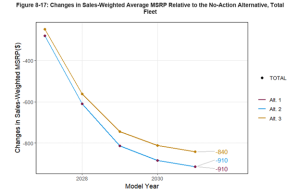
In setting the standards, NHTSA considers costs and benefits to consumers as well as net societal good, including any additional cost vehicle prices due to added technology to reduce energy demand, as well additional cost in fuel consumption. Relative to keeping the standards set by the Biden administration, the alternatives being considered in the new proposed rule would result in an average industry-wide decrease in per-vehicle technology and overall reduction in vehicle retail prices of $840 to $910 by MY 2031.
On the other hand, as the agency noted, “resetting previously established CAFE standards will permit lower fuel economy for some new cars and light trucks, thus increasing their fuel consumption and raising their owners’ fuel costs accordingly.” Specifically, the options proposed are estimated to increase average lifetime fuel costs for MY2031 vehicles by $1,256 to $1,431. For the total fleet, the weakened standards result in a net societal increase of $46.5 to $53.9 billion extra spending on fuel over the lifetime of the total fleet through MY 2031 according to NHTSA’s analysis.
However while the vehicle cost reductions represent immediate savings to consumers, fuel cost increases are paid over time and NHTSA assumes that consumers are only willing to pay for fuel economy improvements that repay the higher prices of models offering those improvements within 36 months. In their estimate, the in-vehicle technology costs do not result in sufficient cost savings to be repaid within 36 months.
The timeframe for repaying technology costs depends on fuel prices though. In estimating fuel cost savings, NHTSA relies on the Department of Energy’s Annual Energy Outlook (AEO), and the regulatory impact analysis acknowledges that the future cost of oil is “one of the most significant sources of uncertainty in this analysis.”
Oil prices in March of this year proved how very uncertain future projections could be. The 2025 AEO projected that motor gasoline costs would be $3.06 in 2026 and then decline staying below $3 per gallon (in 2021 dollars) into the 2030s.
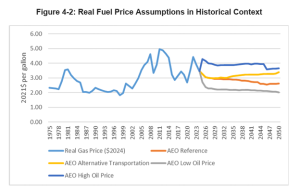
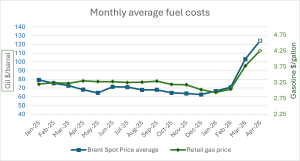
However as part of their proposed rule, NHTSA also conducted sensitivity analysis of costs and benefits if oil prices were higher than expected, using a high oil price scenario produced by in the AEO. In that high oil price scenario, the spot price for Brent oil rises to $124 in 2026 as opposed to the $81 reference case price for a barrel of oil. In fact, in March of this year the average spot price for Brent oil was $103 and in the first two weeks of April, the average price has been $124.
According to NHTSA, their proposal to reduce the stringency of the CAFE standards would result in $24 billion in net benefits to society assuming gasoline prices stay at or below $3 per gallon. But even under the high oil price scenario, while the net benefits of weakening fuel economy standards are lower, they still remain net positive, decreasing by just $4.4 billion. In other words, it is likely that NHTSA will be able to justify reducing the stringency of the CAFE standards even in the midst of high gas prices and global instability in the oil markets, although the politics of doing so may not be as positive as they were when the rule was proposed in December.
Regardless of the minimum standards for fleetwide fuel economy, higher oil prices do change consumer choices and also make some energy efficiency technologies more cost-effective. NHTSA’s analysis acknowledges this and assumes that the numbers of hybrid electric vehicles in the fleet increases under a high oil price scenario.
Historically, surges in oil price have impacted both consumer vehicle purchase choices as well as driving patterns. In earlier eras, consumers could choose smaller cars to improve fuel efficiency, but the range of propulsion options was much more limited. In recent years, consumers seeking more efficient vehicles have had a much wider range of options of hybrid vehicles and electric vehicles. In 2019, car buyers could choose from just twelve different EV models and fewer than 40 hybrid models. However, the number of vehicle options expanded significantly in response to tax incentives and increases in oil prices. Today, there are just under 90 vehicle models available with hybrid technology and over 70 different EV models available on the market.
The most recent surge in oil prices occurred in 2022 in response to supply chain constraints and demand spikes. The table below shows how purchases of hybrids electric vehicles (HEVs), battery electric vehicles (BEVs) and Plug-In Hybrid Electric Vehicles (PHEVs) also surged following the increase in gas prices, especially as consumers were able to choose from a much wider range of technologies and car models that could insulate them from gasoline prices.
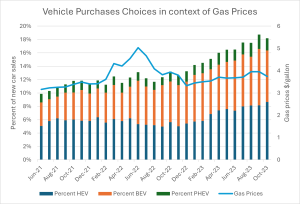
Despite gasoline prices stabilizing at lower prices following the surge in 2022, sales of EVs and hybrids continued to grow, bolstered by the growing range of car models available and by EV tax credits included in the Inflation Reduction Act, which have now been rescinded by the One Big Beautiful Act.
In recent months, sales of EVs and hybrids increased in the fourth quarter of 2025, with consumers taking advantage of tax credits before they were repealed, and then plummeted in the first quarter of 2026. Early data indicates that the high prices of oil in March may again drive renewed interest in the hybrid and EV market. In March, the volume of new EV sales increased by 18.5% month over month to 107,594 units, which was the highest monthly sales amount since the tax credits were repealed. However, this is still well below the 174,733 EVs sold in August of last year. Retail share for EVs in the used market also increased in March, hitting 2% for the first time ever. In contrast to EVs, hybrid vehicle sales stayed steady over 2025 and have grown in 2026. In March, hybrid electric vehicles surpassed a record 14 percent of new-vehicle retail sales.
EVs still face a significant price premium over conventional internal combustion engine vehicles, but that price premium fell in March to the smallest difference yet recorded according to data from Kelley Blue Books. The price gap between EVs and internal combustion engine vehicles has narrowed to about $5,800 in March, despite the federal tax incentive being repealed. The declining price is partially driven by incentives being offered by states as well as by dealers with unsold inventory, and also from the record low prices for EV batteries.
According to data from FHWA’s highway statistics, in 2024 the 240 million licensed drivers in the U.S. consumed 171.8 billion gallons of motor fuel, for an average of 716 gallons per driver per year. At $3 per gallon, a driver would pay $6,444 in 36 months for their fuel use, whereas if gasoline were to hold steady at $5 per gallon for 36 months, a driver would pay $10,740 for the same amount of motor fuel. Depending on the electricity prices paid to charge the vehicle, this could result in EVs becoming less expensive to purchase and operate relative to internal combustion engines even without federal incentives.